Jenora Therapist Connection
See what happened between sessions.Only what your client chooses to share.
A client-controlled, between-session therapy platform for reviewing shared progress, completed practices, emerging patterns, and relevant context before you meet.
Watch · 2½ minutes
Why we built Therapist Connection
Tony Lyda, Certified Addiction Psychotherapist, on what he kept seeing between sessions.
The context
The other 167 hours matter.
A week is difficult to reconstruct in the first few minutes of a session. Jenora gives clients a structured way to notice what happened in daily life, and Therapist Connection gives therapist and client something concrete to look at together.
During those hours, clients can practice skills, record experiences that matter, work with personal plans and warning signs, reflect on patterns, and continue work started in therapy. Much of change happens outside the appointment.
Why recommend Jenora?
Support for the work that happens between appointments.
Clients leave a session and return to everyday life, where cravings, difficult emotions, disrupted routines, relationships, avoidance, and decisions show up. Jenora gives them ways to notice, practice, reflect, and bring relevant context back to therapy.
Notice earlier
Help clients pay attention to personally identified changes, urges, warning signs, supportive routines, and patterns while they are happening.
Practice in real life
Make room for coping strategies, recovery planning, emotional regulation, reflection, and structured activities outside the therapy room.
Bring something useful back
Give client and therapist shared, client-authorized context to explore together at the next appointment.
Jenora supports therapy; it does not promise a particular clinical outcome or replace care.
The client experience
What does your client get from Jenora?
Life in Sync is the overarching day-to-day experience: a personal compass for what matters, what supports wellbeing, what changes to notice, and how the client wants to respond.
A personal Life in Sync plan
Clients identify routines, relationships, values, meaningful activities, coping strategies, recovery supports, and commitments that help them live well.
Personally defined signs and boundaries
Clients can identify changes they want to notice, such as disrupted routines, isolation, avoidance, sleep or mood changes, missed supports, and increased urges. These are the client's own signals, not labels Jenora assigns.
Activities and reflection
Today brings together check-ins and useful next steps. Clients can use self-discovery, values reflection, structured activities, psychoeducation, assessments, and practices assigned by their therapist.
Plans, supports, and pattern reflection
Clients can return to their plans and support resources, reflect on information they have entered, and explore possible patterns.
For a practical guide to making reflection useful, see how Jenora distinguishes reflection from rumination.
Jenora's Three Zones offer a personal planning framework: In Sync (supportive anchors), Drifting (changes the client wants to notice), and Off Course (personally identified serious risks or boundaries). The framework can support addiction recovery, behavior change, emotional regulation, and mental health needs, including co-occurring concerns. Learn about Jenora's Three-Zone framework.
A recovery example
What might this look like in practice?
A client in recovery has stopped using substances and is working with their therapist to maintain recovery and rebuild daily life. Their personal In Sync anchors include regular sleep, movement, supportive relationships, recovery meetings, meaningful activity, and avoiding environments they have identified as high risk.
They have also identified signs that they may be Drifting: isolating, missing meetings, sleeping later, feeling more irritable, romanticizing past use, and noticing increased urges. Over several weeks, sleep and exercise decline, isolation increases, and urges become more frequent. They have not returned to substance use.
Jenora does not tell the client that relapse is coming. The client can review what they entered, notice how these changes relate to their own plan, return to protective activities, use coping strategies, contact supports, or raise the changes with their therapist. If the client has chosen to share relevant categories, the therapist may have that context to review before the next session.
If shared, the therapist may see relevant client-entered context, changes in routines or urges, and completed work supported by the portal. The therapist interprets that information; Jenora supplies context, not a conclusion.
Ongoing use
Designed to give clients a reason to come back.
Jenora does not depend only on assigned homework or daily streaks. A small check-in, a relevant activity, pattern reflection, a support plan, and intentional rest can each be appropriate choices. The app is meant to offer value directly to the client, not simply collect information for a therapist. Read why Jenora uses values-based planning rather than habit tracking.
A day away from the app is not a clinical signal or a failure. Therapists should not interpret non-use on its own as deterioration.
- A brief Life in Sync check-in
- Recording an urge or meaningful experience
- Checking Today for a relevant next step
- Trying an activity or talking with Ori
- Reviewing a reflection or pattern
- Working through self-discovery or an assignment
- Returning to a personal plan or support
- Taking intentional time away when needed
How it works
Three steps. Client-controlled at every one.
Your client connects securely
A client links their Jenora account to your workspace and chooses which categories to share before anything becomes visible.
You prepare with shared context
Review progress, practices, patterns, and a concise preparation summary drawn only from information the client has authorized.
You use it together
Bring the shared context into the conversation, recognize what is helping, and agree on useful work for the time between sessions.
For the therapist
What does Therapist Connection give you?
A clearer starting point for conversation: client-authorized context from between appointments, connected to assignments and other supported work. Review it before you meet and decide together what deserves attention.
Continuity
Keep shared practices, assessments, and reflections connected to the ongoing work.
Focused conversations
Explore what changed, what helped, and what the client wants to do with the information.
Evidence to review
Where the portal presents a pattern observation, supporting context remains available for review.
Clinical judgment
Use information as a prompt for curiosity. It does not supply a diagnosis, treatment recommendation, or clinical conclusion.
Sharing, made concrete
What can you actually see?
Jenora may contain more than a client shares. Therapist Connection displays only information supported by the portal and authorized by the client; connecting alone does not open the client's whole account.
Information in Jenora
Clients can create journal entries, check-ins, mood and urge logs, Life in Sync and Three Zone information, plans, activities, and supported health signals.
The client's choice
Clients select eligible sharing categories. Private information remains private, and sharing can be changed, paused, or revoked in their account.
The therapist portal
The portal can show authorized categories and supported assignment and screening work. Generated observations are distinct from underlying entries and remain open to review.
Available information depends on the feature, current sharing permissions, and the client's use of Jenora.
Before the session
Walk in with more of the week already in view.
A concise preparation summary organizes authorized information into a useful overview. Patterns, supporting evidence, current context, and possible questions remain visible for therapist review.
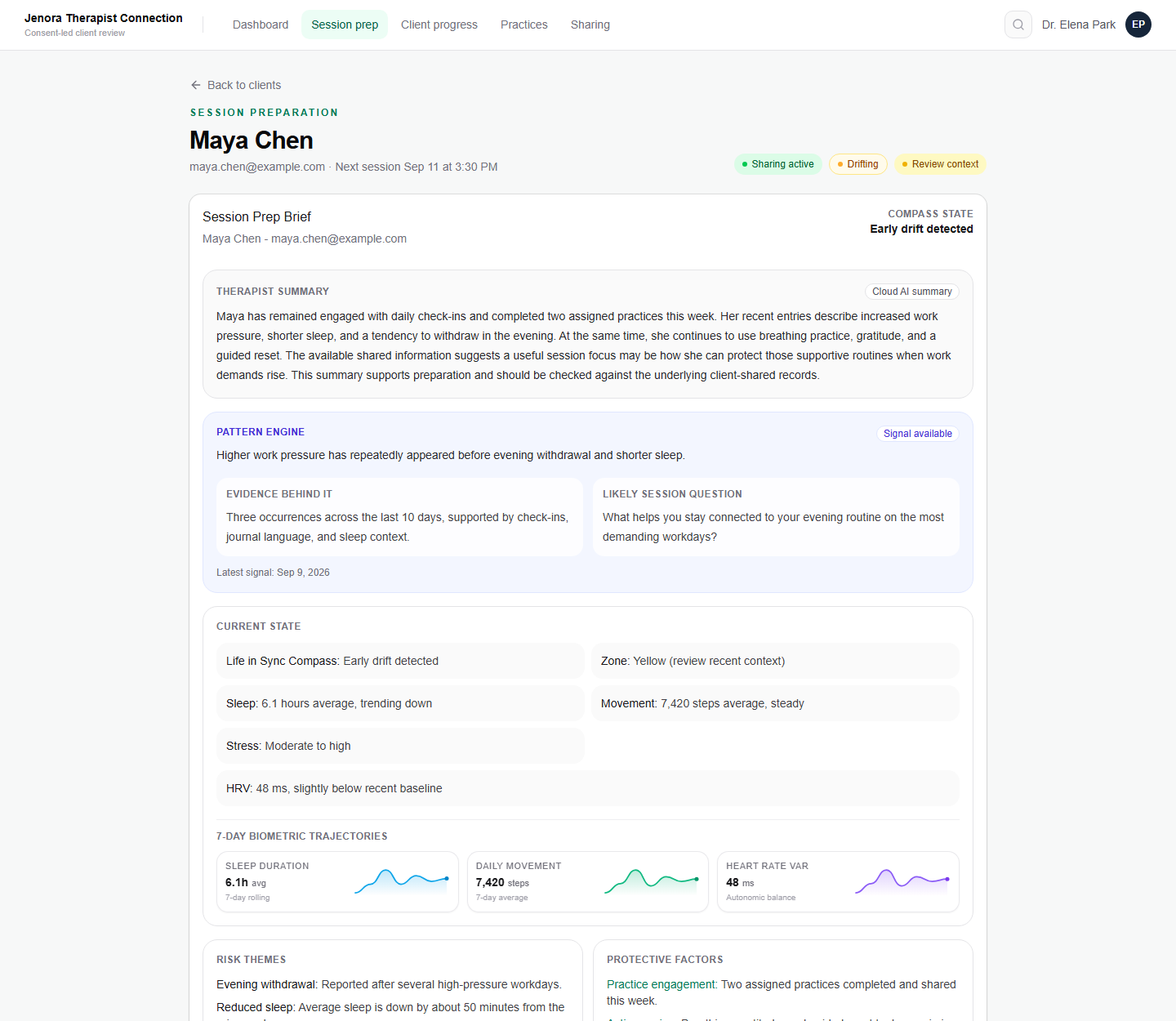
Patterns with the evidence still attached
When Jenora surfaces a repeated relationship in information your client has chosen to share, you can review the supporting context and a possible question to explore in session.
These are observations, not diagnoses or predictions, and not treatment recommendations. Suggested questions are prompts for clinical curiosity, not directives.
Between sessions
Continue the work in everyday life.
Assign a practice, see whether it was completed, and review a response only when the client chooses to share it. Bring what happened back into the next conversation.
Over time
See what may be drifting—and what is already helping.
A longitudinal view for conversation—not continuous monitoring.
Review recent shared activity and supportive routines to see what may deserve a closer look and what's already helping.
The client stays in control
Consent you can see, not just a promise you have to trust.
Connected doesn't mean everything is shared.
Sharing is category-level and set entirely by the client: some categories may be shared while others stay private. The Therapist Connection agreement covers Cloud AI preparation of only the categories the client selects.
Client-controlled sharing
Clients choose sharing categories and can change, pause, or revoke access from Jenora.
Protected access
Data is encrypted in transit and at rest, with role-based access and auditable consent history.
Cloud AI within the agreement
Cloud preparation summaries are covered by the client's Therapist Connection agreement and apply only to categories shared with that therapist.
HIPAA-supporting workflows
Jenora's Therapist Connection is designed to support HIPAA-covered workflows with client-controlled sharing, role-based access, audit controls, Business Associate Agreements for eligible providers, and HIPAA-eligible cloud infrastructure.
HIPAA protections apply to Therapist Connection workflows used under an applicable Business Associate Agreement.
Read our Privacy Policy →Jora Pro
Therapist Connection, in your pocket.
Jora Pro is the optional mobile companion to Jenora Therapist Connection. Quickly review your caseload, prepare for sessions, assign or review activities, catch up on updates, and access selected client information from your phone.
- Review your caseload
- Prepare for sessions
- Assign and review modules or practices
- See updates
- Review shared trends, protective factors and screening results
- Use biometric lock for added device-level privacy
Only information your client has chosen to share is available.
Therapist Connection remains your full web workspace. Quick access. Less friction. Same therapist workspace.
What this is not
Built for preparation, not surveillance.
Not an EHR
Jenora Therapist Connection does not replace clinical records, billing, or practice-management systems.
Not continuous monitoring
It is designed for preparation and collaborative review between sessions, not constant observation of clients.
Not a replacement for clinical judgment
Jenora organizes client-shared context. It does not diagnose, predict relapse, or automatically label a client as deteriorating. Clinical interpretation and decisions remain with the therapist.
Safety and boundaries
What happens when someone is struggling?
Clients can return to personal safety planning, support contacts, and coping resources in Jenora. In some conversations, the app may recognize crisis-related language and offer crisis resources or navigation to in-app support tools. These features can miss context and are not emergency care.
Jenora is not a crisis-response service
Therapist Connection does not continuously monitor clients or automatically alert therapists to a crisis. It does not replace emergency services, crisis care, or a client's treatment team. If there is immediate danger, contact local emergency services or an appropriate crisis resource.
Trust and accountability
Can I trust Jenora with my clients?
Jenora is designed around client autonomy, visible consent, and therapist judgment. It is not covert behavioral surveillance, and clients remain people with context—not scores.
Therapist Connection uses role-based access, consent controls, and audit history. Neyda Technologies, Inc. provides Business Associate Agreements for eligible providers. HIPAA protections apply to Therapist Connection workflows under an applicable, accepted BAA.
AI supports reflection and preparation
Ori is an in-app conversational companion for reflection and guided activities. Cloud AI may help organize client-authorized information for session preparation when the required agreement and permissions are in place. Generated content can be incomplete or wrong; it is not a clinical assessment, diagnosis, prediction, or treatment recommendation. The therapist reviews the underlying shared information and applies their own judgment.
Cost and adoption
What will this cost?
For therapists
Apply for professional access. The Free Therapist Connection plan supports up to two connected clients. No credit card is required until you connect more than two clients. Solo is $24.99/month or $240/year; clinic pricing is available by contacting Jenora.
Evaluate Therapist Connection with up to two connected clients before deciding whether to expand. Approval is required.
For clients
Clients can use Jenora and connect with a therapist without paying. Premium is optional and may be purchased separately or sponsored through Connected Care. Store prices vary by region; eligible annual subscriptions may include a 14-day trial, with terms and price shown before purchase. Therapist Connection does not add a client charge.
Questions
Frequently asked questions
What is Jenora Therapist Connection?
Jenora Therapist Connection is a client-controlled, between-session platform where you review shared progress, completed practices, emerging patterns, and a concise session-preparation summary — only for the categories a client has chosen to share. It's designed to support the conversations you already have in session, not to replace them.
How does client data sharing actually work?
A client links their own Jenora account to your therapist workspace and selects which categories to share — for example check-ins, completed practices, or identified patterns — before anything becomes visible to you. Sharing is set entirely by the client and can be changed at any time from their account.
Can a client revoke my access, and what happens if they do?
Yes. Clients can change, pause, or revoke sharing at any time from their privacy settings, with immediate effect. Once revoked, no further information becomes visible to you for that category going forward.
Is Jenora Therapist Connection HIPAA compliant?
Jenora's Therapist Connection is designed to support HIPAA-covered workflows. Neyda Technologies, Inc. (Jenora's operating entity) enters into a Business Associate Agreement (BAA) with eligible therapist organizations, and HIPAA protections apply to Therapist Connection workflows used under an applicable, accepted BAA.
Does Jenora replace my EHR or practice-management software?
No. Jenora Therapist Connection is not an EHR and doesn't handle clinical records, billing, or practice management. It's built to sit alongside those systems as a source of client-authorized, between-session context.
Does Jenora diagnose clients, or predict relapse or risk?
No. Jenora does not diagnose, calculate relapse probability, predict risk, or automatically label anyone as deteriorating. Cloud AI organizes information the client has already shared into a preparation summary — patterns, supporting evidence, current context, and possible questions — but clinical interpretation and decisions remain with you.
What credentials do I need to apply for therapist access?
Access is reviewed for licensed or credentialed mental health professionals. When you apply, you'll share your professional credentials (for example LCSW or PhD) and the state, province, or region where you're licensed, and Jenora reviews these before approving a therapist workspace.
Does my client need to already be using the Jenora app?
Yes. Jenora is a standalone app for clients first, and Therapist Connection is an optional layer on top of it. A client needs an active Jenora account to link to your workspace and choose what to share with you.
Is this continuous monitoring of my client between sessions?
No. Therapist Connection is built for preparation and collaborative review, not constant observation. You see what a client has chosen to share since your last review, not a live feed of their daily activity.
Can I assign between-session practices and see if they were completed?
Yes. You can assign a practice from Jenora's library and see whether it was completed. Any written response stays private unless the client chooses to share it with you.
How much does Jenora Therapist Connection cost?
Therapist Connection Free is $0 and supports up to 2 connected clients. Solo is $24.99 per month or $240 per year; Clinic pricing is available by contacting Jenora. You must apply and be approved; after approval you can evaluate with up to 2 connected clients before a credit card is required. See the pricing page for full plan details.
Is the Jenora app free for my clients?
Yes. A client can use Jenora and connect to your workspace without paying anything — Therapist Connection sharing doesn't require a paid plan on either side. If you'd like a client to have Jenora Premium features, you can sponsor them through Connected Care; even the Free therapist plan includes 2 active Connected Care sponsorships, with more available on paid plans.
Is there a mobile option for reviewing shared client updates on the go?
Jora Pro is the optional mobile companion to Therapist Connection, for quick access to the information your clients have chosen to share, plus assignments and updates, from your phone. It is coming soon and is currently available to approved testers. Therapist Connection remains your full web workspace.
Can I use Jenora with clients in addiction recovery or with co-occurring needs?
Jenora's personalized Life in Sync and Three Zones planning can support reflection on recovery, urges, client-defined warning signs, protective routines, emotional regulation, and other behavior or mental health patterns. It is a companion to care, not a treatment or diagnostic system. The framework is personal to each client rather than tied to a single diagnosis.
What framework does Jenora use?
Life in Sync is the day-to-day compass. The Three Zones help clients identify supportive anchors (In Sync), changes they want to notice (Drifting), and personally identified serious risks or boundaries (Off Course). These are planning and reflection concepts, not automated clinical labels. Read more on the Our Approach page.
Does Jenora alert me if my client is in crisis?
No. Therapist Connection is not continuous monitoring and does not automatically alert therapists to a crisis. Jenora may offer client-facing crisis resources or in-app support tools in some situations, but it is not an emergency or crisis-response service.
What if my client stops using Jenora?
Jenora does not require daily use or treat a break as a failure. Non-use by itself should not be interpreted as deterioration. Any information available to you remains subject to the client's sharing choices.
Therapist access
Bring more of the week into the conversation.
Apply for access to Jenora Therapist Connection. We review professional credentials before a therapist workspace is approved.
View pricing