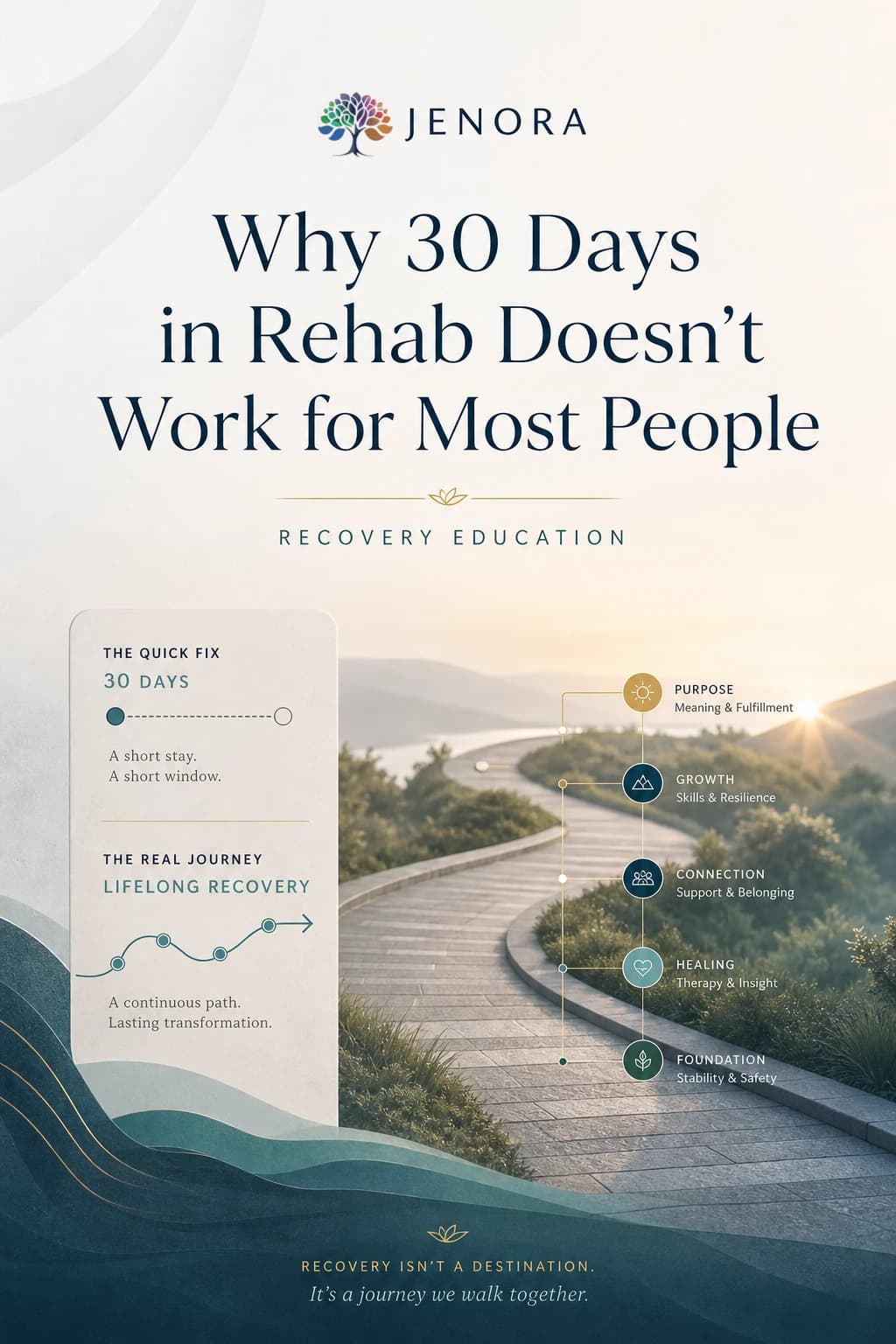
There's a number burned into the American understanding of addiction recovery: 30 days.
It shows up in insurance policies, HR leave agreements, TV plotlines, and family ultimatums. "Get yourself into a 30-day program" has become cultural shorthand for taking addiction seriously. The implication is clear — thirty days is enough to fix it.
It isn't. And the gap between what people expect from a month of residential treatment and what the research actually shows isn't a small one. It's the gap where most relapses live.
Where 30 Days Came From
The 30-day residential model didn't emerge from clinical outcome data. It emerged from insurance reimbursement structures in the 1980s. Managed care organizations needed a number, and 30 days became the default unit — long enough to justify coverage, short enough to control costs.
That's it. There was no randomized controlled trial establishing that 28 to 31 days was the physiologically or psychologically optimal window for addiction treatment. The number was administrative, and the field built infrastructure around it.
Decades later, the model has calcified. Many treatment centers still structure their entire clinical approach around the 30-day discharge date — even as the evidence base has moved decisively in a different direction.
What's Actually Happening in the Brain
Addiction is not a behavioral failure that resolves once the substance is removed. It's a neurological reorganization — one that took months or years to establish and doesn't reverse on a 30-day timeline.
Here's what 30 days is actually enough for: detoxification and acute stabilization. The physical withdrawal has typically subsided. The person is sleeping, eating, and thinking more clearly. By most surface measures, they look recovered.
But underneath, the brain is still mid-reorganization.
Dopamine signaling — disrupted by chronic substance use — takes significantly longer to normalize. Cue-reactivity, the automatic craving response triggered by people, places, and emotions associated with use, doesn't diminish meaningfully in a month. In some cases, it intensifies in early recovery as the brain recalibrates. The prefrontal cortex's capacity for impulse regulation, eroded by chronic use, rebuilds slowly, over months and years of consistent behavioral practice.
This is not a pessimistic view of recovery. It's an accurate one. And accurate framing is where effective treatment has to begin.
The Habit Formation Problem
The science of behavioral change has become substantially more precise in the last two decades. One of its clearest findings is directly relevant here: habits take far longer to form than we assumed.
A widely cited UCL study by Phillippa Lally and colleagues tracked how long it actually took people to form new habits in real-world conditions. The average was 66 days — with a range running from 18 days to 254 days depending on the complexity of the behavior and the individual.
Recovery from addiction isn't forming one habit. It's restructuring a constellation of them simultaneously — sleep patterns, social routines, stress responses, emotional regulation strategies, identity and self-narrative. It's building what researchers call a "recovery lifestyle": a new set of automatic behaviors that can compete with the deeply entrenched cues and routines associated with use.
Thirty days cannot do that. Even an ideal 30-day program cannot do that. The neurological and behavioral groundwork simply isn't laid in that timeframe.
What 30 days can do — and this is meaningful — is create a protected window for stabilization, psychoeducation, and the beginning of therapeutic work. The problem is when it's treated as an endpoint rather than a starting line.
The Handoff Problem
Even when a residential program is clinically excellent, the transition out is where treatment most commonly fails.
A person exits after 30 days into the same neighborhood, the same relationships, the same emotional triggers that preceded their admission. The environmental control that made the residential setting feel manageable — no access, structured days, peer support, constant clinical contact — evaporates immediately. They're handed a discharge plan, sometimes a list of outpatient referrals, and sent back into the life they came from.
The cue-reactivity that hadn't resolved is now being tested continuously, without the scaffolding that helped contain it. The new coping strategies practiced in group therapy haven't had enough repetition to become automatic. The therapeutic relationship — often the most stabilizing element of the residential stay — is severed or severely reduced.
This is the window in which most relapses occur. Studies consistently find the highest relapse risk in the first 30 to 90 days post-discharge. Which means the period immediately following most people's entire treatment episode is their most dangerous.
What the Research Actually Supports
Longer treatment duration is one of the most consistent predictors of better outcomes in addiction research. Studies from NIDA and SAMHSA have found that treatment episodes lasting 90 days or more show substantially better long-term recovery outcomes than shorter episodes — across substance types and demographic groups.
The 90-day threshold isn't arbitrary. It corresponds roughly to the timeframe in which new behavioral patterns begin developing meaningful automaticity, cue-reactivity begins to attenuate, and therapeutic work reaches deeper layers of the underlying emotional and relational patterns that typically drive substance use.
But duration alone isn't the point. What the research supports is continuity: a sustained relationship with recovery support across the transition from acute treatment back to real life. That can look like longer residential stays, but it can also look like intensive outpatient treatment, peer support networks, regular therapeutic contact, structured accountability, and daily practices embedded into ordinary life.
What it doesn't look like is a clean 30-day endpoint.
Recovery Is a Lifestyle, Not an Event
This is the reframe that matters most — and it's one that most people, including many in the treatment field, resist because it's harder to sell, harder to measure, and harder to structure insurance reimbursement around.
Recovery isn't something that happens to a person in a clinical setting. It's something a person builds, daily, over an extended period, through repeated behavioral choices that gradually reshape neural pathways, social networks, and self-concept.
The research on long-term recovery — particularly the work coming out of the Recovery Research Institute and studies on people with decades of sustained recovery — consistently identifies a few common elements: stable housing and social support, meaningful daily structure, ongoing peer connection, a sense of purpose or identity beyond addiction history, and daily micro-practices that anchor recovery behavior.
None of those elements are delivered by 30 days in residential treatment. All of them are built, slowly, in ordinary life.
What This Means in Practice
If you're a clinician, this reframe shifts the question from "did they complete treatment?" to "do they have what they need to sustain the work?" Discharge planning isn't an administrative task — it's the most clinically critical moment of the entire episode.
If you're someone in recovery, this reframe is actually liberating. It means that not completing 30 days, or completing it and relapsing, doesn't mean you failed. It means you were handed a timeline that was never designed around how your brain actually works. The work isn't over. It's not even close to over. That's not discouraging — it's honest, and honest is where real recovery starts.
If you're a family member, it means adjusting your expectations from "fixed after 30 days" to "beginning a longer arc." It means understanding that the support you provide in the 90 days after discharge may matter more than anything that happened inside the program.
The Bottom Line
30 days in rehab can be a meaningful intervention. For some people, in some circumstances, it genuinely saves lives in the short term. That's not nothing.
But it is not treatment. Not in any complete sense. At 30 days, the brain is still reorganizing, the new habits aren't formed, the cues haven't been defused, and the life that needs to change is waiting exactly where it was left.
Recovery requires what habits require: time, repetition, support, and structure that persists past the point where motivation alone can carry it. For most people, that's not 30 days.
It's closer to the rest of their lives — and that's not a tragic sentence. For the people who get there, it's how they describe the best version of themselves they've ever been.
Tony Lyda is a licensed therapist and the founder of Jenora, a clinical-quality wellness and recovery app designed to support the daily work of sustained recovery.