There's a moment that anyone close to addiction will recognise. Someone reaches for the thing again — the drink, the drug, the phone — and if you asked them honestly whether they even enjoy it anymore, they'd say no. Not really. Not the way they used to. And yet here they are, reaching for it, sometimes before they've even decided to.
That's the puzzle this article is about. If the substance has stopped feeling good, why does the pull get stronger? To answer that, we have to correct one of the most widespread misunderstandings in popular science — the idea that dopamine is the brain's "pleasure chemical." It isn't. And once you understand what dopamine actually does, the whole strange machinery of addiction starts to make sense.
The pleasure chemical that isn't
For decades, dopamine was cast as the molecule of pleasure. Do something enjoyable, dopamine floods the brain, you feel good — that was the story. It's a tidy story. It's also wrong, and researchers have known it's wrong for a long time.
The scientists who did most to overturn it, Kent Berridge and Terry Robinson, showed something that sounds impossible at first. You can take away an animal's dopamine entirely, and it will still show every sign of enjoying a sweet taste — the same contented reactions as before. What it won't do is work for the sweet taste. The enjoyment survives; the drive to pursue collapses.
That single finding cracks pleasure and dopamine apart. They aren't the same system. So the brain's reward machinery has two separate jobs running side by side, and the confusion between them is where nearly everyone gets lost:
- Liking — the actual pleasure, the enjoyment in the moment you get the thing.
- Wanting — the pull toward the thing, the drive to go and get it.
Dopamine runs the wanting. Not the liking. And that distinction, which sounds like a technicality, turns out to explain almost everything.
The magnet and the verdict
Here's the way to hold it.
Think of wanting as a magnet. Certain things in your world — and certain cues that predict those things — get a magnet installed in them. They start to pull. Your attention drifts toward them, your feet carry you there, and often you're moving before you've consciously decided anything. The smoker who lights up mid-conversation without noticing isn't making a choice in that moment. The magnet did its work.
Think of liking as the review you write afterward. It's the verdict — was that actually any good? — and it only gets filed once the thing is in front of you.
In everyday life these two travel together. The things that pull us are the things we enjoy, so we never notice they're separate. The magnet points you at the meal; the meal is good; the review is positive. Everything lines up.
Addiction is what happens when they come apart. The magnet keeps getting stronger — the pull grows, the attention narrows, the pursuit becomes relentless — while the reviews keep getting worse. A strengthening magnet sitting next to a pile of bad reviews is an uncomfortable image, and it's meant to be. It's the exact shape of the thing. The wanting sensitises and grows; the liking fades. That's not a contradiction to be explained away. It's the mechanism.
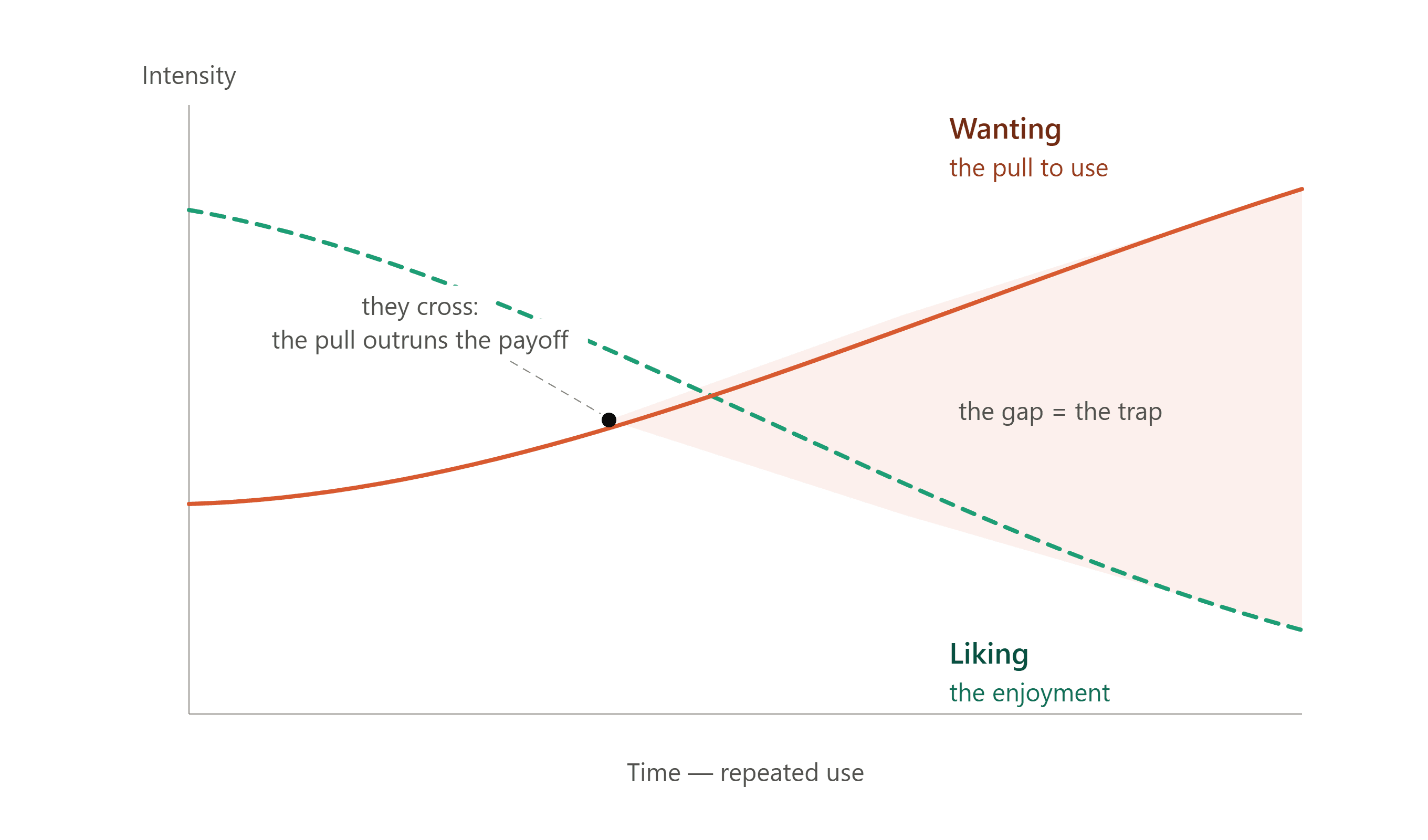
But this raises an obvious question. Why would a brain be built with a separate pull-system at all? Why not just let pleasure do the job?
Why we have "wanting" in the first place
Because pleasure, on its own, is useless.
Imagine a creature that enjoys eating a berry but feels no drive to go and find the next one. It sits contentedly where it is — and starves. Enjoyment is a signal that fires at the moment of contact. It can't reach backward in time and haul you across the forest to the bush. It can't make you get up tomorrow and do it again.
Survival doesn't reward good taste. It rewards pursuit. So evolution built a second system whose entire purpose is to turn "that was good" into "go and get it — prioritise it, spend energy on it, do it again." That system is wanting, and it does three things that kept our ancestors alive:
- It makes you pursue rather than merely enjoy.
- It makes you repeat, so a good outcome becomes a habit instead of a one-off.
- It makes you anticipate, by latching the pull onto the cues that predict reward — the smell, the place, the time of day — so you're drawn toward the berry patch before anything is in your mouth.
That last one is the clever part. The magnet doesn't just get installed in the reward itself. It gets installed in everything that reliably comes before the reward. This is what lets motivation operate across distance and delay — you navigate toward good things in advance, guided by their signposts. For a creature in a world where food and safety were scarce and hard-won, this is a spectacular piece of design. It is, arguably, the engine of all goal-directed behaviour.
And it works beautifully — as long as two things stay true. First, that rewards are effortful to get. Second, that wanting and liking rise and fall together, so the things pulling at you are genuinely the things worth having.
Mind-altering substances break both rules at once. To see how, we have to answer one more question — the one that turns out to sit at the very centre of this.
What makes a drug a "reward" at all?
Here's something worth sitting with: there's nothing about a molecule that should register as valuable to your survival. A drug isn't food. It isn't warmth or safety or connection. So why does the reward system — this ancient machinery tuned to keep you alive — treat a chemical as if it were a berry?
The answer reframes everything, so it's worth being precise.
The reward system was never actually built to detect good things in the world. It can't — it has no direct line to the world. What it was built to detect is a signal: a particular pattern of activity inside the brain that, across evolutionary time, reliably happened to fire whenever something genuinely valuable occurred. Food caused that signal. So did sex, warmth, connection, winning status. The brain treats that internal signal as its very definition of "reward." The good thing out in the world was only ever the cause of the signal — evolution had no way to wire the system to the thing itself. It could only wire it to the internal echo.
That's the whole vulnerability, in one line: the reward system responds to the signal, not to the source.
For all of human history that was a perfectly safe shortcut, because there was only one way to produce that signal — actually go and get something valuable. Nothing could fake it. The signal was a trustworthy stand-in precisely because it couldn't be counterfeited.
A drug is the counterfeit. What makes a mind-altering substance a "reward" is simply that it produces the internal signal directly — chemically, through the back door — skipping the berry, the effort, the achievement, the real survival benefit entirely. The substance generates the "this is good" pattern, the brain reads it exactly as designed, and concludes a reward has occurred. It has no way to check. It was never built with a way to check, because for a million years it never had to be.
So the honest answer to what makes a drug rewarding is: nothing about the drug itself does. It's a reward only in the way a skeleton key is a "key" — it fits the lock without belonging to it. The substance is a chemical skeleton key that happens to fit the ignition of the reward system. And it's worse than a harmless fake, because it usually produces the signal more intensely and more reliably than any real reward can. Natural rewards are noisy, delayed, and hard-won. A drug delivers the signal cleanly, strongly, and on demand. That's why it can out-compete food, relationships, and everything else the system was tuned for — not because it's better, but because it cheats.
Putting it together: when the security system works for the burglar
Now watch the two ideas lock into each other.
The counterfeit signal doesn't just get liked for a moment. It feeds the wanting system — which promptly does its ancient job and installs the magnet in every cue that predicts the signal. The street corner. The time of day. The notification tone. The sound of a can opening. All of it gets magnetised, because the machinery is doing exactly what it was designed to do: bind the pull to whatever reliably comes before the reward.
The lock gets picked — and then the whole security system starts working for the burglar.
This is why the pull outlives the pleasure. The liking fades, because the brain adjusts to the chemical flood and the euphoria dims. But the wanting doesn't fade with it — it sensitises, growing stronger and more easily triggered over time. So the person ends up hauled back again and again by cues, toward a substance that, as they'll freely tell you, they no longer even enjoy. The magnet is at full strength. The reviews stopped being good long ago.
That's the answer to the puzzle we started with. The thing dragging someone back isn't weakness, and it usually isn't even pleasure. It's an ancient survival system — the same one that once steered their ancestors toward food and safety — running perfectly, aimed at the wrong target.
Why this matters for recovery
It would be easy to read all of this as grim. It isn't, and here's why.
If you believe addiction is a pleasure problem — that you keep going back because it feels so good — then every relapse is evidence of a personal defect. You wanted the good feeling more than you wanted your life. What kind of person does that?
But that's not what's happening. The pleasure often left a long time ago. What's still running is a wanting system that was counterfeited — an old, universal piece of machinery, present in every human brain, that has no way to tell a chemical skeleton key from the real thing. That's not a flaw in you. It's a design constraint in a system everyone is running.
This isn't an excuse, and it doesn't remove agency. The work of recovery is still real, still effortful, and still yours to do. But it relocates the problem — from a rotten place in your character to a predictable vulnerability in human wiring. And that relocation matters, because it's very hard to do the work while you're drowning in shame. Sometimes the first genuinely useful thing a person can learn is that the thing pulling at them has a name, a mechanism, and a reason — and that the reason isn't because something is wrong with me.
Understanding the magnet is the beginning of learning where it's been installed. And once you can see the cues for what they are — signposts to a counterfeit, not to anything you actually want — you can start, slowly, to take the magnets back out.
Sources
-
Robinson, T. E., & Berridge, K. C. (1993). The neural basis of drug craving: an incentive-sensitization theory of addiction. Brain Research Reviews, 18(3), 247–291. — The original theory. Supports the central claim that dopamine mediates "wanting" (incentive salience) rather than the pleasure of a reward, and that this "wanting" can sensitise and grow over time.
-
Berridge, K. C., & Robinson, T. E. (2016). Liking, wanting, and the incentive-sensitization theory of addiction. American Psychologist, 71(8), 670–679. — Supports the wanting/liking dissociation, the finding that "liking" is generated by small opioid-based hotspots and is not dependent on dopamine, and the claim that addiction amplifies wanting without amplifying liking.
-
Robinson, T. E., & Berridge, K. C. (2025). The incentive-sensitization theory of addiction 30 years on. Annual Review of Psychology, 76, 29–58. — The current status of the theory. Supports the claim that the core dissociation is now well established, and that cue-triggered "wanting" persists long after drug use stops.