Let's start with a question people have argued about for a long time.
Is addiction a disease, or is it a choice?
Hold onto your answer for a moment, because there's a good chance the question itself is set up wrong. Most people feel pulled to pick a side. If it's a choice, then someone struggling just needs to make a better one. If it's a disease, then maybe choice has nothing to do with it. Both of those feel a little off, don't they? And that "little off" feeling is worth paying attention to.
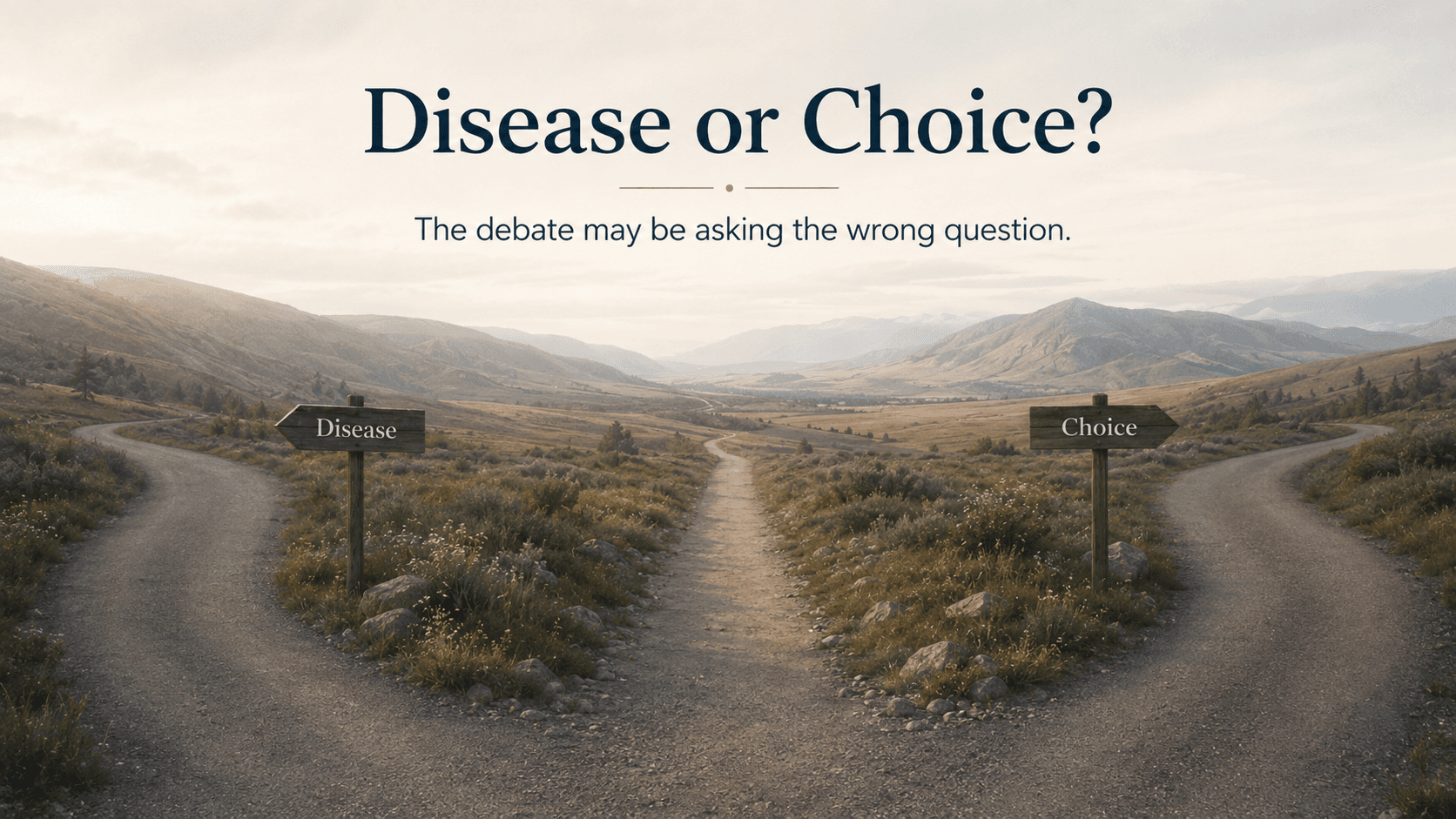
Addiction is often framed as disease or choice. This series looks at the missing middle: what changes in the brain, and what that means for responsibility and recovery.
Here's a different way in. Instead of debating the label, let's look at what a disease actually is — and see whether addiction fits.
Every disease has three parts
It turns out you can break almost any disease down into three pieces:
- The organ — the part of the body involved
- The dysfunction — what's going wrong inside that organ
- The symptoms — what you actually see and feel
Take type 1 diabetes. The organ is the pancreas. The dysfunction is that it isn't making enough insulin. The symptoms are things like thirst, fatigue, and high blood sugar. Three parts, all accounted for.
Or something simpler — a broken leg. The organ is the bone. The dysfunction is the fracture. The symptoms are pain, swelling, and not being able to walk on it.
Once you see the pattern, it's hard to unsee. Almost anything we call a disease has all three pieces.
Now let's try addiction
When I've walked people through this in person, something interesting happens almost every time.
Ask what the organ is, and most people get there: the brain. Ask about the symptoms, and people can list them without much trouble — the cravings, the loss of control, the way it damages relationships and health, the return to using even when someone desperately wants to stop.
But then there's the middle piece. The dysfunction. What is actually going wrong in the brain?
This is where the room usually goes quiet. People have heard addiction called a disease their whole lives, but almost no one has ever had the middle part explained to them. And that missing piece is exactly where the confusion — and a lot of the shame — comes from. If you can't see the dysfunction, addiction really does look like nothing but a string of bad choices.
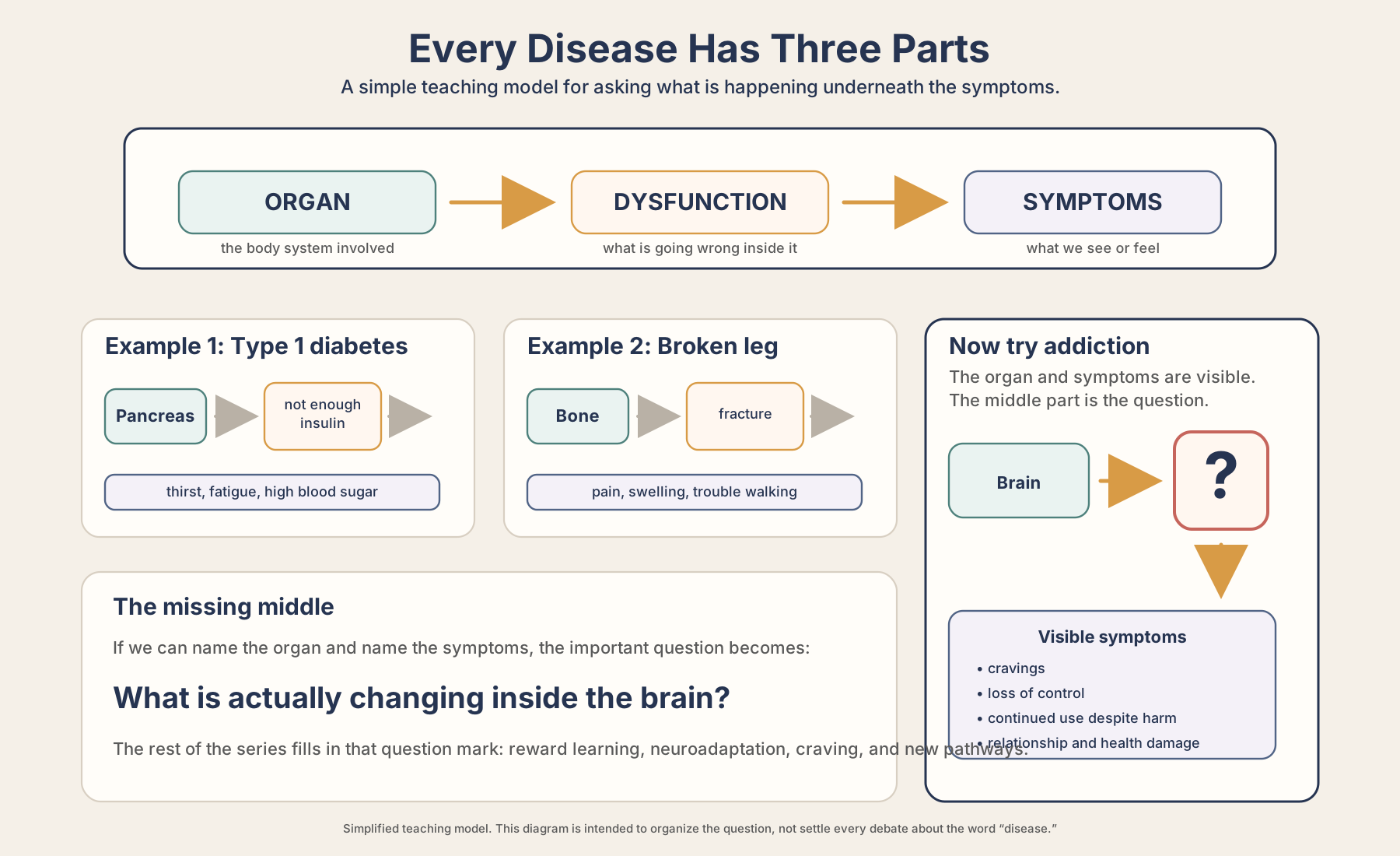
The missing middle is the dysfunction: what is happening in the brain that helps explain the symptoms people can see from the outside.
Where this is going
Over the next few articles, we're going to fill in that question mark. Not with vague ideas, but with what's actually happening in the brain — how your reward system works, how it gets hijacked, and why it drives the behavior it does.
A quick note before we go further: calling addiction a "disease" isn't about taking away your choices or your responsibility. The current understanding among most clinicians is that addiction has a real biological basis and still involves a person who can act. It's not one or the other. Understanding the biology doesn't excuse anything — but for a lot of people, it's the first time the whole thing stops feeling like a personal failing and starts making sense.
Nobody takes their first drink or their first pill hoping to end up in trouble. Once you understand what's happening underneath, you can start to see why.
Next up: the survival brain — the ancient part of you that's been running the show far longer than you might think.
This article is educational and isn't a substitute for professional care. If you're struggling, support is available — and the next step doesn't have to be a big one.