In the last article, the brain filed a drug onto the survival list and started building around it. Now comes a twist that catches almost everyone off guard: the brain immediately begins working against the very high it just marked as important. To understand why, we need one more idea — and it's one your body uses every second of every day.
Your body loves balance
There's a word for this: homeostasis. It sounds technical, but it just means balance — the way every living thing tries to hold its internal state steady.
Think about body temperature. When you get too hot, you sweat to cool down. Too cold, you shiver to warm up. You don't decide to do either — your body is constantly nudging itself back to a healthy middle. That's homeostasis.
Your brain treats dopamine exactly the same way. It wants to stay in that healthy 40-to-100 band we talked about. So when a drug shoves dopamine far above 100, the brain doesn't celebrate — it registers an imbalance and gets to work pulling things back down.
What's happening in the gap
To see how, we have to zoom in to where brain cells actually talk to each other.
Your nerve cells don't quite touch. Between them is a tiny gap called the synapse. When a signal fires, dopamine is released into that gap, drifts across, and lands on receptors on the next cell — like a key fitting into a lock. The more dopamine that crosses, and the longer it stays, the stronger the signal. That strong, sustained signal is the high. Afterward, tiny pumps normally vacuum the dopamine back up to be reused.
When a drug keeps flooding that gap over and over, the brain fights to restore balance in three main ways:
- It clears dopamine faster — ramping up the cleanup so less of it lingers in the gap.
- It makes less dopamine — dialing down its own production.
- It reduces its receptors — pulling back the number of "locks," so the same amount of dopamine has fewer places to land.
None of this is damage in the dramatic sense. It's the brain doing its job — adapting to what it thinks is the new normal.
Tolerance developing
Here is the difficult part. With repeated exposure, the brain keeps adapting against the surge. It is not trying to punish the person. It is trying to restore balance.
Early on, the pattern may look like this: the brain starts around its ordinary baseline, the high rises far beyond the ordinary range, and then the system comes back down again.
Over time, the brain begins preparing for that repeated surge. The starting point may be lower. The high may not rise as high. The return point may drop lower than before.
In simple terms, the experience may shift from something like 75 -> 120 -> 75 toward something more like 55 -> 110 -> 55.
The high is fading, but the pull is not.
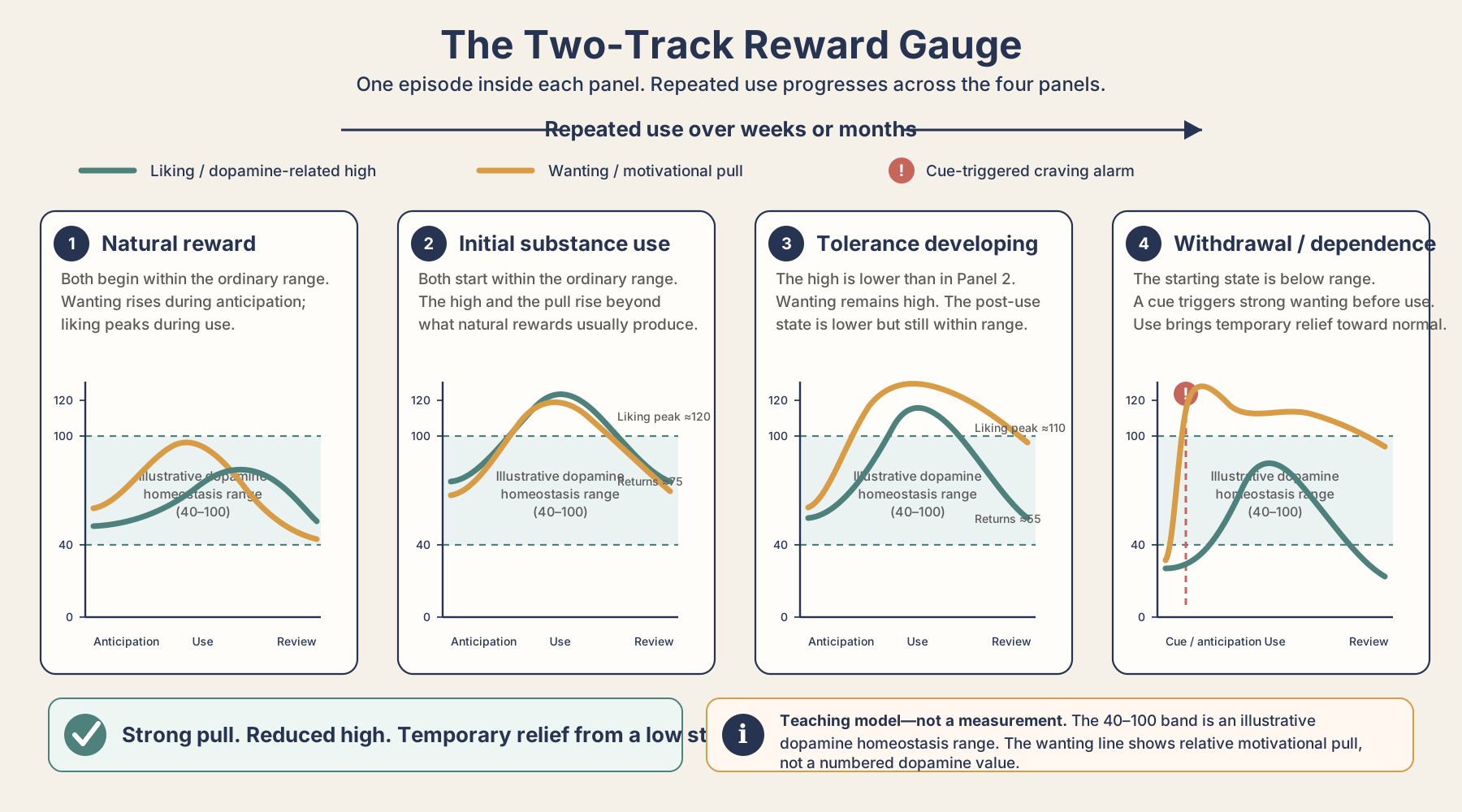
Use the later panels of the full two-track reward gauge to notice the pattern in this section: the liking/high track falls while the baseline drops lower. The high is fading, but the pull is not.
The 40-100 range is an illustrative dopamine homeostasis model, not a clinical dopamine measurement.
That downward drift is tolerance - needing more to reach an effect that keeps getting harder to reach. When the baseline drops low enough, the person is no longer using only to feel high. They may be using to feel okay.
What adaptation can look like
Adaptation can happen in several ways:
- The brain may release less dopamine.
- Dopamine may be cleared away faster.
- Receptors may become less sensitive or less available.
- Ordinary rewards may feel flatter.
- Cues linked to use may still trigger a strong pull.
None of this is dramatic damage in a cartoon sense. It is the brain adjusting to repeated extremes. But the result can be brutal: the person feels less reward from ordinary life, less high from the substance, and more discomfort without it.
This is how using to feel good can quietly become using to feel okay.
And as the baseline drops, the person moves toward withdrawal - the flat, empty, unwell state where nothing works and normal life feels impossible.
The second dysfunction
This is the next piece of our question mark. The brain, trying faithfully to rebalance, ends up somewhere terrible: a person who now needs the drug just to feel okay, and who feels genuinely awful without it. That's not weakness. That's a balancing system doing its job against a force it was never built to withstand.
And being stuck below that line isn't just uncomfortable. To a survival brain, it reads as an emergency — which is exactly where things turn next.
Next up: why cravings can overpower almost everything else — and what they have in common with dying of thirst.
This article is educational and isn't a substitute for professional care. If you're struggling, support is available — and the next step doesn't have to be a big one.