We ended the last article with two things moving apart.
The liking/high is getting smaller. The baseline is getting lower. But the wanting system can remain strong, and it can become more sensitive to cues.
That combination matters:
Low baseline + cue-triggered wanting + expectation of relief.
This article is about what the brain does with that pattern. And for many people, this is the part that finally explains behavior they have spent years feeling ashamed of.
Beginning below the ordinary range
Remember the 40-100 model from earlier in the series. It is not a clinical dopamine measurement. It is a simple way to picture the brain's ordinary motivational range.
When the baseline drops below that range, the brain may enter a low-reward state. This can feel like:
- flatness
- restlessness
- anxiety
- irritability
- emptiness
- physical discomfort
- the sense that nothing is right until relief arrives
The brain does not read this as "I am having a difficult day." The survival brain reads it as a problem that needs to be fixed.
And it already knows the fastest route to relief.
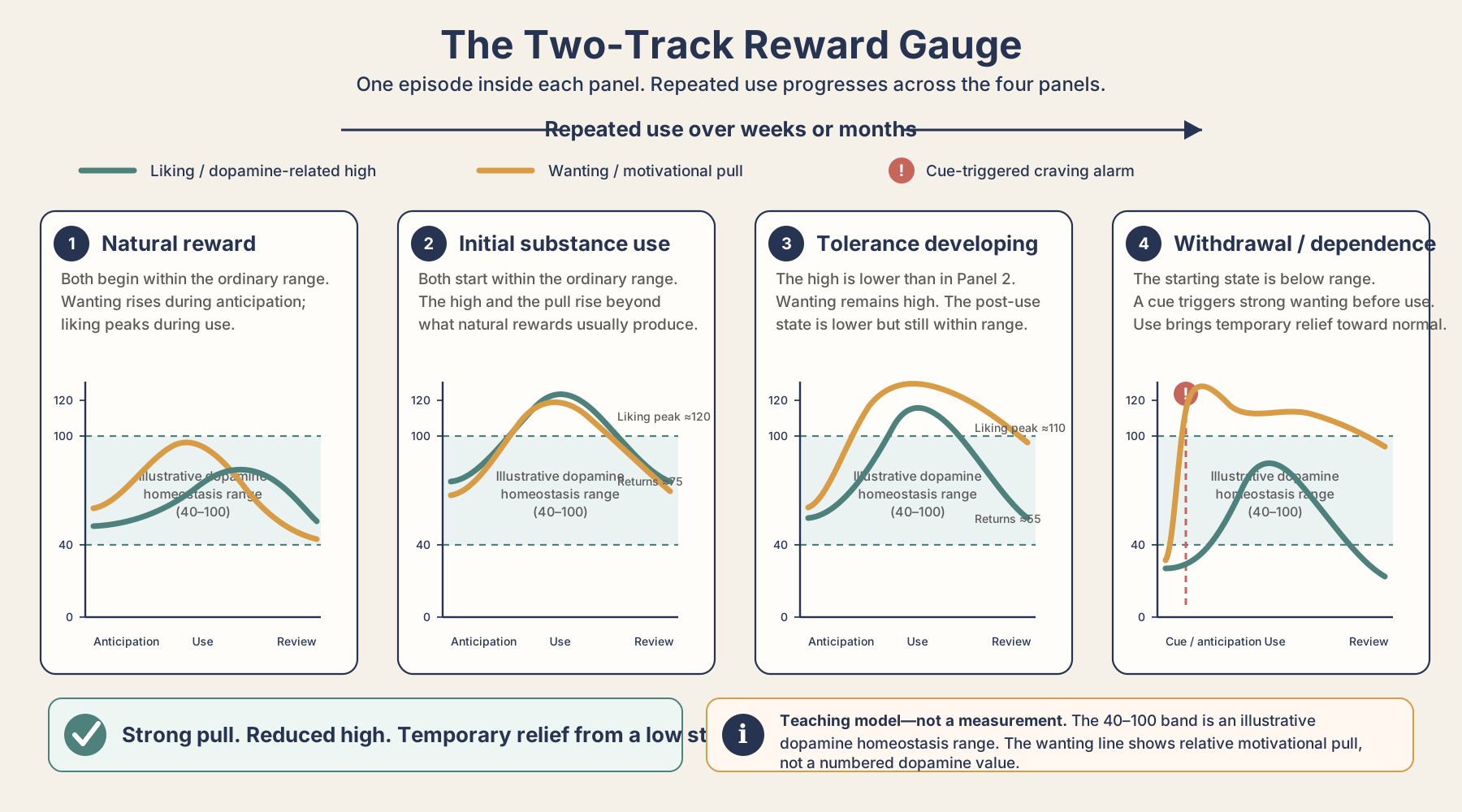
Use the final panels of the full two-track reward gauge to notice the craving-alarm pattern: lower baseline, cue-triggered wanting, and the expectation of relief.
The 40-100 range is an illustrative dopamine homeostasis model, not a clinical dopamine measurement.
The craving alarm
A craving is not just a thought. It is a learned alarm response.
A cue can set it off before a person has had time to reason through anything:
- a place
- a person
- a time of day
- stress
- loneliness
- a smell
- a sound
- a memory
- a thought
- the first feeling of withdrawal
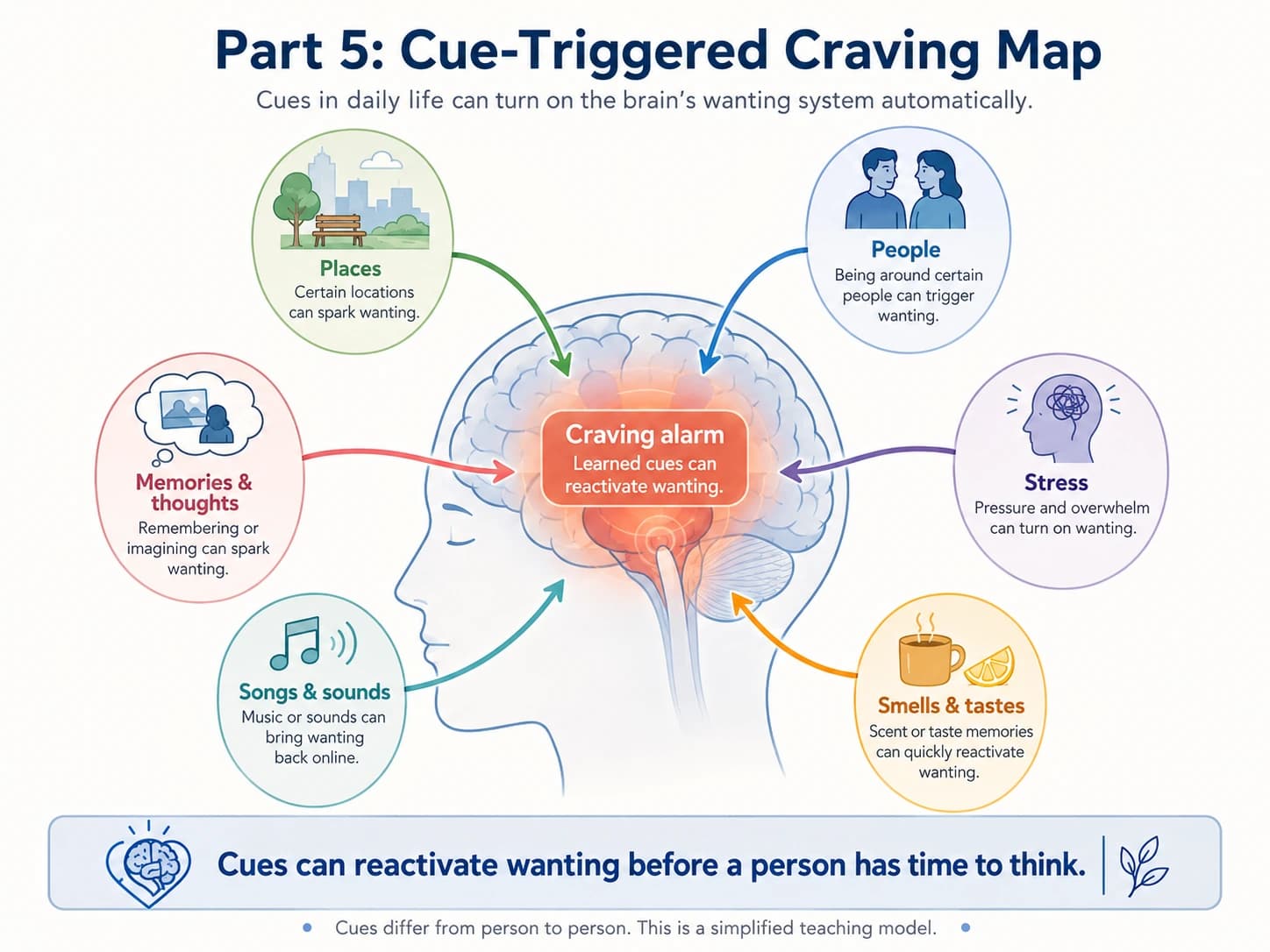
Cues can reactivate wanting before a person has time to think. Places, people, stress, smells, sounds, memories, and thoughts can all become linked to relief.
Cues differ from person to person. This is a simplified teaching model, not a fixed universal response.
Why it can feel so urgent
This is why craving can feel so confusing from the outside. The person may not be chasing a big high anymore. The high may be smaller than it used to be. But the brain still expects relief, and the wanting system can still generate a strong pull toward the old solution.
That does not erase harm. It does not remove responsibility. But it does change the story from:
What is wrong with me?
to:
Look what my brain learned - and look what I have been up against.
The desert
Here is a way to feel what that means.
Imagine you have been lost in the desert for three days. No water. You are not "a bit thirsty." You are in real danger. Then you crest a hill and see it: a campsite, and on a table, a tall, cold glass of water with condensation running down the side.
You move toward it. And just before you reach it, someone steps in front of the glass and says: no - you cannot have this.
The urgency would be surprising. Your attention would narrow. The water would not feel like a preference. It would feel necessary.
Craving is not thirst. A substance is not water. But a hijacked wanting system can assign survival-like urgency to relief.
That is why people in addiction sometimes do things that seem impossible to explain: lying to people they love, breaking promises they meant with their whole heart, acting against their own values. It is not because they stopped caring. It is because a survival system was pulling hard toward relief.
One more thing worth knowing: this alarm does not vanish the moment the substance is gone. Cravings can surge with stress, a familiar place, or an old song long into recovery. That is not failure. That is the alarm system still quieting down.
Which raises the last big question: if the pull is this strong, how does anyone ever build a way out?
Next up: the two roads — and the neuroscience of how recovery actually rewires the brain.
This article is educational and isn't a substitute for professional care. If you're struggling, support is available — and the next step doesn't have to be a big one. Cravings are one of the sensitive parts of this topic; if reading about them stirs something up, it may help to reach out to someone you trust.