By now the question mark from Part 1 is mostly filled in. The reward system gets hijacked, the brain rebalances into tolerance and withdrawal, and the low state sets off a survival-level craving. It's a heavy picture. So here's the turn: the very same feature of the brain that dug this hole is also the thing that can build the way out.
The 25-lane highway
Picture a highway from above — but not a normal one. This one is twenty-five lanes wide, perfectly straight, no bumps, no potholes. You could get in your favorite car and fly down it without touching the wheel. It's effortless.

Recovery often begins as the smaller, less familiar road. The old highway can feel easier because it has been traveled so many times.
That highway is the pathway addiction has carved into the brain. Every time the loop ran — crave, use, relief, repeat — the road got a little wider and smoother. Now, whenever your brain decides it needs dopamine, this is the route it reaches for first. Not because you're weak. Because it's the easiest, fastest, most well-built road you have.
This is what those earlier articles were describing, seen from above.
The narrow road
Now imagine a small dirt track branching off near the start of that highway. Narrow. Winding. Full of potholes. Hard going.
That track is recovery, early on. When someone stops, the brain begins building a new pathway — but it starts out exactly this rough. Every step takes effort the highway never asked for. And here's the hard part: at each bend in the narrow road, there's an on-ramp that leads straight back to the smooth, easy highway. The old road is always right there, always inviting.
Why the brain "lies"
Building a new road costs the brain real energy, and your brain often reaches for the easier route — especially when there is a smooth, familiar highway sitting right there. So it does something sneaky. It starts offering you reasons to get back on it.
You've had a brutal week. You deserve it. You had a fight with your partner. It's Friday. Just this once — you can handle it now.
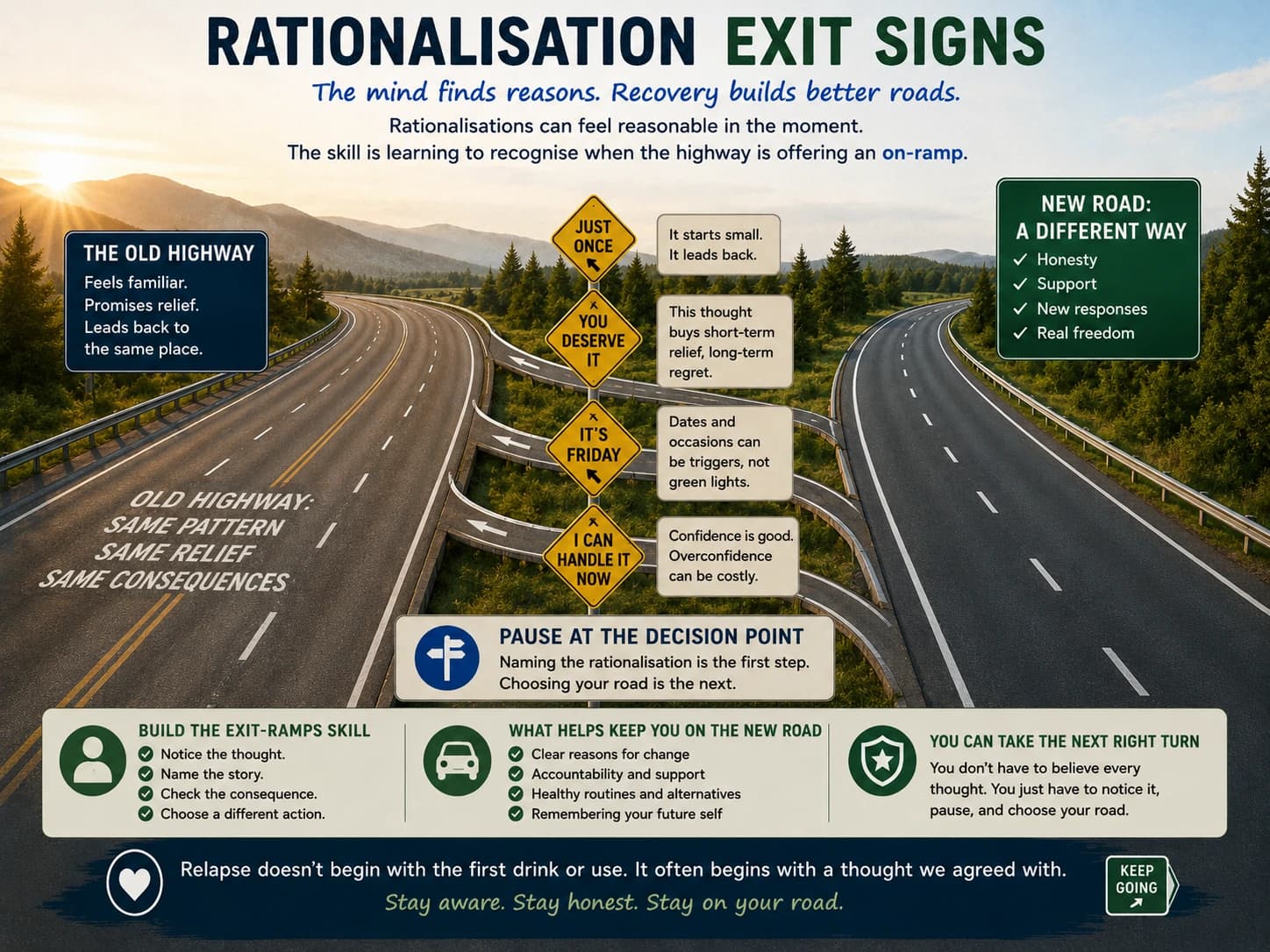
Rationalisations can feel reasonable in the moment. The skill is learning to recognise when the old highway is offering an on-ramp back to the same pattern.
This is a teaching metaphor about common thoughts, not a literal map of the brain.
These thoughts can feel completely reasonable in the moment. That's what makes them powerful. But remember where the hijacked pathway runs — straight up through the frontal lobe, the part of you that makes decisions. So in those moments, your own reasoning is being quietly bent toward the highway.
This is worth saying carefully, because it's easy to hear it the wrong way. It doesn't mean you're broken or that you can never trust yourself. It means that in specific moments — usually when the craving is loud — your brain will hand you very convincing arguments for the thing it wants. The skill of recovery isn't being strong enough to never feel the pull. It's learning to recognize the voice — to notice "it's Friday, just once" and think, ah, there's the highway talking, instead of taking it as your own honest conclusion.
That recognition is something you can practice. And it gets easier.
The road widens
Here's the part grounded in real neuroscience, and it's the hopeful part. Brains change with repetition. The reason the addiction highway got so wide is that it was traveled so many times. The new road works exactly the same way. Every time you take it — every craving you ride out, every honest choice, every hard bend you get around — the track gets a little wider and a little smoother.
It won't happen fast, and it won't happen evenly. But travel it enough, and the narrow winding road becomes a real road — and eventually a highway of its own. The old one doesn't disappear overnight, but it stops being the only route your brain knows.
That takes time, and it takes consistency. Which brings us to the last, and maybe the most important, part of this whole story.
Next up: what all of this means for shame, responsibility, and forgiving yourself.
This article is educational and isn't a substitute for professional care. If you're struggling, support is available — and the next step doesn't have to be a big one.