In the last article, we left off with a question mark sitting in the middle of the diagram — the dysfunction nobody had ever explained. To fill it in, we need to start somewhere that has nothing to do with drugs at all. We need to start with survival.
The oldest part of you
Picture your brain from the side. The upper, front part — right behind your forehead — is the newest, most human part. It's where you plan, weigh options, and make decisions. We'll come back to it.
But underneath and toward the back sits a much older system. This part has been around for millions of years, and it has barely changed, because it's been doing its one job well the whole time. That job is simple: keep you alive.
This survival brain doesn't think in words. It works quietly, in the background, pushing you toward the things that have kept humans going for a very long time: food and water, shelter, safety, connection with other people, caring for those we love. You don't decide to care about these things. Your survival brain already does.
How your brain says "do that again"
So how does this older part of you steer you toward what you need? It uses a reward.
Think about how you'd train a dog. The dog does something you like, you give it a treat, and over time the dog learns to repeat the behavior. You're not forcing it — you're making the behavior feel worth repeating.
Your brain does something remarkably similar to you, using a chemical called dopamine.
It's tempting to call dopamine the "pleasure chemical," but that's not quite right, and the difference matters. Dopamine is better understood as the motivation chemical — the nudge that says this mattered, go toward it, do it again. When you do something that helps you survive, your survival brain releases a little dopamine, and that signal tags the behavior as important. It's the invisible push that gets you out of bed, that drove you to make a friend, that bonds a parent to a child.
The loop that makes it stick
Here's the part that ties it together.
When dopamine is released, the signal travels forward — from that old survival brain up to the thinking brain behind your forehead, the part that makes decisions. At the same time, a second signal runs to your memory centers, quietly recording what you just did to earn that reward.
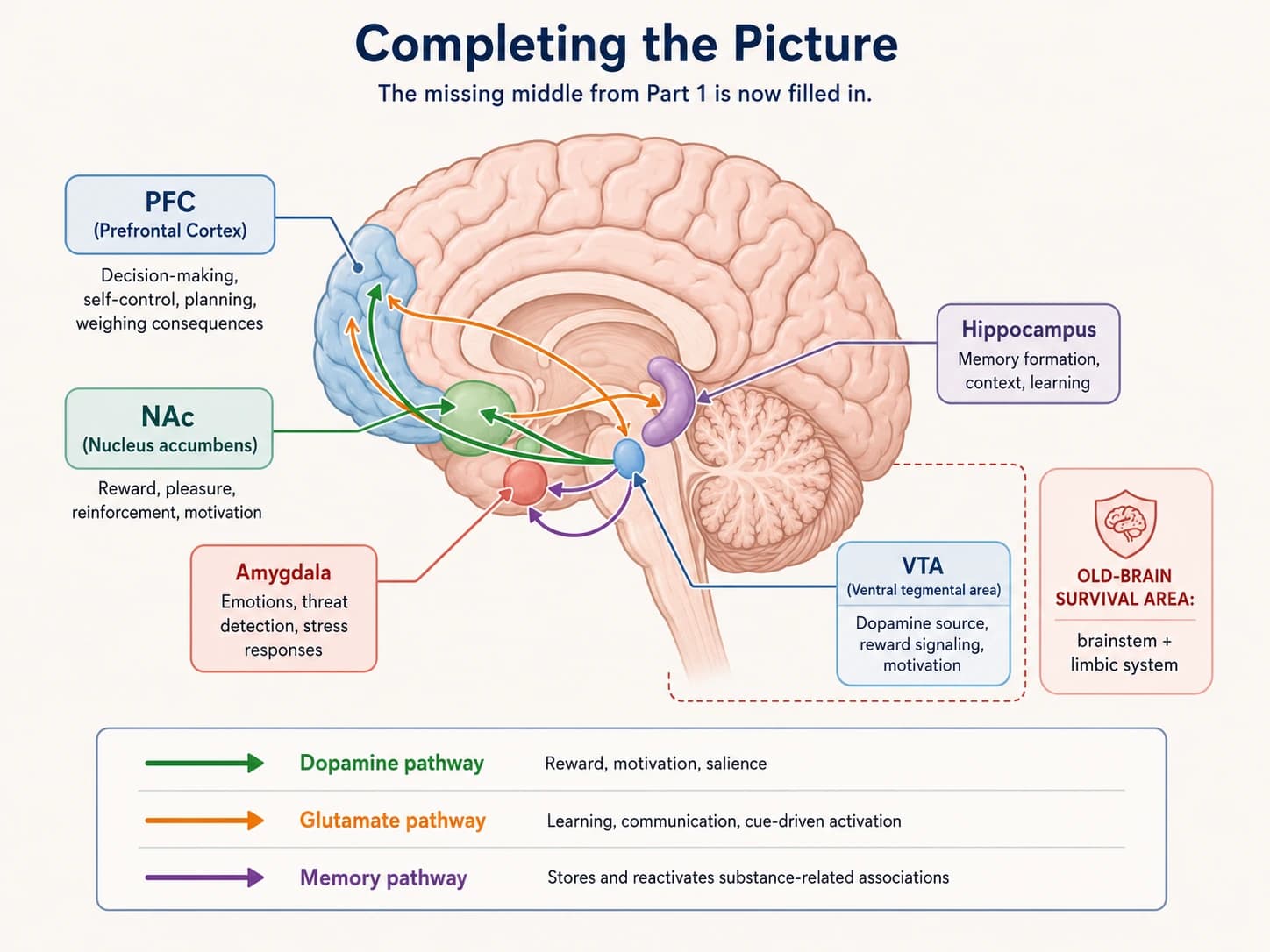
Dopamine helps connect motivation, action, and memory. The brain learns not only that something mattered, but how to move toward it again.
So the loop is complete. The behavior gets tagged as worth repeating, the decision-making brain gets nudged toward doing it, and the memory of how gets stored for next time. Multiply that across thousands of small moments, and it's a big part of how you become who you are.
None of this is broken. This is your brain working exactly as designed — a system fine-tuned over millions of years to keep you alive and moving forward.
Which raises the obvious question. If this system is so well built, how does it end up causing so much harm?
Next up: what happens when something comes along that pushes this system far, far past anything nature ever prepared it for.
This article is educational and isn't a substitute for professional care. If you're struggling, support is available — and the next step doesn't have to be a big one.