We started this series with a question mark. Six articles later, it's time to fill it in — and then talk about what it all actually means for the person carrying it.
Completing the picture
Way back in Part 1, we broke disease into three parts — organ, dysfunction, symptoms — and found that with addiction, most people could name the organ (the brain) and the symptoms (cravings, loss of control, the harm it causes), but the middle piece was a mystery.
Now you can fill it in.
The dysfunction is everything we walked through:
- exaggerated reward learning
- neuroadaptation
- a lowered reward baseline
- cue-triggered wanting that can become a craving alarm
These are real changes in a real organ.
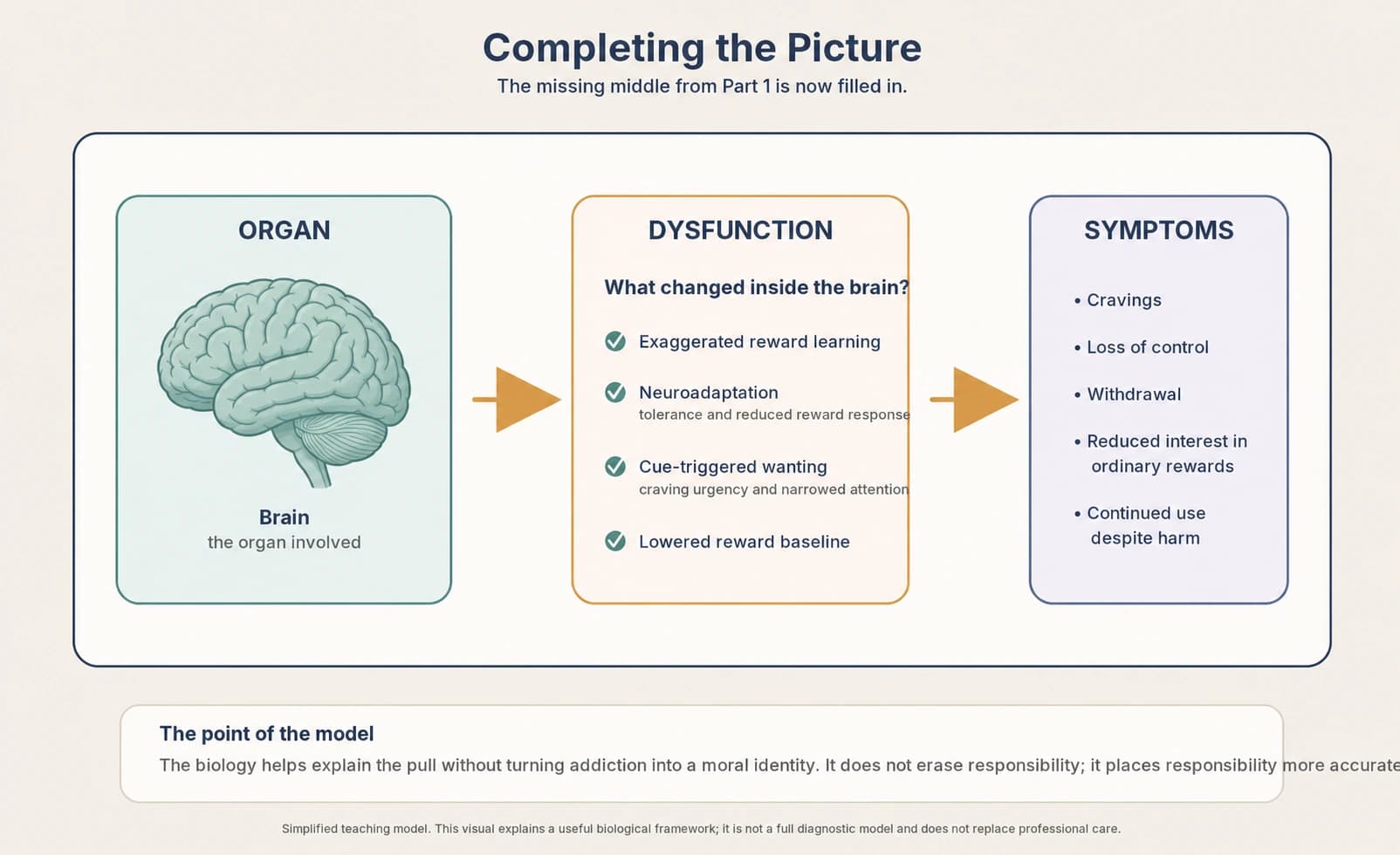
The completed model fills in the missing middle: addiction involves exaggerated reward learning, neuroadaptation, a lowered baseline, and cue-triggered wanting.
This is a simplified educational model, not a complete clinical explanation of every form of addiction.
That is the whole picture. Addiction is not simply a person making bad choices for no reason. There is a great deal going on underneath.
The line between two things
Here's where understanding the biology changes something real.
It lets you separate two things that shame usually glues together.
The first is what happened to your brain — the hijacking, the rebalancing, the alarm. You didn't choose those. They're what any human brain does when it meets these substances. Nobody sits down with their first drink or their first pill thinking, I hope this is the one that takes my life apart. The biology unfolded the way biology does. That part is not a moral failing, and it was never your fault.
The second is what you do from here — the choices ahead, the narrow road, the work of repairing what was hurt. That part is yours. Not as a punishment, but as something real you get to take hold of.
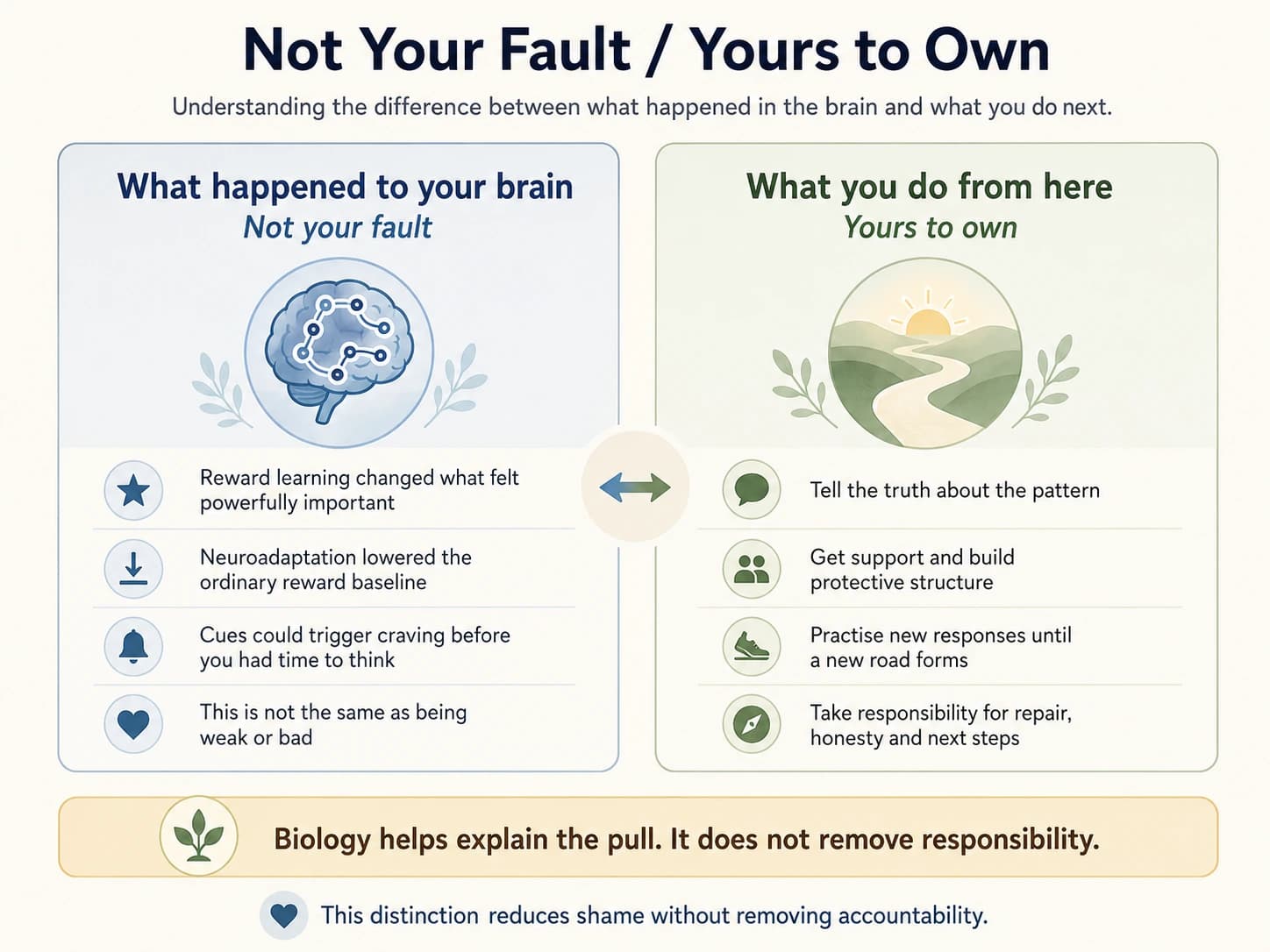
Biology helps explain the pull. It does not remove responsibility. This distinction reduces shame without removing accountability.
Understanding the science doesn't erase responsibility. It puts it in the right place.
Guilt can stay. Shame can go.
There's a difference between two feelings that get tangled together, and it matters enormously in recovery.
Guilt says, I did something I regret. It looks at a specific action, and it can actually help — it points toward repair, toward doing better. Guilt can travel with you and still let you move.
Shame says something different. It says, I am something bad. It's not about an action; it's a verdict on the whole person. And shame doesn't motivate recovery — it corrodes it. It's heavy, it's isolating, and more often than not, it drives people straight back toward the highway.
Here's the quiet power of everything you've just read: it gives you permission to set the shame down without letting go of the accountability. You can hold I'm responsible for my next step in one hand and let go of I'm a broken person who did this because something is wrong with me in the other. The biology says the second one was never true.
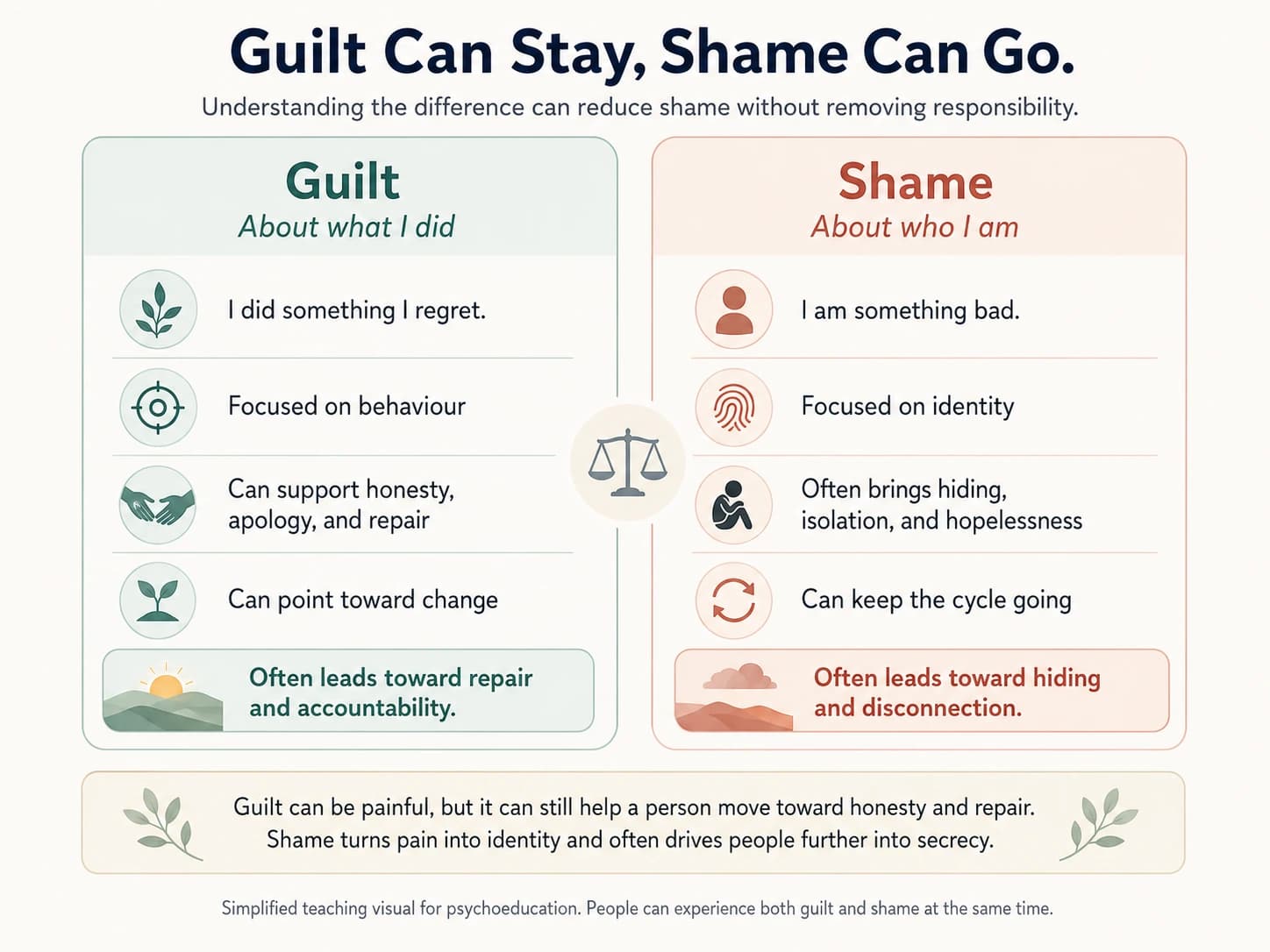
Guilt can point toward repair. Shame turns pain into identity. Recovery needs accountability without the weight of a false identity.
Where this leaves you
If you've been beating yourself up for the changes that happened in your brain — for not being able to willpower your way out of a survival alarm the size of a baseball field — this is the part where you're allowed to stop.
Not because none of it matters. Because it was never the failure you thought it was.
Your brain built one road under extraordinary pressure. It can build another. That road starts narrow and rough, and it widens with every honest step you take down it. You don't have to walk it perfectly, and you don't have to walk it alone.

The old road does not vanish. The new road becomes stronger through repeated use.
That's what your brain was doing. And that's what you get to do next.
Thank you for reading this series. This content is educational and isn't a substitute for professional care. If any of it resonated with your own experience, that's worth paying attention to — and reaching out to a professional or someone you trust can be a meaningful next step. It doesn't have to be a big one.