How to tell whether your thinking is helping you understand — or keeping you stuck
After something difficult happens, the mind often wants to go back over it.
You may replay a conversation, examine what you did, wonder what another person meant, or try to understand why you reacted the way you did. Sometimes this process helps. You see something more clearly, recognise what you needed, or decide what you want to do differently.
At other times, the thinking keeps circling.
The same questions return without producing a useful answer:
- Why did I do that?
- What is wrong with me?
- Why can't I get over this?
- What if it happens again?
- How could they have treated me like that?
- Why didn't I see it sooner?
It can feel as though you are working on the problem. But after twenty minutes — or two hours — you may be no clearer about what happened or what to do next. You may simply feel more ashamed, angry, anxious, or exhausted.
This is one of the important differences between reflection and rumination.
Both involve thinking about an experience. But they do not always take you to the same place.
If you want a practical example of how this distinction applies to one hard day, What Can You Learn From a Difficult Day? walks through the same method step by step.
Reflection helps you learn from experience
Reflection is the process of looking back at an experience with enough curiosity and distance to learn from it.
It may help you understand:
- what happened;
- what you were thinking and feeling;
- what mattered to you;
- what made the situation harder;
- what helped;
- what you needed;
- what you might repeat or change.
Healthy reflection does not always produce a perfect explanation. Sometimes it simply gives you a clearer question, a more balanced view, or one reasonable next step.
Reflection usually has some movement in it. Your thinking may move from:
"That went badly."
to:
"I was already overwhelmed before the conversation began."
and then to:
"Next time, I may need to pause before trying to resolve something important."
The experience has not disappeared, but you have gained information you can use.
Rumination keeps returning to the distress
Rumination is repetitive thinking that stays focused on distress, its possible causes, and what it may mean about you or your future.
Researchers often use the broader term repetitive negative thinking to describe thinking that is repetitive, difficult to disengage from, negatively focused, and present across several forms of emotional difficulty, including depression and anxiety (Ehring & Watkins, 2008; Watkins, 2008).
Rumination may sound like:
"Why am I always like this?"
"I should have known better."
"Everyone probably thinks I am a failure."
"I need to understand exactly why this happened before I can move on."
"What if this proves that nothing is changing?"
Rumination can feel like an attempt to solve a problem, but it often interferes with effective problem-solving and action (Nolen-Hoeksema, Wisco, & Lyubomirsky, 2008; Watkins & Roberts, 2020). One reason may be that it stays broad and abstract — focused on questions such as "Why am I like this?" — rather than becoming specific enough to identify what happened and what could be tried next.
The difference is not simply that reflection feels good and rumination feels bad. Reflection can be uncomfortable. You may recognise something painful, take responsibility, or accept that a situation needs to change.
The more useful question is:
Is this thinking helping me see more clearly, or am I repeatedly arriving at the same painful conclusion?
Reflection and rumination can begin in the same place
Imagine that you spoke harshly to someone you care about.
You might begin by asking:
"Why did I react that way?"
That question could lead toward reflection:
"I felt criticised, and I became defensive. I had also slept poorly and had been holding in frustration all day. That does not excuse how I spoke, but it helps me understand the build-up. I need to apologise, and next time I want to ask for a pause before I respond."
Or it could lead toward rumination:
"Why do I always ruin things? I should be better than this. Maybe I am just a bad partner. They are probably going to leave. I always do this."
The event is the same. Even the opening question is the same.
What changes is the direction and quality of the thinking.
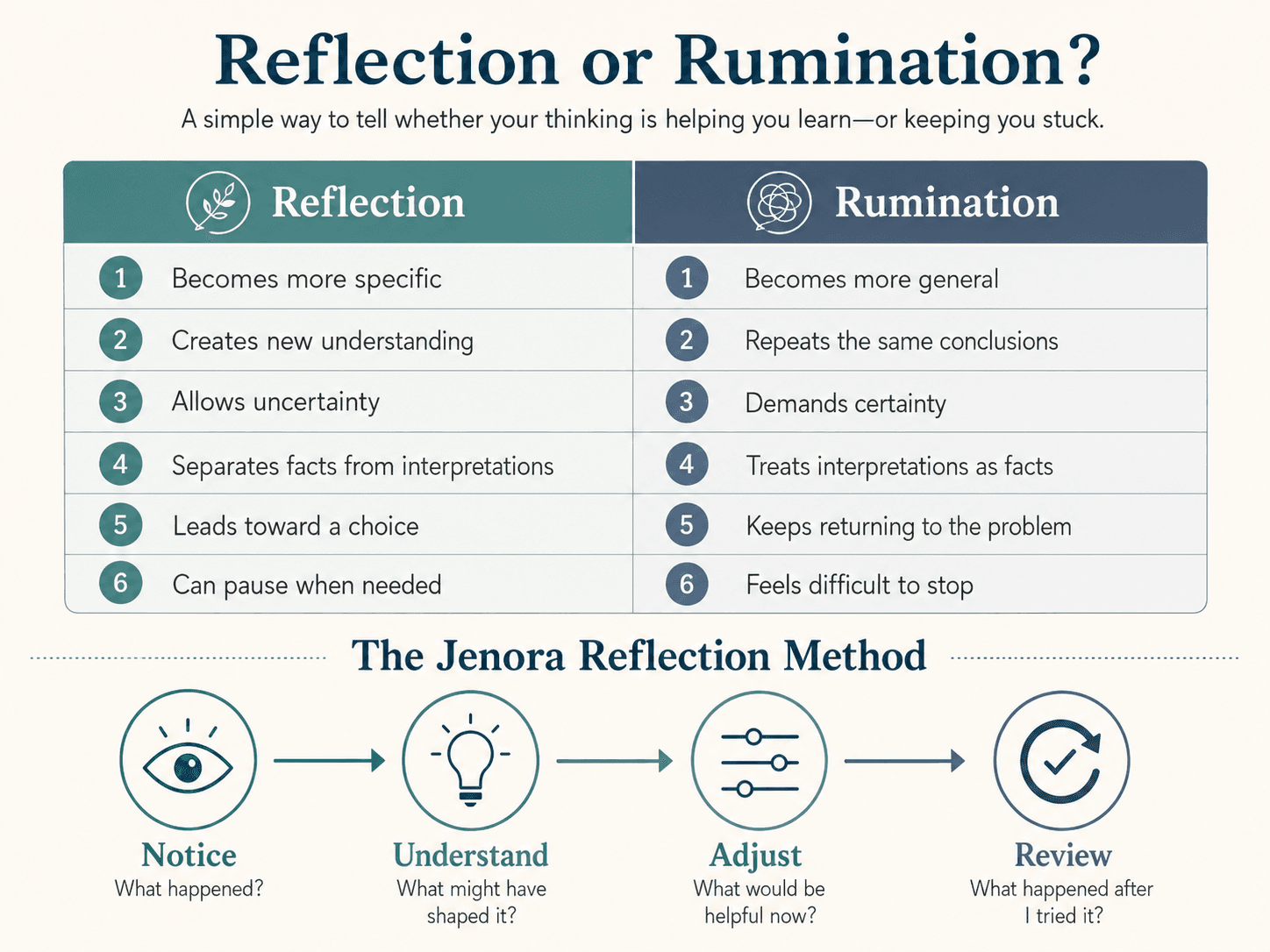
Reflection becomes more specific, balanced, and connected to choice.
Rumination becomes more repetitive, global, and condemning.
Signs that reflection may have become rumination
You may be moving into rumination when:
- you keep asking the same question without gaining new information;
- your thoughts become increasingly broad, such as "I always fail" or "nothing ever changes";
- you focus more on what the experience says about you as a person than on what actually happened;
- you mentally replay the event but do not identify any useful next step;
- you search for complete certainty that may not be available;
- you imagine increasingly negative consequences;
- your body becomes more tense or agitated as you continue;
- you feel compelled to keep thinking even though it is no longer helping;
- you become less able to sleep, work, connect, or attend to the present;
- you finish the process feeling more trapped rather than more informed.
No single sign proves that you are ruminating. Difficult reflection can take time. The important question is whether the process is gradually creating understanding, flexibility, or direction.
A quick visual guide
If you want a simple way to compare the two modes side by side, the chart below shows the difference between reflection and rumination, along with Jenora's four-step reflection method.
Rumination often asks "why?" without enough structure
"Why?" can be a useful question. But when you are distressed, it can also become too broad.
Questions such as:
- Why am I like this?
- Why does this always happen?
- Why can't I cope?
- Why did they do this to me?
may not have one clear answer. They can invite the mind to produce theories, accusations, and worst-case conclusions rather than workable information. Research comparing different modes of self-focus suggests that abstract, evaluative processing of this kind impairs problem-solving, while more concrete processing — attending to the specific details and sequence of what happened — supports it (Watkins & Moulds, 2005).
More specific questions are often easier to reflect on.
Instead of:
"Why did I lose control?"
Try:
"What was happening before I reacted?"
Instead of:
"Why am I so weak?"
Try:
"What was I carrying at that moment, and what did I need?"
Instead of:
"Why do I always make the same mistake?"
Try:
"What part of this pattern have I noticed before?"
Instead of:
"Why can't I stop thinking about it?"
Try:
"What does my mind seem to be trying to resolve or protect me from?"
This does not mean that every question will produce an answer. It gives the mind somewhere more concrete to begin.
The Jenora reflection method
Jenora uses a simple four-part process:
Notice → Understand → Adjust → Review
The purpose is not to analyse every detail. It is to help you move from experience toward learning without becoming trapped in self-criticism.
1. Notice
What happened?
Begin with observation rather than judgement.
You might ask:
- What was the situation?
- What was said or done?
- What did I notice in my body?
- What thoughts and feelings were present?
- What did I do?
- What happened next?
Try to separate what you observed from the meaning you later attached to it.
For example:
"My friend did not reply to my message for two days."
Interpretation: "They do not care about me."
The interpretation may or may not be accurate. Reflection begins by noticing the difference.
2. Understand
What might have shaped the experience?
This is where you become curious rather than prosecuting yourself.
You might ask:
- What mattered to me in that moment?
- What felt threatened, disappointed, or unmet?
- What made the situation more difficult?
- Was I tired, hungry, lonely, stressed, frightened, or overwhelmed?
- What assumptions was I making?
- What helped, even slightly?
- Have I noticed anything similar before?
- What other explanation might be possible?
- Is there something I still do not know?
The word might is important.
You are exploring possibilities, not declaring a final diagnosis of yourself, another person, or the situation.
You may conclude:
"I think I reacted strongly because I believed I was being dismissed."
That is different from:
"I know they were deliberately trying to humiliate me."
Reflection leaves some room for uncertainty.
3. Adjust
What would be helpful now?
Reflection becomes useful when it informs a choice.
That choice might be:
- repeating something that helped;
- changing one part of your response;
- making an apology;
- setting a boundary;
- asking for clarification;
- seeking support;
- allowing yourself to rest;
- practising a coping skill;
- observing the pattern for longer;
- accepting that you do not yet have enough information.
Try to choose one manageable adjustment rather than redesigning your entire life after one difficult event.
For example:
"The next time I notice myself becoming defensive, I will ask for ten minutes before continuing the conversation."
Or:
"I am not ready to decide what this relationship means. I will speak to someone I trust before acting."
4. Review
What happened after I tried something different?
Without review, it is easy to assume that an adjustment either "worked" or "failed."
Instead, you can ask:
- Did it help?
- Did it help only under certain conditions?
- Did it make no noticeable difference?
- Did something unexpected happen?
- What did I learn?
- What should I keep, change, or stop?
- Do I need more support?
An adjustment is not a test of your worth. It is an experiment.
Sometimes it will help. Sometimes it will show you that the situation is more complicated. Both outcomes provide information.
A quick check: Is this reflection helping?
When you are unsure whether you are reflecting or ruminating, pause and ask:
Am I discovering anything new?
You do not need a major insight, but is your understanding becoming more specific or balanced?
Am I staying with facts and possibilities?
Or am I turning the experience into a sweeping judgement about myself, other people, or the future?
Is there a decision, action, or question emerging?
Reflection often leads toward something, even if that something is simply:
"I need to stop for tonight and return to this when I am calmer."
Is my thinking becoming more flexible?
Can you consider more than one explanation, or does one painful conclusion feel completely certain?
What is this doing to my body?
If your thoughts are increasing panic, agitation, shame, or exhaustion, you may need regulation before more analysis.
Sometimes the healthiest response is to stop thinking for now
Not every experience needs to be processed immediately.
When you are highly activated, exhausted, intoxicated, in withdrawal, or overwhelmed by traumatic material, continued analysis may not produce clarity. It may intensify distress.
You may need to begin with:
- slow breathing;
- grounding through your senses;
- food, water, rest, or movement;
- a safe environment;
- contact with someone supportive;
- a calming or absorbing activity;
- returning to the reflection later.
Mindfulness-based approaches have shown benefits in reducing ruminative thinking for some people, particularly in the context of depression, although no single strategy works for everyone (Mao et al., 2022).
Stopping is not avoidance simply because you have not resolved the issue.
You can say:
"This matters, but I am not in the right state to think about it usefully."
That is a reflective decision.
Reflection does not mean excusing yourself
A curious and non-judgemental approach does not remove responsibility.
You can understand why you behaved in a certain way and still recognise that the behaviour caused harm.
You can say:
"I was frightened and overwhelmed, and I should not have spoken to them that way."
Both parts can be true.
Shame tends to turn behaviour into identity:
"I did something harmful, therefore I am irredeemably harmful."
Reflection separates the person from the behaviour enough to make responsibility and change possible:
"I do not like how I acted. I need to repair what I can and practise a different response."
Compassion is not the absence of accountability. It is a way of facing reality without destroying the person who needs to respond to it.
Reflection does not require a positive conclusion
Sometimes reflection reveals:
- a relationship may not be safe;
- a loss cannot be repaired;
- a choice had serious consequences;
- someone may never provide the explanation you want;
- you need more support than you currently have;
- the same pattern is still happening;
- you do not yet know what to do.
Reflection is not forced optimism.
Its purpose is to help you relate to reality more clearly and respond with greater awareness.
Sometimes the most honest conclusion is:
"This hurts, I do not fully understand it, and I need support while I decide what comes next."
When reflection may need professional support
Some experiences are difficult to explore alone, particularly when they involve:
- trauma;
- abuse or coercive control;
- self-harm or suicidal thoughts;
- severe shame;
- intrusive memories;
- dissociation;
- addiction or relapse;
- intense grief;
- repeated panic;
- experiences that leave you feeling unsafe or unable to function.
You do not have to push through distress to prove that you are willing to reflect.
A therapist or other qualified professional can help you slow the process down, remain grounded, examine interpretations safely, and decide what support is appropriate.
If reflection begins to make you feel unsafe or creates an urge to harm yourself or someone else, stop the exercise and seek immediate support through local emergency services, a crisis service, or a trusted professional.
A different question to carry forward
The mind often believes that if it thinks long enough, it will eventually find certainty.
Sometimes it does find insight.
Sometimes it simply wears a deeper path through the same painful conclusion.
When you notice that happening, you might ask:
Is there anything more for me to understand right now — or is there something I need to do, feel, accept, or ask for instead?
Reflection helps experience become information.
Rumination keeps experience alive without necessarily helping you respond to it.
You do not need to prevent every repetitive thought. You only need to become better at noticing when your thinking has stopped serving you — and give yourself permission to choose a different direction.
References
Ehring, T., & Watkins, E. R. (2008). Repetitive negative thinking as a transdiagnostic process. International Journal of Cognitive Therapy, 1(3), 192–205.
Mao, L., Li, P., Wu, Y., Luo, L., & Hu, M. (2023). The effectiveness of mindfulness-based interventions for ruminative thinking: A systematic review and meta-analysis of randomized controlled trials. Journal of Affective Disorders.
Nolen-Hoeksema, S., Wisco, B. E., & Lyubomirsky, S. (2008). Rethinking rumination. Perspectives on Psychological Science, 3(5), 400–424.
Watkins, E. R. (2008). Constructive and unconstructive repetitive thought. Psychological Bulletin, 134(2), 163–206.
Watkins, E. R., & Moulds, M. (2005). Distinct modes of ruminative self-focus: Impact of abstract versus concrete rumination on problem solving in depression. Emotion, 5(3), 319–328.
Watkins, E. R., & Roberts, H. (2020). Reflecting on rumination: Consequences, causes, mechanisms and treatment of rumination. Behaviour Research and Therapy, 127, Article 103573.