
How to reflect on what happened without turning one hard day into a judgement about yourself
A difficult day can leave more behind than tiredness.
You may replay what happened on the drive home, while lying in bed, or as soon as you wake the next morning. You may focus on something you said, a task you did not complete, a craving you experienced, an argument, a mistake, or the moment when the day seemed to get away from you.
Sometimes the mind goes further.
A difficult day becomes evidence:
"I am back where I started."
"Nothing is changing."
"I always ruin things."
"I should be able to handle this by now."
"This proves I am not getting better."
This is where reflection can quietly turn into judgement.
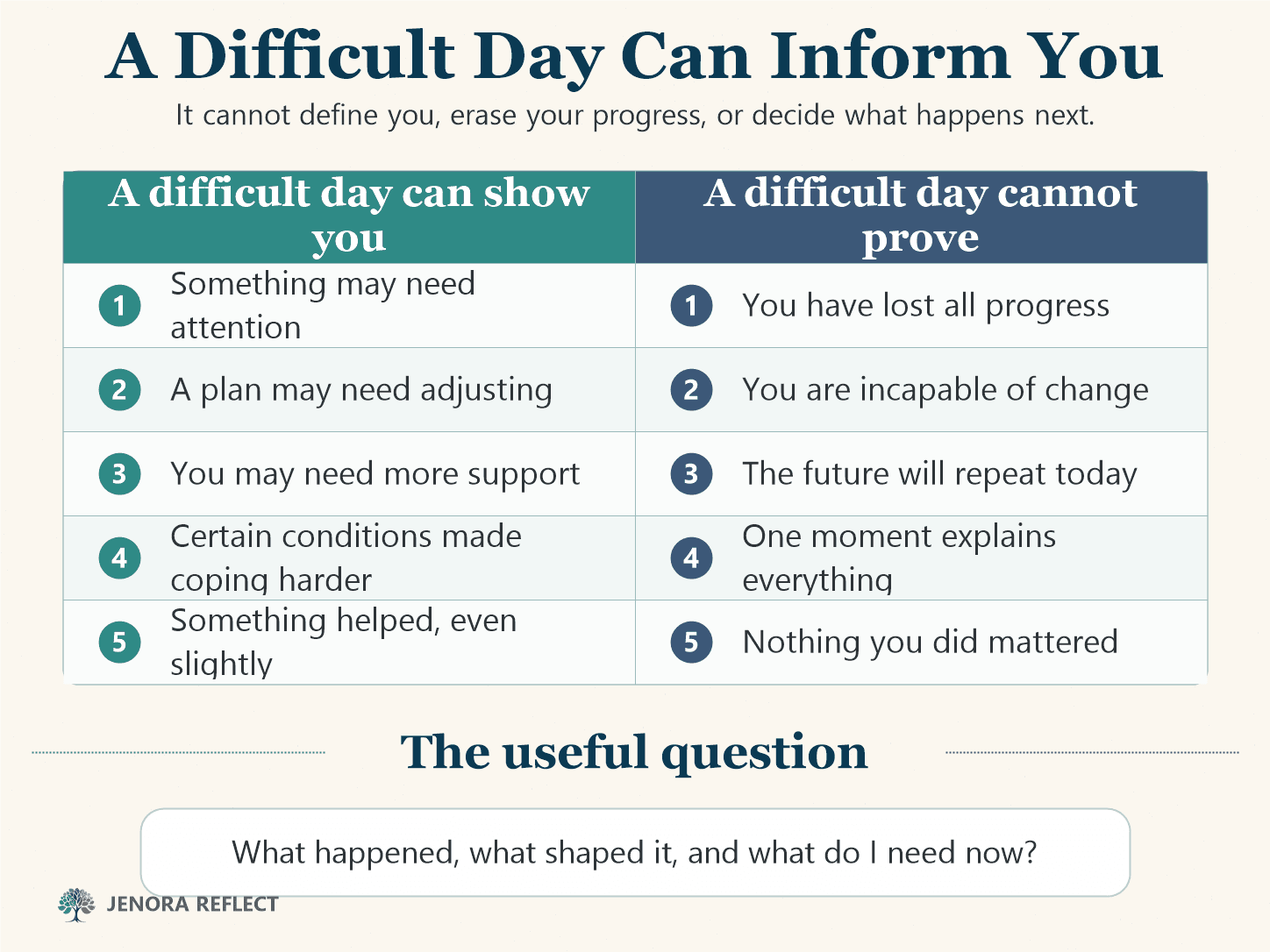
A difficult day may contain useful information. It may show you that something needs attention, that a plan was unrealistic, that you need more support, or that a familiar pattern is beginning to return.
But a difficult day is not a complete account of who you are.
It is one period of experience — not a verdict on your character, progress, or future.
A difficult day often leaves us with two stories
The first story is what happened.
Perhaps:
- you slept badly and missed breakfast;
- work became overwhelming;
- someone criticised you;
- you withdrew instead of asking for help;
- you drank, used, acted impulsively, or returned to an old coping behaviour;
- you became irritable with someone you care about;
- you spent most of the day avoiding what needed to be done;
- you felt flat, anxious, angry, ashamed, or emotionally exhausted.
The second story is what you decide the day means.
Perhaps:
"I am weak." "I cannot trust myself." "I am failing." "Other people cope better than I do." "I will never change."
The first story may need honesty.
The second story needs examination.
Reflection begins by separating the experience from the meaning you immediately attach to it.
Start with the day, not the judgement
After a difficult experience, the mind often moves quickly from facts to conclusions.
For example:
"I stayed in bed until midday and missed an appointment."
The judgement: "I am lazy and incapable of managing my life."
Or:
What happened: "I had a strong craving and contacted someone connected to my past use."
The judgement: "My recovery is falling apart."
The judgement may feel true because it arrives with strong emotion. But emotional certainty is not the same as accuracy.
A more useful starting point is:
What happened, as specifically as I can describe it?
Try to use language that could have been observed.
Instead of:
"The whole day was a disaster."
Try:
"I slept for four hours, arrived late to work, avoided two phone calls, argued with my partner, and did not complete the activity I had planned."
This does not minimise the day. It makes it clearer.
Specific descriptions are usually more workable than global conclusions. As we explored in Reflection or Rumination?, abstract, general thinking tends to interfere with problem-solving, while concrete descriptions make it easier to see what actually happened and what might be changed.
Look at the build-up, not only the final moment
A difficult day rarely begins at the moment when something goes wrong.
There is often a build-up.
You may have been:
- sleeping poorly for several nights;
- carrying stress from work or money worries;
- avoiding an important conversation;
- eating irregularly;
- spending more time alone;
- skipping routines that normally help;
- feeling rejected or criticised;
- trying to meet too many expectations while pretending you were fine.
This does not excuse harmful behaviour.
It gives the behaviour context.
Consider the difference between these two statements:
"I lost control for no reason."
and:
"I had been sleeping badly, had not eaten, felt criticised, and had been holding in frustration all day. When the conversation began, I reacted more strongly than I expected."
The second version is not softer because it removes responsibility. It is more useful because it identifies conditions that may matter.
Reflection asks:
What was I carrying before the difficult moment happened?
That question often produces more information than:
"Why am I like this?"
Notice what was happening inside you
A difficult day is not only a sequence of events. It also includes what was happening internally.
You might ask:
- What emotions were present?
- What did I notice in my body?
- What thoughts were repeating?
- What felt threatened?
- What was I trying to avoid?
- What did I need but not express?
Sometimes the most visible emotion is not the only one.
Anger may be covering hurt.
Avoidance may be protecting against fear of failure.
Defensiveness may appear when someone feels ashamed.
A craving may appear alongside loneliness, exhaustion, resentment, or the wish to escape.
Reflection does not require you to find one hidden "real" emotion. Human experience is often mixed.
A more honest conclusion may be:
"I felt criticised, embarrassed, tired, and afraid that I was disappointing someone."
That is usually more informative than reducing the experience to:
"I was angry."
Be honest about your response
Reflection should not become a way of explaining everything away.
Perhaps you were exhausted and still spoke cruelly.
Perhaps you felt rejected and still crossed a boundary.
Perhaps you were overwhelmed and still lied, avoided responsibility, or returned to behaviour that put you at risk.
Context matters, but impact matters too.
You can say:
"I understand more clearly why I reacted that way, and I am still responsible for what I did."
Both parts can be true.
Understanding the build-up may help prevent repetition. Accountability helps you respond to the harm.
You might ask:
- What did I do, and what effect did it have?
- Is there anything I need to repair?
- Do I owe someone an apology?
- Is there something I need to disclose honestly?
- Do I need help to prevent this happening again?
Shame tends to turn behaviour into identity:
"I did something harmful, therefore I am a harmful person."
Reflection separates the action from the whole person:
"I acted in a way I do not want to repeat. I need to take responsibility and choose a different response."
That distinction is not permission to avoid consequences. It is what makes responsible change possible.
Ask what made the day harder
Some factors may have been within your control. Others may not have been.
Possibilities include:
- too many demands or unclear expectations;
- disrupted sleep, illness, pain, or not eating;
- an unsafe or hostile environment;
- lack of support or isolation;
- conflict, grief, or trauma reminders;
- access to alcohol, drugs, gambling, or other high-risk behaviours;
- a change in medication or health;
- trying to conceal distress.
The purpose is not to create a perfect causal explanation.
It is to notice what may have contributed.
Use language such as:
"This may have made the day harder."
That is more accurate than:
"This is definitely why it happened."
A single day rarely proves a pattern. It may simply give you something to observe.
Ask what helped — even slightly
When people reflect on a difficult day, they often focus entirely on what went wrong.
That can make the day appear more complete and hopeless than it actually was.
Something may have helped, even if it did not solve everything.
Perhaps:
- you paused before making the situation worse;
- you contacted someone;
- you left an unsafe environment;
- you attended an appointment despite wanting to cancel;
- you delayed acting on an urge;
- you told the truth, or apologised;
- you returned to your plan later in the day;
- you noticed what was happening earlier than you once would have.
These actions matter.
The question is not only:
"What went wrong?"
It is also:
"What kept the day from becoming worse?"
This helps identify protective factors — the people, choices, environments, routines, and skills that make difficult periods more manageable.
It also prevents reflection from becoming a search for failure.
Partial success still counts
A difficult day does not become a good day simply because you used one coping skill.
But progress often appears in partial forms.
Perhaps you still became distressed, but:
- the distress lasted two hours instead of the entire day;
- you noticed the warning signs sooner;
- you asked for help before reaching crisis;
- you returned to your routine the next morning;
- you did not use the coping behaviour that would once have been automatic;
- you made one values-aligned choice during a hard period.
Progress is not always the absence of difficulty.
Sometimes it is a different response to difficulty.
This matters because all-or-nothing thinking can erase meaningful change:
"I struggled, so none of my progress counts."
A more balanced reflection might be:
"I struggled today, and I also responded differently in two important ways."
Ask what you needed
One of the most useful questions after a difficult day is:
What did I need that I did not have, recognise, request, or allow?
The answer might be:
- rest, food, or movement;
- reassurance or emotional support;
- a boundary, or permission to say no;
- help with a task;
- space before responding;
- a realistic plan;
- contact with someone who understands;
- professional support.
A need is not automatically a demand that another person must meet.
It is information.
For example:
"I needed reassurance."
may lead to:
"Next time, I will ask directly rather than testing whether the other person notices."
Or:
"I needed support."
may lead to:
"I will contact my therapist, sponsor, doctor, friend, or support group rather than trying to manage this alone."
Understanding a need does not guarantee it can be met exactly as you wish. It may still help you respond more deliberately.
Do not build a new life plan after one difficult day
A hard day can create urgency.
You may decide that you need to change your entire routine, end a relationship, begin ten new habits, impose strict rules, or remove every source of risk at once.
Sometimes major change is necessary.
But decisions made in shame, panic, exhaustion, or anger may be larger than the available information supports.
Reflection usually works better when it identifies one reasonable adjustment.
For example:
"I will not discuss difficult relationship issues after midnight."
"I will contact someone if I miss two planned support activities."
"I will take ten minutes to settle before responding to criticism."
"I will move the alcohol out of the house and tell someone I am struggling."
One adjustment is easier to test than an entire personal transformation.
Applying the Jenora Reflection Method to a difficult day
The full method — Notice → Understand → Adjust → Review — is introduced in Reflection or Rumination?. Here is how it applies to a single hard day.
1. Notice — describe the day as specifically as possible
What happened? What did you notice in your body? What thoughts and emotions were present? What did you do, and what happened next?
One addition matters especially for difficult days: watch for the words always, never, completely, ruined, and failure. These words may express how the day felt, but they turn description into verdict.
2. Understand — ask what may have shaped the day
What was building up beforehand? What made the situation harder? What did you need? What helped, even slightly? Is there another possible explanation?
This stage is about curiosity, not certainty — possibilities, not a final diagnosis of yourself.
3. Adjust — choose one helpful response
An adjustment should be specific enough that you will know whether you tried it.
Instead of:
"I need to take better care of myself."
Try:
"I will eat before the afternoon meeting and take a ten-minute break afterwards."
Instead of:
"I need more support."
Try:
"I will message my counsellor tomorrow morning and tell my friend that this week has been difficult."
4. Review — check what happened after you tried it
Did it help? Did it help only under some conditions? Did it reveal that the difficulty needs more attention than a self-help strategy can provide?
Review prevents an adjustment from becoming another test you must pass. You are gathering information — and none of the possible outcomes makes the reflection a failure.
A worked example
Imagine someone planned to attend an evening recovery meeting but did not go.
By the end of the night, they were isolated, ashamed, and experiencing strong cravings.
Their first conclusion might be:
"I am not serious about recovery."
Using the reflection method, the review may look different.
Notice
"I slept badly, worked through lunch, and felt emotionally drained by 5 p.m. I went home intending to rest for twenty minutes. I lay down, avoided messages, and did not attend the meeting. Later, I began thinking about drinking."
Understand
"I was exhausted and hungry. I also felt embarrassed because I had not completed something I said I would do. Going to the meeting would have meant admitting I was struggling. Avoiding it gave short-term relief but left me more isolated. I did answer one message from a friend, which helped interrupt the craving."
Adjust
"On meeting days, I will bring food and go directly from work rather than going home first. If I decide not to attend, I will tell one person instead of disappearing."
Review
"After trying this for two weeks, I attended twice. Going directly from work helped. On the third occasion, I was too unwell to go, but I contacted someone rather than isolating."
The difficult day provided information.
It did not prove that the person was unserious, incapable, or back at the beginning.
What if you caused harm?
Some difficult days involve more than discomfort or disappointment.
Perhaps you hurt someone, broke an agreement, acted unsafely, or returned to behaviour with serious consequences.
In those situations, reflection should not stop at self-understanding.
It may need to include:
- taking responsibility and making a truthful disclosure;
- apologising without demanding forgiveness;
- repairing what can be repaired;
- accepting consequences;
- changing access to risk;
- seeking treatment or professional help;
- involving others rather than relying only on intention.
A useful reflection might be:
"I understand the conditions that contributed, but those conditions do not remove the impact. I need to take responsibility and put stronger support in place."
Self-compassion is not pretending nothing serious happened.
It is refusing to believe that self-destruction is the same as accountability.
What if the day was difficult because of someone else?
Not every difficult day is primarily about your response.
You may have experienced mistreatment, discrimination, intimidation, manipulation, abuse, coercive control, betrayal, harassment, or an unsafe workplace or relationship.
Reflection should not automatically turn into:
"What should I have done better?"
That question can place responsibility on the wrong person.
Other questions may be more appropriate:
- Was I treated safely and respectfully?
- Is this part of a repeated pattern?
- Do I feel able to disagree or say no?
- Am I being blamed for another person's behaviour?
- Do I need advice, documentation, support, or protection?
- Who can help me assess what is happening?
Sometimes the adjustment is not better emotional regulation.
It may be distance, boundaries, formal support, legal advice, medical help, or a safety plan.
If abuse or coercion may be present, seek support from a qualified professional or specialist service rather than relying only on a self-reflection exercise.
Know when reflection should wait
Reflection is not always the first task.
If you are highly distressed, panicked, intoxicated, withdrawing, dissociated, exhausted, or overwhelmed by traumatic memories, you may not be in the best state to analyse the day.
Begin with safety and regulation.
That may mean:
- moving to a safer place;
- contacting someone;
- slowing your breathing and grounding through your senses;
- eating, drinking water, or sleeping;
- following a crisis or recovery plan;
- removing access to substances or other risks;
- postponing major decisions.
You can say:
"This day matters, but I do not need to understand it while I am overwhelmed."
That is not avoidance.
It is choosing a better time to reflect.
One day is information, not a pattern
A single difficult day can be important.
But it does not automatically prove:
- that your mental health is deteriorating;
- that relapse is inevitable;
- that a relationship is doomed;
- that you have lost all progress;
- that you are returning to who you used to be.
Patterns require repeated observation and context.
You may notice:
"This is the third time I have become overwhelmed after working late and skipping dinner."
That is worth exploring.
But even then, the conclusion should remain proportionate:
"This may be a contributing pattern. I will adjust it and observe what happens."
Not:
"I have discovered the cause of all my problems."
Reflection gives you a working understanding, not total certainty.
A difficult day does not erase progress
Growth is easy to recognise when life is going well.
It is often more visible when life becomes difficult.
Perhaps the day still hurt.
Perhaps you still reacted in a way you regret.
Perhaps you did not use every skill, follow every plan, or make the choice you hoped to make.
But you may also have:
- noticed sooner;
- stopped earlier;
- told the truth;
- accepted help;
- repaired something;
- returned more quickly;
- chosen one different action.
Those things matter.
A difficult day may show you where support is still needed.
It may also show you where change has already begun.
The purpose of reflection is not to turn the day into a lesson before you are ready. It is not to force gratitude, excuse harm, or find a positive interpretation for everything.
It is to ask:
What happened? What may have shaped it? What helped? What do I need now?
Then choose one response that respects both the reality of the day and the possibility of moving forward.
One hard day is part of your experience.
It is not the whole story.