
"I know I'm overthinking it... but I can't stop."
Perhaps you've replayed a conversation dozens of times, wondering whether you said the wrong thing. Maybe you lie awake at night imagining every possible future. Perhaps your mind turns tiny decisions into exhausting debates.
You tell yourself to "just stop thinking," but your brain doesn't seem to have an off switch.
If this sounds familiar, you're not alone. Overthinking is one of the most common struggles people experience. Everyone thinks deeply sometimes, but chronic overthinking can leave you exhausted, anxious, disconnected from the present, and unable to make decisions.
The good news is that overthinking isn't a personality flaw. It's usually your brain trying—often unsuccessfully—to keep you safe.

What Is Overthinking?
Psychologists generally describe overthinking as spending excessive time analysing, worrying, or replaying thoughts without moving toward a solution. Instead of helping you solve problems, your thoughts begin circling. This often includes:
- replaying conversations
- imagining worst-case scenarios
- analysing every decision
- worrying about things that haven't happened
- questioning yourself repeatedly
- trying to predict every possible outcome
Thinking becomes less about solving problems and more about chasing certainty. Unfortunately, certainty never arrives.

Why Does the Brain Overthink?
Your brain has one primary job: keep you alive.
Long before modern life, noticing danger quickly helped humans survive. Today's threats are rarely lions or predators. Instead, your brain worries about:
- rejection
- embarrassment
- failure
- relationships
- finances
- health
- work
- the future
To your survival system, emotional pain can feel almost as threatening as physical danger. So your brain keeps scanning.
"If I think about this enough, maybe I'll prevent something bad."
The intention is protection. The result is exhaustion.
The Brain Mistakes Thinking for Solving
One of the biggest misconceptions is believing that more thinking equals better decisions. Often the opposite happens.
Imagine trying to drive through thick fog. Driving slower helps. Stopping completely doesn't. Driving backwards certainly doesn't.
Overthinking is like repeatedly reversing to check whether you've already missed the turn. You feel busy. But you aren't moving.

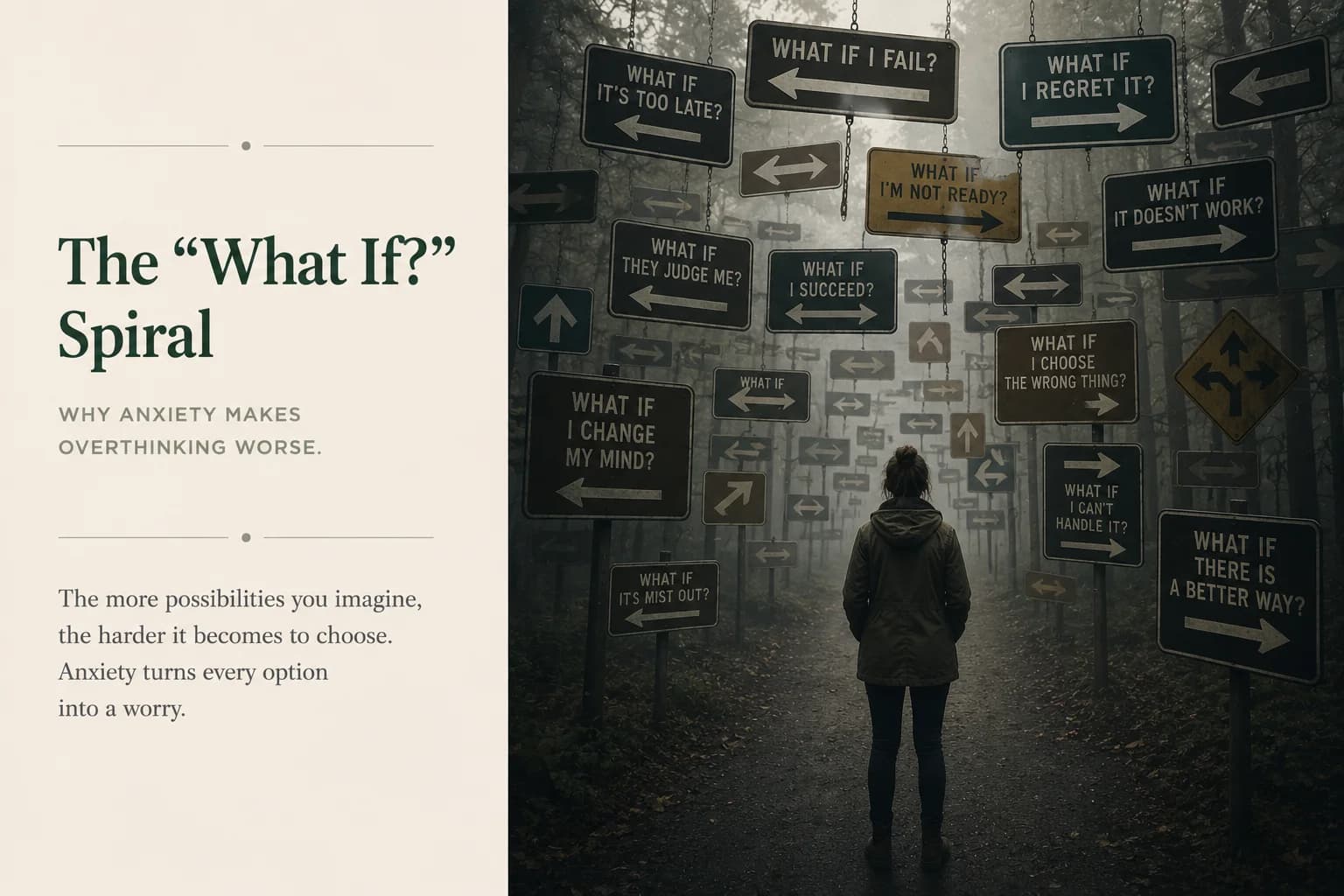
Why Anxiety Makes Overthinking Worse
When you're anxious, your brain becomes hyper-alert. The amygdala—the brain's threat detector—becomes more active, and stress hormones such as cortisol increase. Your nervous system prepares for danger.
When this happens:
- you notice threats more quickly
- uncertain situations feel unbearable
- your attention becomes stuck on possible risks
Your brain keeps asking:
"What if?" "What if they didn't like me?" "What if I fail?" "What if I forgot something important?"
The more anxious you feel, the more convincing these thoughts become.
The Perfectionism Trap
Many people who overthink aren't simply anxious—they're perfectionists.
Perfectionism isn't really about having high standards. It's often about fearing mistakes. You might think:
"I just need to make the perfect decision." "I need everyone to like me." "I can't afford to get this wrong."
The problem is that perfection doesn't exist. The search for the perfect answer often becomes the reason no decision gets made.

Why We Replay Conversations
One of the most frustrating forms of overthinking is replaying social interactions.
You leave a meeting. A dinner. A phone call. Hours later, your brain starts asking:
"Why did I say that?" "Did I sound stupid?" "They probably think I'm awkward."
In reality, other people are usually too busy thinking about themselves to remember the tiny detail you're obsessing over. This habit is called post-event processing, and it's common in people experiencing social anxiety.

Why Trauma Can Create Overthinking
If you've lived through difficult experiences, your brain learns an important lesson: the world isn't always safe.
After trauma, your nervous system often stays on high alert. It becomes easier to anticipate danger than to trust safety. Overthinking then becomes an attempt to prevent future pain.
"If I analyse everything, maybe I'll never get hurt again."
Unfortunately, no amount of thinking can eliminate uncertainty.

Depression Can Cause Overthinking Too
Many people associate overthinking with anxiety, but depression often creates a different pattern called rumination. Instead of worrying about the future, rumination repeatedly focuses on the past. People may think:
"Why am I like this?" "I always ruin everything." "If only I'd done things differently."
Rumination keeps painful emotions alive rather than helping people move forward.
Why Overthinking Feels Impossible to Stop
Here's something many people don't realise. Every time overthinking seems to prevent something bad—even by coincidence—your brain learns: "Thinking worked." This reinforces the habit.
It's similar to checking the front door lock repeatedly. Checking once feels sensible. Checking twenty times briefly reduces anxiety. Soon your brain believes checking is necessary. Overthinking works in much the same way.

The Cost of Overthinking
Although overthinking feels productive, it often steals exactly what you're trying to protect. It can affect:
- sleep
- confidence
- relationships
- productivity
- decision-making
- mood
- enjoyment of everyday life
Instead of living your life, you begin living inside your head.
What Actually Helps?
You don't need to stop thinking. You need to change your relationship with your thoughts. Research supports several helpful approaches.
Notice your thoughts
Instead of believing every thought, simply notice it: "I'm having the thought that I'll fail." This creates psychological distance.
Ask whether you're solving or spinning
A useful question is: "Is this helping me solve the problem, or am I just going around in circles?" If there's no new information, your brain is probably ruminating rather than solving.
Accept uncertainty
One of the hardest lessons is that certainty isn't possible. Healthy people don't have certainty—they learn to tolerate uncertainty. Ironically, accepting uncertainty often reduces anxiety far more than searching for perfect answers.
Return to the present
Overthinking usually lives in yesterday, tomorrow, or imaginary futures. Your body always exists here. Simple grounding exercises—such as noticing five things you can see or focusing on your breathing—can gently bring your attention back to the present moment.
Take imperfect action
Action often reduces anxiety more effectively than endless thinking. Small steps teach your brain something important: "I can cope."
What This Means for You
If you overthink everything, it doesn't mean you're weak. It doesn't mean you're broken. It doesn't even mean there's something wrong with your brain.
Your mind is trying to protect you. It's simply using a strategy that has become overused.
Recovery isn't about eliminating thoughts. It's about recognising that thoughts are not facts. You don't have to follow every thought your mind produces.
Sometimes the kindest thing you can say to yourself is:
"Maybe I don't need another answer. Maybe I just need to take the next small step."
Key Takeaways
✔ Overthinking is your brain trying to keep you safe—not a sign of weakness.
✔ Anxiety often fuels "what if" thinking, while depression commonly leads to rumination about the past.
✔ Perfectionism and trauma can make the brain seek certainty where none exists.
✔ Thoughts are mental events, not facts.
✔ Taking small, imperfect actions often quiets the mind more effectively than endless analysis.
✔ Learning to tolerate uncertainty is one of the most powerful ways to reduce overthinking.

References
American Psychiatric Association. (2022). Diagnostic and Statistical Manual of Mental Disorders (5th ed., text rev.).
Ehring, T., & Watkins, E. R. (2008). Repetitive negative thinking as a transdiagnostic process. Journal of Behavior Therapy and Experimental Psychiatry, 39(3), 192–205.
Nolen-Hoeksema, S., Wisco, B. E., & Lyubomirsky, S. (2008). Rethinking rumination. Perspectives on Psychological Science, 3(5), 400–424.
Watkins, E. R. (2016). Rumination-Focused Cognitive-Behavioral Therapy for Depression. Guilford Press.
Hayes, S. C., Strosahl, K., & Wilson, K. G. (2016). Acceptance and Commitment Therapy: The Process and Practice of Mindful Change (2nd ed.).