Introduction
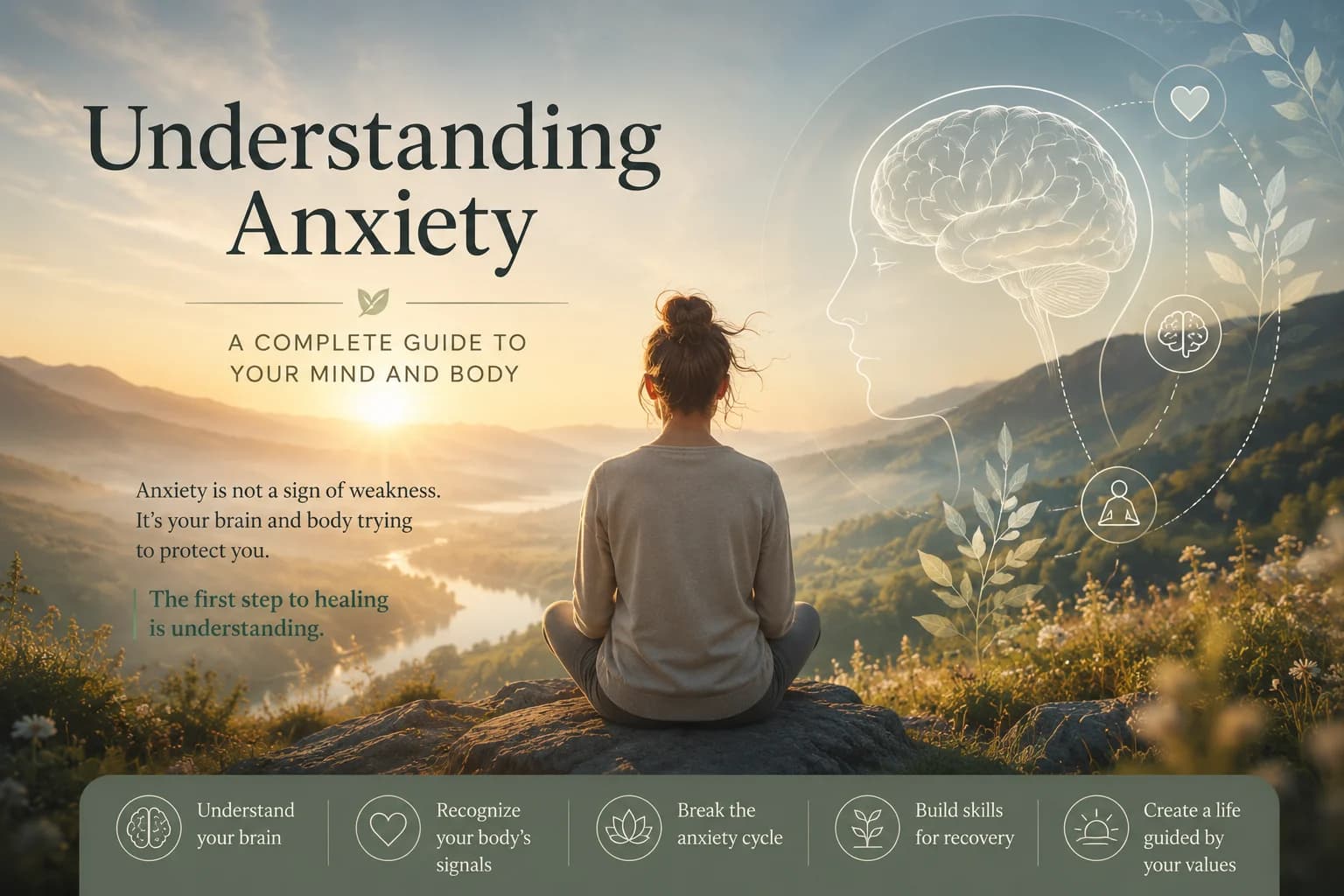
If you have picked this up because anxiety has been weighing on you lately, please know this first: you are not alone, and there is nothing wrong with you for feeling this way.
Anxiety is one of the most common human experiences in the world. It touches people of every age, background and culture. The World Health Organization estimates that hundreds of millions of people worldwide live with an anxiety disorder, making it one of the most common mental health conditions on the planet (World Health Organization [WHO], 2023).
Perhaps your heart races before a meeting. Perhaps you lie awake at night, turning tomorrow over and over in your mind. Perhaps thoughts arrive that you cannot seem to switch off, or your body has thrown up symptoms - dizziness, a tight chest, nausea - that left you wondering, quietly and with some fear, whether something was seriously wrong.
These experiences can be frightening. But in most cases, they are simply your body doing what it was built to do: responding to a perceived threat.
Here is the reassuring part. Anxiety is highly treatable. Research consistently shows that evidence-based approaches - Cognitive Behavioural Therapy (CBT), lifestyle changes, mindfulness, and, where appropriate, medication - can meaningfully reduce anxiety symptoms and improve quality of life (National Institute for Health and Care Excellence [NICE], 2020; Cuijpers et al., 2023).
Understanding how anxiety works is often the first real step towards feeling more in control of it. When we understand what our brain and body are doing, and why, they tend to become a little less frightening.
This guide will walk you through what anxiety is, why it happens, how it shows up in both mind and body, and what you can practically do about it.
What Is Anxiety?
Anxiety is a normal human emotion. In fact, it is one of the reasons our species is still here.
Long before modern medicine, homes or supermarkets existed, our ancestors survived by detecting danger quickly. Whether facing a predator, a natural disaster or unfamiliar territory, those who noticed threats early were more likely to survive and pass on their genes. Over thousands of generations, our brains evolved a finely tuned alarm system to keep us safe.
That same alarm system is still running today.
The difference is that most of us are no longer fleeing predators. Instead, our brains fire in response to deadlines, financial pressure, relationship strain, health worries or plain uncertainty about what comes next.
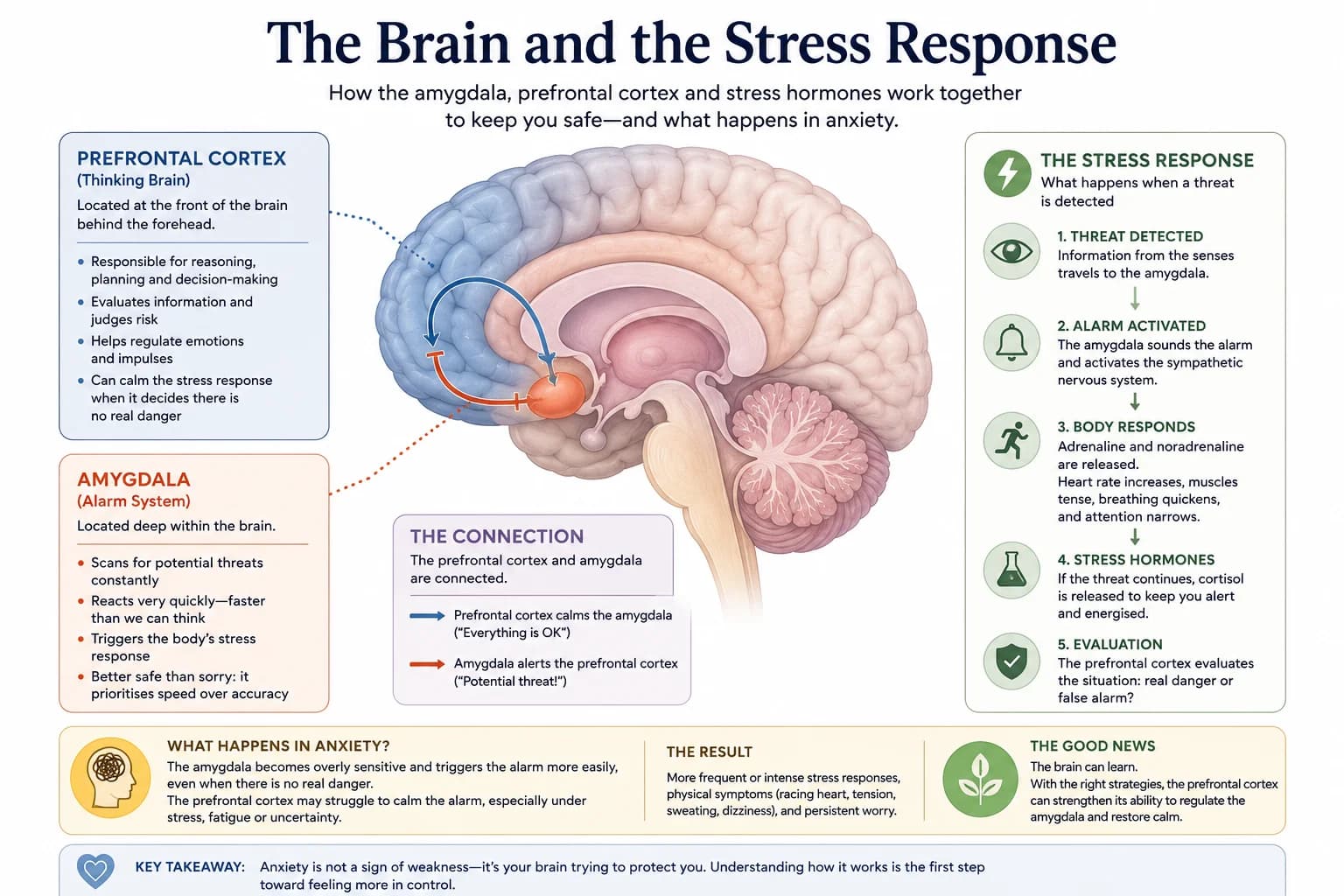
So anxiety is not a sign of weakness, and it is not a personal failing. It is your brain trying, in its own way, to keep you safe.
The trouble starts when that alarm system becomes overly sensitive, and begins reacting to situations that are uncomfortable but not actually dangerous.
Picture a smoke detector that goes off every time you make toast. Technically, it is doing its job - it has detected smoke. The problem is that it is far too easily triggered. For many people living with anxiety, the brain's alarm system behaves in much the same way.
Anxiety vs Fear
We often use "fear" and "anxiety" interchangeably in everyday speech, but psychologists draw an important distinction between the two.
Fear is an immediate response to a real, present danger. For example:
- A car suddenly swerves towards you.
- You narrowly avoid slipping on a wet floor.
- You hear someone breaking into your home.
Fear prepares your body to act right now.
Anxiety, by contrast, is anticipation of a possible future threat. For example:
- Worrying about an upcoming presentation.
- Wondering whether people will judge you.
- Believing you may have a serious illness despite medical reassurance.
- Imagining everything that could go wrong before a holiday.
Fear is rooted in what is happening now. Anxiety is rooted in what might happen.
Both are protective emotions. But anxiety often becomes the harder of the two to live with, because the imagined threats never really stop arriving.
When Does Anxiety Become a Problem?
Feeling anxious now and then is entirely normal, and it is worth saying clearly: anxiety is not always something to get rid of. A moderate amount of it can actually sharpen your performance, increasing alertness, concentration and motivation. This is why students often do better having felt some nerves before an exam, athletes before competition, and professionals before an interview - a bit of anxiety helps the brain prepare for action. This relationship is described by the Yerkes-Dodson Law, which holds that performance improves with rising arousal up to an optimal point, beyond which anxiety begins to work against us (Yerkes & Dodson, 1908).
Anxiety becomes a problem when it:
- occurs frequently or feels hard to control
- is out of proportion to the actual situation
- lingers long after the situation has passed
- leads you to avoid everyday activities
- interferes with work, relationships or daily life
- causes real, ongoing distress.
Anxiety disorders are not simply "feeling anxious." They are defined by excessive fear or worry that is persistent and has a meaningful impact on daily life (American Psychiatric Association [APA], 2022).
Why Does Anxiety Happen?
Here is something worth holding onto: your brain is not trying to make your life harder. It is trying to protect you.
A helpful way to think about anxiety is to imagine your brain running an internal security system. Like any security system, its job is to spot danger and respond quickly. The trouble is, it cannot always tell the difference between a genuine threat and a perceived one.
This means your brain can respond to things like:
- giving a presentation
- sending an important email
- attending a social event
- waiting for medical results
- financial uncertainty
in much the same way it would respond to physical danger.
Your Brain's Alarm System
Several regions of the brain work together to keep us safe.
The Amygdala
The amygdala is a small, almond-shaped structure deep in the brain, and it plays a central role in detecting potential threats. It constantly scans information from both the world around you and your own thoughts. The moment it senses something might be dangerous, it reacts almost instantly.
Importantly, the amygdala is built to prioritise speed over accuracy. From an evolutionary standpoint, it is far safer to mistake rustling bushes for a predator than to ignore a genuine one. This is part of why anxiety so often feels automatic, arriving before you have had a chance to think.
The Prefrontal Cortex
The prefrontal cortex sits behind the forehead and handles reasoning, planning, problem-solving and weighing evidence. Once the initial alarm has sounded, this part of the brain steps in to ask questions such as:
- Is there really a danger here?
- What evidence do I actually have?
- Is there another way to explain this?
- What would be the most helpful response?
When anxiety intensifies, communication between the amygdala and the prefrontal cortex can become less efficient. The emotional alarm grows louder while logical reasoning grows quieter (Arnsten, 2009).
This is part of why so many people say something like: "I know I'm probably overreacting, but I can't stop feeling anxious." That gap between knowing and feeling is not a contradiction - it is neurology.
Stress Hormones
When the brain detects danger, it activates the sympathetic nervous system. Within seconds, hormones such as adrenaline and noradrenaline prepare the body for action:
- Heart rate increases.
- Breathing quickens.
- Muscles tense.
- Blood is redirected towards large muscle groups.
- Digestion slows.
- Attention narrows.
If the situation continues, the hypothalamic-pituitary-adrenal (HPA) axis releases cortisol, helping the body stay alert for longer stretches (McEwen & Akil, 2020).
These changes are enormously useful when facing genuine danger. But when they fire again and again in response to everyday stress, they become exhausting.
Many of the physical sensations people associate with anxiety - a racing heart, sweating, trembling, dizziness - are not signs that something is wrong with your body. They are signs that your body's survival system has switched on.
Fight, Flight, Freeze or Fawn
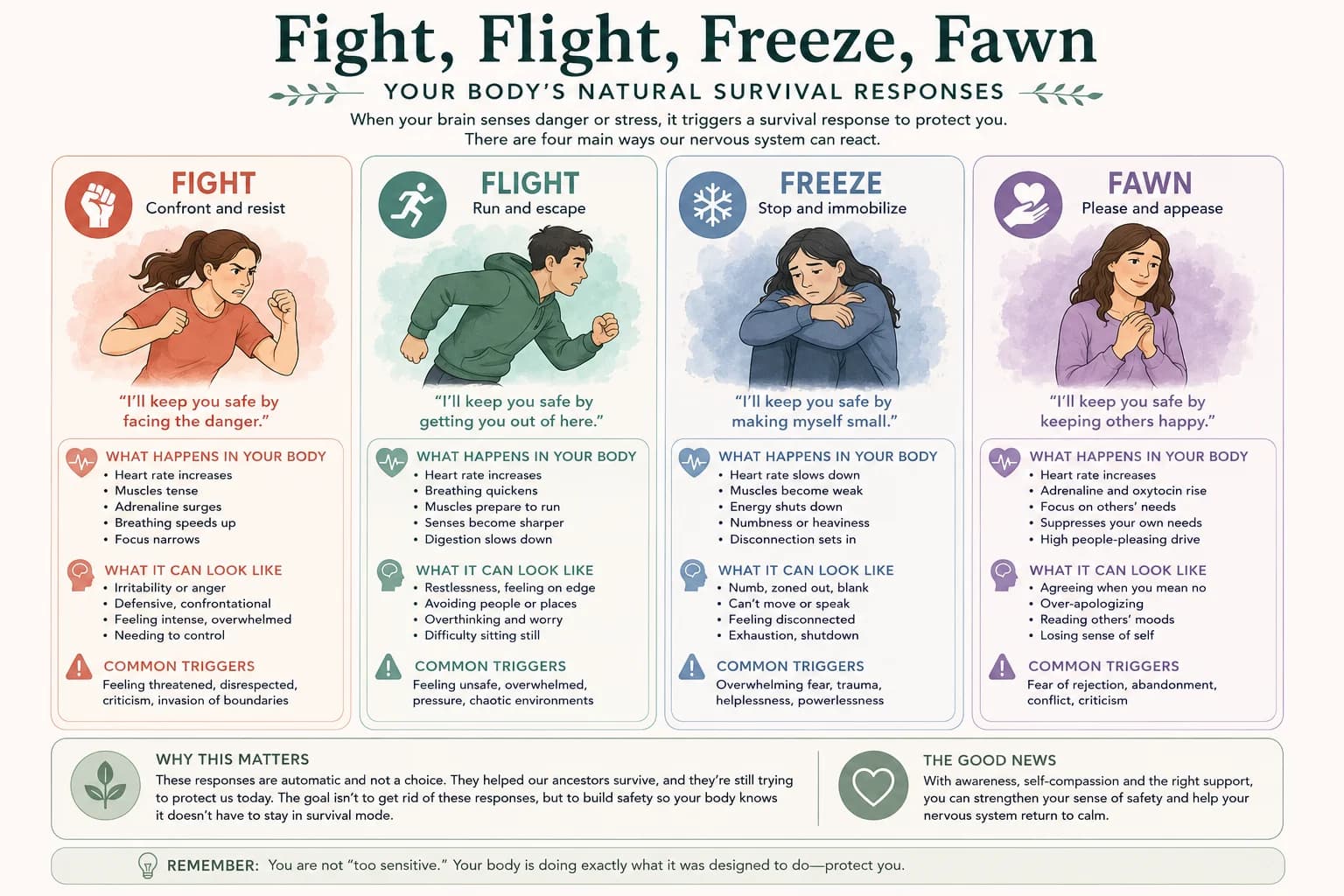
Most people have heard of "fight or flight," but the body's survival system actually has more than two settings. When your brain senses danger, it doesn't simply choose between standing your ground or running. Depending on the situation, and often without any conscious choice at all, it may also freeze, or fawn.
Fight is the urge to confront the threat directly. Your jaw clenches, your fists tighten, and you may feel a surge of irritability or anger that seems to come from nowhere. Flight is the urge to escape. Your legs feel restless, your heart races, and you feel a strong pull to leave the room, end the call, or simply get away.
Freeze is less well known, but just as common. Sometimes a threat feels too overwhelming to fight or escape, and the body's response is to become still: thoughts go blank, movement feels difficult, and you may feel strangely detached from what is happening around you. This is often described as feeling "frozen" or "stuck," and it is not a failure to respond. It is a genuine survival strategy, seen throughout the animal kingdom (Bracha, 2004).
Fawn is the newest of the four to enter everyday language. It describes a tendency to appease or please the source of a perceived threat in order to reduce conflict and stay safe - agreeing quickly, apologising unnecessarily, or prioritising someone else's comfort over your own (Walker, 2013). For many people, fawning developed as a sensible way to navigate relationships where conflict felt unsafe, and it can quietly continue long into adulthood.
None of these four responses is "wrong." They are simply different strategies your nervous system reaches for, shaped by biology, temperament and personal history. Recognising which one you tend towards can be a useful first step in understanding your own anxiety more clearly.
Anxiety Is Not Your Enemy
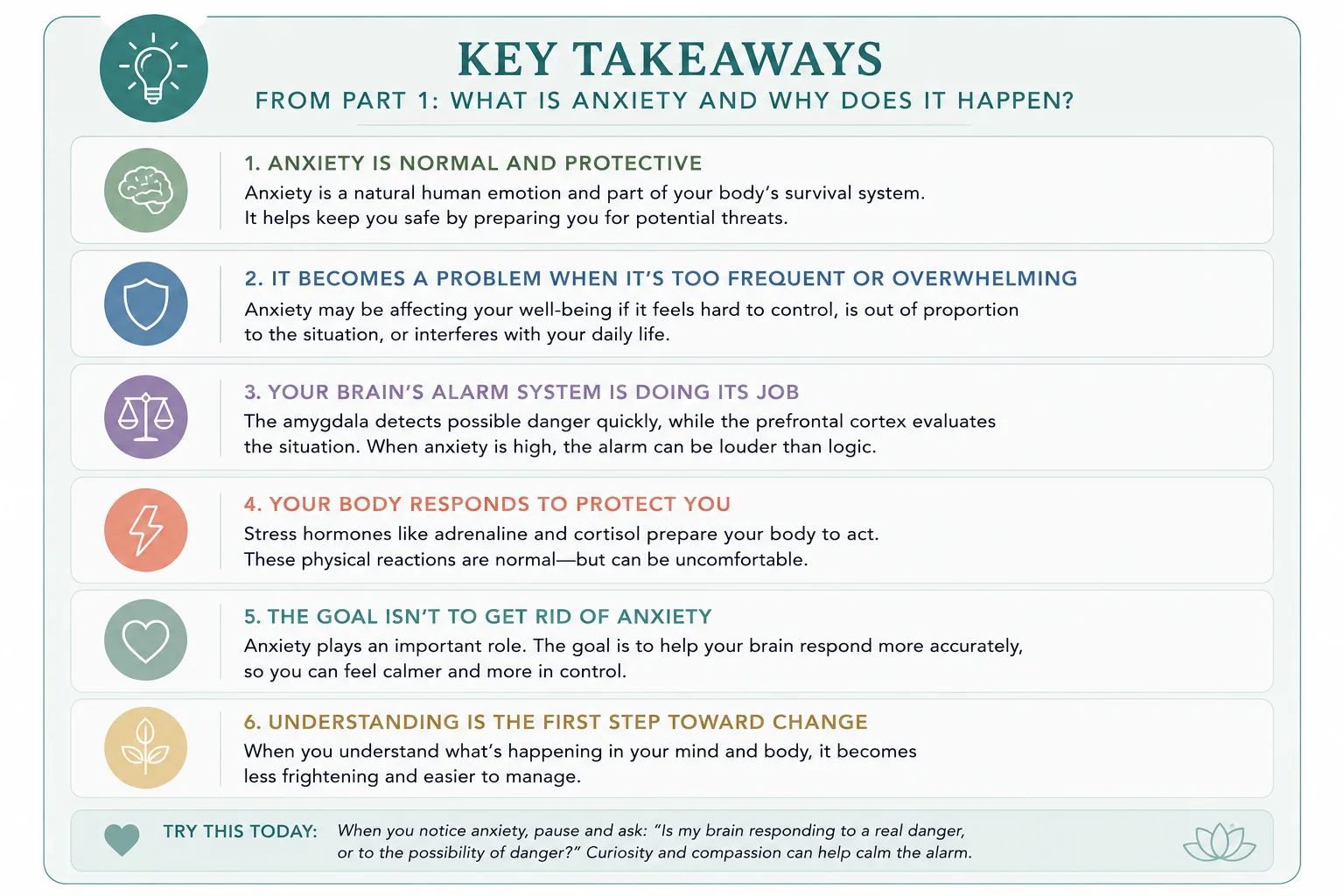
One of the biggest misconceptions about anxiety is that it is something to fight against. In reality, anxiety evolved to keep us alive. Without it, we might cross busy roads without looking, ignore warning signs of illness, take unnecessary risks, or fail to prepare for challenges that matter to us.
So the goal is not to eliminate anxiety altogether. The goal is to help your brain learn to tell the difference between real danger and false alarms.
Rather than staying trapped in a constant state of survival, we can gently teach the nervous system to respond more accurately to the world around us. This is one of the central aims of Cognitive Behavioural Therapy (CBT), which has consistently been shown to reduce anxiety by helping people identify unhelpful thinking patterns, test their fearful predictions against reality, and gradually reduce avoidance (Hofmann et al., 2012).
Try This Today
Ask yourself one simple question: "Is my brain responding to a real danger, or to the possibility of danger?"
You do not need to dismiss what you are feeling, or tell yourself to just calm down. Simply notice what your brain is trying to do for you. You might even thank it: "I know you're trying to protect me. Let's slow down and look at what's really happening."
This small shift, from fighting anxiety to understanding it, can be the first step towards changing your relationship with it.
References
American Psychiatric Association. (2022). Diagnostic and statistical manual of mental disorders (5th ed., text rev.; DSM-5-TR). American Psychiatric Association Publishing.
Arnsten, A. F. T. (2009). Stress signalling pathways that impair prefrontal cortex structure and function. Nature Reviews Neuroscience, 10(6), 410-422. https://doi.org/10.1038/nrn2648
Bracha, H. S. (2004). Freeze, flight, fight, fright, faint: Adaptationist perspectives on the acute stress response spectrum. CNS Spectrums, 9(9), 679-685.
Cuijpers, P., Miguel, C., Harrer, M., et al. (2023). Cognitive behaviour therapy for anxiety disorders: A meta-analysis of randomised controlled trials. World Psychiatry, 22(1), 105-115.
Hofmann, S. G., Asnaani, A., Vonk, I. J. J., Sawyer, A. T., & Fang, A. (2012). The efficacy of cognitive behavioural therapy: A review of meta-analyses. Cognitive Therapy and Research, 36(5), 427-440.
McEwen, B. S., & Akil, H. (2020). Revisiting the stress concept: Implications for affective disorders. The Journal of Neuroscience, 40(1), 12-21.
National Institute for Health and Care Excellence. (2020). Generalised anxiety disorder and panic disorder in adults: Management (CG113). https://www.nice.org.uk/guidance/cg113
Walker, P. (2013). Complex PTSD: From surviving to thriving. Azure Coyote Publishing.
World Health Organization. (2023). Mental disorders.