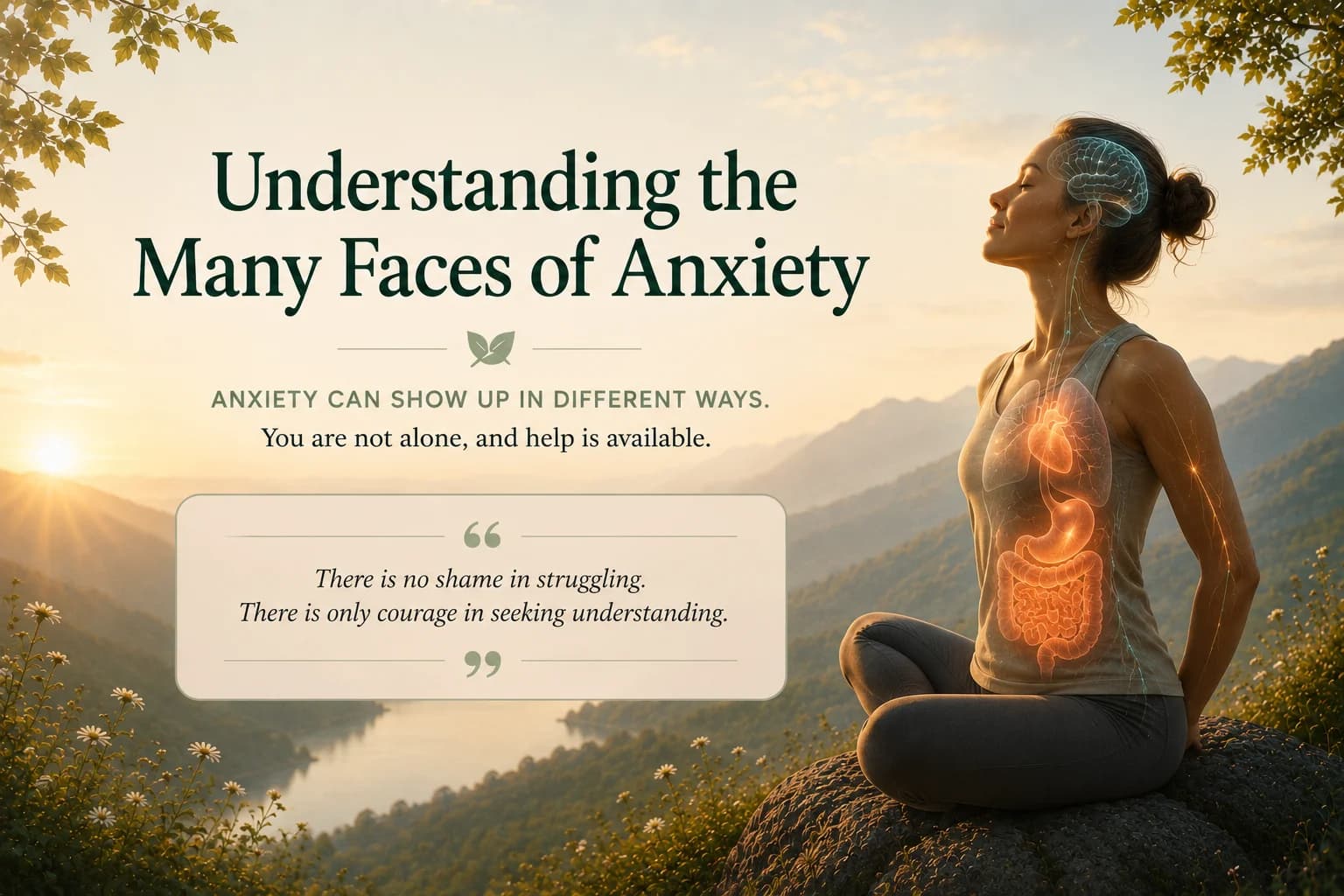
Anxiety Looks Different for Different People
Imagine asking ten people with anxiety to describe what they experience. One might say, "I worry constantly about everything." Another, "I panic out of nowhere." Someone else, "I avoid parties because everyone is judging me." Another person might say, "I keep thinking I have a serious illness."
All of these experiences involve anxiety. Yet they can feel completely different. That is because anxiety disorders are not defined by one specific symptom. Instead, they are a group of related conditions that share many underlying brain processes but differ in what the brain perceives as threatening.
Think of anxiety as one alarm system. Different anxiety disorders simply have different alarm triggers. Understanding which pattern best matches your experience can help you make sense of your symptoms, and guide you towards the most effective treatment.
Generalised Anxiety Disorder (GAD)
"What if something goes wrong?"
Generalised Anxiety Disorder, often called GAD, is characterised by excessive and persistent worry about many different areas of life. People with GAD often describe feeling as though their mind never truly switches off. Their worries may move from one topic to another --- finances, work, family, health, relationships, everyday responsibilities. As soon as one concern fades, another often appears.
Unlike ordinary worrying, GAD involves worries that feel difficult to control and that continue for months rather than days. Common symptoms include:
-
Constant worrying
-
Feeling on edge
-
Difficulty relaxing
-
Restlessness
-
Muscle tension
-
Fatigue
-
Trouble concentrating
-
Sleep difficulties
Many people with GAD already know that they worry more than others. The difficulty isn't recognising that the worries are excessive. The difficulty is feeling unable to stop.
Living With GAD
Imagine driving to work. Most people simply drive. Someone with GAD may spend the journey thinking, "What if I'm late?", "What if I forget something important?", "What if my boss wants to speak to me?", "What if I made a mistake yesterday?"
By the time they arrive, nothing has happened. Yet their body already feels exhausted, because it has spent the entire journey preparing for problems that never occurred.
Panic Disorder
"Something terrible is happening right now."
A panic attack is one of the most intense experiences the human body can produce. Without warning, people may experience a racing heart, chest pain, dizziness, trembling, sweating, nausea, shortness of breath, feelings of unreality, fear of dying, or fear of losing control.
The first panic attack often feels so overwhelming that many people believe they are having a heart attack, and understandably seek emergency medical care. After medical causes have been excluded, many people begin fearing the panic attacks themselves. Ironically, this fear of panic often increases the likelihood of future attacks --- a pattern known as the fear of fear. The body begins reacting not only to external situations but also to harmless bodily sensations. A slightly faster heartbeat after climbing stairs may suddenly trigger the thought, "It's happening again," and the panic cycle begins.
An Important Reassurance
Panic attacks are frightening. But they are not dangerous. Although they produce intense physical sensations, they are caused by the body's normal survival response operating at the wrong time. The symptoms usually reach a peak within minutes before gradually subsiding.
Knowing this does not instantly stop panic. But understanding what is happening often reduces the fear surrounding it.
Social Anxiety Disorder
"Everyone is judging me."
Most people feel nervous before speaking in front of others. That is normal. Social Anxiety Disorder goes much further. The fear is not simply public speaking --- it is the fear of being negatively evaluated. People may worry that others will notice blushing, shaking, sweating, stumbling over words, or looking nervous.
Many avoid situations such as parties, meetings, eating in public, dating, asking questions, or making phone calls. Ironically, the more someone tries to hide their anxiety, the more attention they often pay to themselves, and this increased self-focus makes the anxiety feel even stronger.
Health Anxiety
"What if it's something serious?"
Everyone notices physical sensations from time to time. People with health anxiety interpret these sensations differently. A headache becomes, "Could this be a brain tumour?" A skipped heartbeat becomes, "Maybe I have heart disease." A stomach ache becomes, "Perhaps it's cancer."
The internet has made health anxiety even more challenging --- a simple search can quickly produce dozens of frightening possibilities. Unfortunately, reassurance rarely lasts. Many people feel temporary relief after seeing a doctor, only for the anxiety to return days or weeks later.
Specific Phobias
A phobia is an intense fear of a particular object or situation. Examples include spiders, snakes, flying, heights, injections, blood, or enclosed spaces.
People generally recognise that their fear is stronger than the actual danger. Yet their nervous system reacts as though the threat is immediate. Fortunately, specific phobias often respond extremely well to gradual, exposure-based therapy.
Separation Anxiety
Although often associated with children, separation anxiety can also affect adults. People may experience significant distress when separated from loved ones, or fear that something terrible will happen while they are apart. They may repeatedly check on family members, avoid travelling alone, struggle when loved ones leave, or seek constant reassurance.
Again, these behaviours come from a very human desire to feel safe.
Agoraphobia
Many people think agoraphobia means being afraid of open spaces. In reality, it is usually a fear of situations where escape might feel difficult, or where help might not be available if anxiety or panic occurs. People may avoid shopping centres, trains, buses, cinemas, queues, or crowded places.
Over time, avoidance can become increasingly restrictive, and for some people, simply leaving the house becomes frightening. The goal of treatment is not to force someone into these situations immediately. Instead, confidence is rebuilt gradually, through repeated experiences of safety.
Can You Have More Than One Type?
Absolutely. In fact, many people experience features of several anxiety disorders at once. Someone with Generalised Anxiety Disorder may also experience panic attacks. A person with Social Anxiety may also develop Health Anxiety.
This overlap is one reason therapists focus not only on diagnoses, but on the underlying psychological processes. Whether someone worries constantly, panics unexpectedly, or avoids social situations, many of the same treatment principles still apply.
What All Anxiety Disorders Have in Common
Although the triggers differ, anxiety disorders share several important characteristics. They all involve:
-
Overestimating danger
-
Underestimating your ability to cope
-
Avoidance or safety behaviours
-
A nervous system that has become overly protective
-
Learning patterns that can be changed
This final point is perhaps the most hopeful. The brain learned these patterns, which means the brain can also learn new ones.
Diagnosis Is Not a Label --- It's a Guide
Some people feel relieved when they receive a diagnosis. Others feel frightened. It is worth remembering that a diagnosis is not an identity. It is simply a way of describing a collection of symptoms that commonly occur together.
Think of it like a map. A map does not tell you who you are. It helps you find the best route forward. The purpose of diagnosis is not to put people into boxes --- it is to help them access the treatments that research has shown to be most effective.
Hope for Recovery
One of the biggest myths about anxiety disorders is that people simply have to "live with them." While anxiety may remain a natural part of being human, anxiety disorders themselves are highly treatable. Research consistently demonstrates that therapies such as Cognitive Behavioural Therapy (CBT), Acceptance and Commitment Therapy (ACT), exposure-based interventions and, where appropriate, medication can significantly reduce symptoms and improve quality of life (Cuijpers et al., 2023; NICE, 2020).
Recovery does not necessarily mean never feeling anxious again. Recovery means understanding your anxiety well enough that it no longer controls your choices. That is a goal that millions of people around the world reach every year.
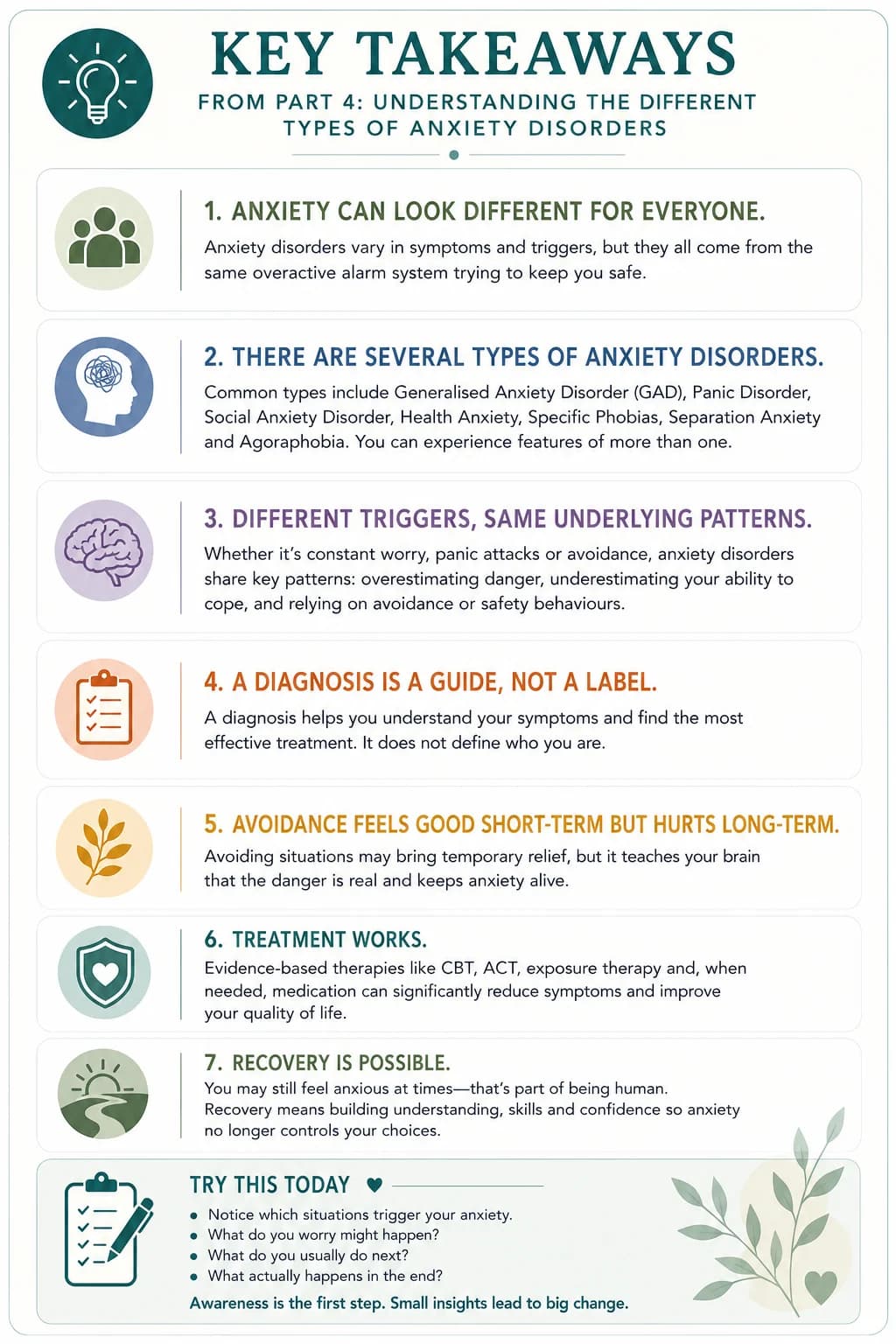
Try This Today
Instead of asking yourself, "Which anxiety disorder do I have?", try asking, "What situations make my brain believe I am unsafe?"
Notice the patterns rather than the labels. Labels can guide treatment. Patterns are what create change. You might even write down:
-
What situations trigger my anxiety?
-
What do I predict will happen?
-
What do I usually do next?
-
What actually happens?
This simple reflection can begin to reveal the unique way your own anxiety operates.
References
American Psychiatric Association. (2022). Diagnostic and statistical manual of mental disorders (5th ed., text rev.; DSM-5-TR). American Psychiatric Association Publishing.
Cuijpers, P., Miguel, C., Harrer, M., et al. (2023). Cognitive behavioural therapy for anxiety disorders: A meta-analysis of randomised controlled trials. World Psychiatry, 22(1), 105--115.
Craske, M. G., & Barlow, D. H. (2008). Mastery of your anxiety and panic (4th ed.). Oxford University Press.
National Institute for Health and Care Excellence. (2020). Generalised anxiety disorder and panic disorder in adults: Management (CG113). https://www.nice.org.uk/guidance/cg113
World Health Organization. (2023). Mental disorders. https://www.who.int/news-room/fact-sheets/detail/mental-disorders