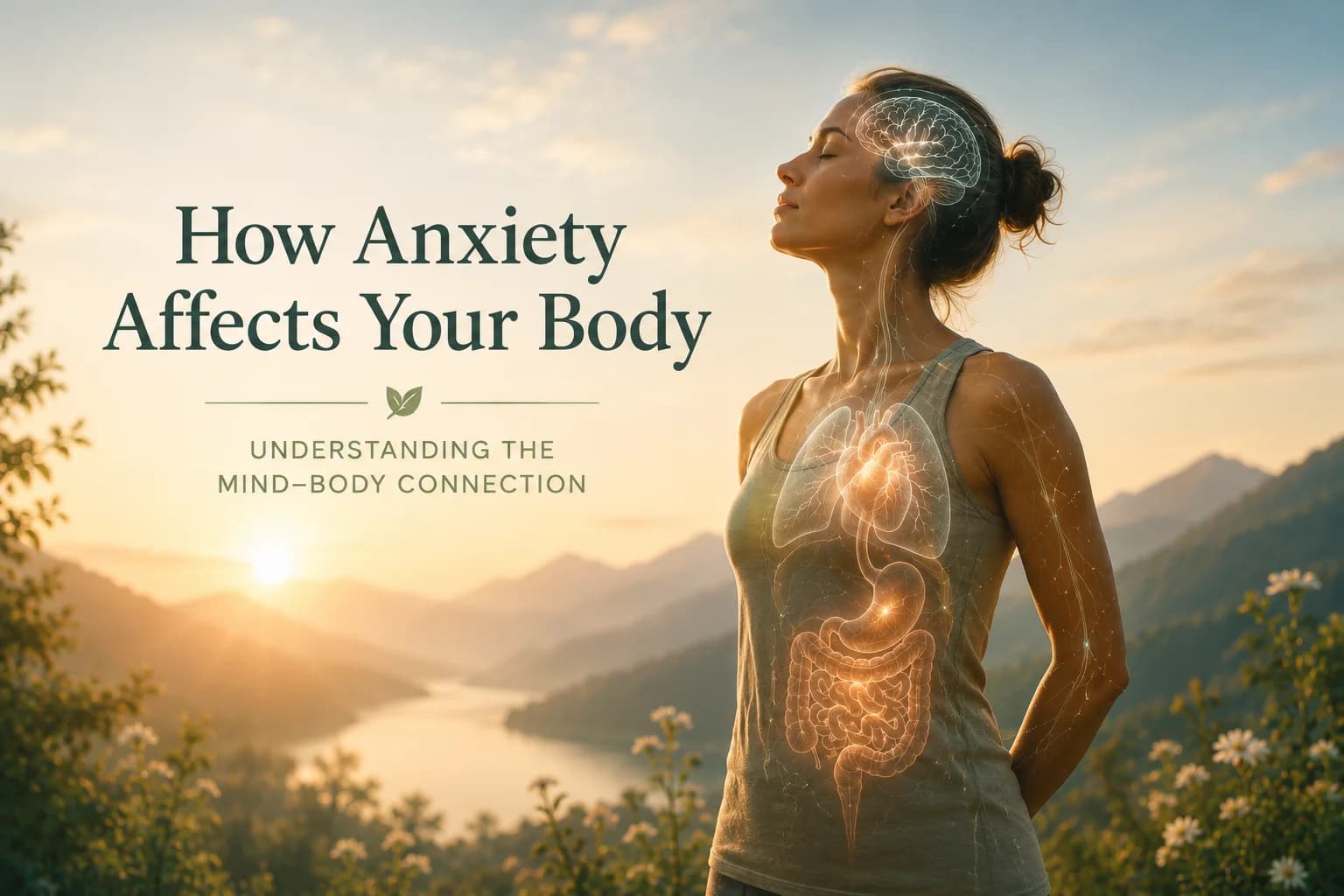
Anxiety Can Affect Your Whole Body
Many people think of anxiety as "just worrying." In reality, anxiety touches nearly every system in the body.
That is because anxiety is not simply an emotion --- it is a whole-body survival response. When your brain believes you may be in danger, it prepares you to fight, escape or protect yourself. This process draws on your brain, nervous system, heart, lungs, muscles, digestive system and even your immune system.
The result is that anxiety can produce dozens of physical, emotional, cognitive and behavioural symptoms.
For some people, the physical symptoms are so intense that they believe they are having a heart attack, a stroke or another serious medical event. This is one reason anxiety disorders are among the most common reasons people seek emergency medical care (American Psychiatric Association, 2022).
Here is the reassuring part: these symptoms are real, but they are usually the result of your body's alarm system rather than any damage to your body.

Four Types of Anxiety Symptoms
Every person experiences anxiety a little differently, but psychologists generally group symptoms into four categories: cognitive (how you think), emotional (how you feel), behavioural (what you do), and physical (what happens in your body).
Understanding these categories can help you recognise anxiety earlier and respond to it with greater confidence.
Emotional Symptoms
Emotions are often the first thing people notice. Common emotional symptoms include:
-
Persistent worry
-
Feeling on edge
-
Fear or dread
-
Irritability
-
Feeling overwhelmed
-
Restlessness
-
A sense that something bad is about to happen
-
Difficulty relaxing
These emotions are driven by the brain's attempt to anticipate future threats. Imagine your brain saying, "Let's prepare for every possible problem so nothing catches us by surprise."
Unfortunately, the brain cannot always tell the difference between productive planning and endless worrying. The more uncertain a situation feels, the more room anxiety has to imagine worst-case scenarios.
Why Anxiety Loves Uncertainty
One of anxiety's favourite questions is "but what if...?" What if I embarrass myself? What if they don't like me? What if I lose my job? What if something is wrong with my health? What if I fail?
The human brain naturally prefers certainty. When certainty is unavailable, the anxious brain often fills the gaps with imagined threats.
Ironically, trying to predict every possible danger rarely brings relief. Instead, it teaches the brain that uncertainty itself is dangerous, which keeps the cycle of worry turning.
Cognitive Symptoms
Anxiety changes not only how you feel, but how you think. Many people describe it simply as, "I can't switch my brain off."
Common cognitive symptoms include:
-
Racing thoughts
-
Difficulty concentrating
-
Overthinking
-
Catastrophising
-
Constant mental rehearsal
-
Indecision
-
Negative predictions
-
Intrusive thoughts
-
Difficulty remembering information
When the brain is focused on survival, it has fewer resources left for learning, memory and creative thinking. This is why students sometimes "go blank" in an exam despite knowing the material, or why people forget simple things when they are highly anxious.
Catastrophising
One of the most common thinking patterns in anxiety is catastrophising: automatically imagining the worst possible outcome.
For example, a friend hasn't replied to your message. Instead of thinking, "They're probably busy," the anxious brain jumps to "They're angry with me," "They don't want to talk to me," or "I've ruined the friendship."
Catastrophising feels convincing because anxiety treats possibilities as probabilities. Learning to notice and gently question these thoughts is one of the core skills taught in Cognitive Behavioural Therapy (CBT).
Physical Symptoms
Perhaps the most unsettling part of anxiety is what happens in the body. Many people are surprised to learn that anxiety can produce symptoms affecting almost every organ system.
Heart and Circulation
You may notice:
-
A racing heart (palpitations)
-
A strong or pounding heartbeat
-
Chest tightness
-
Increased blood pressure
-
Flushing
Why does this happen? Adrenaline tells your heart to pump faster so oxygen-rich blood can reach your muscles quickly if you need to escape danger. This response is entirely normal during genuine emergencies. When anxiety triggers the same response in everyday situations, it can feel alarming --- but it does not necessarily mean something is wrong with your heart.
Breathing
Common symptoms include:
-
Shortness of breath
-
Rapid breathing
-
Sighing frequently
-
Feeling unable to take a satisfying breath
-
Hyperventilation
When breathing becomes rapid, the balance of oxygen and carbon dioxide in your blood shifts. This can contribute to several other anxiety symptoms, including dizziness, tingling and a sense of unreality.
Muscles
Anxiety prepares the muscles for action. You may notice:
-
Muscle tension
-
Jaw clenching
-
Neck pain
-
Shoulder tightness
-
Trembling
-
Shaking
-
Restlessness
Many people carry this tension for hours, or even days, without realising it. Over time, it can contribute to headaches, back pain and fatigue.
Digestive System
The digestive system is often one of the first areas affected by anxiety. Symptoms may include:
-
Nausea
-
"Butterflies" in the stomach
-
Stomach pain
-
Diarrhoea
-
Constipation
-
Acid reflux
-
Loss of appetite
-
Increased appetite
Why? Because digestion is not essential during immediate danger. When the sympathetic nervous system activates, the body temporarily redirects energy away from digestion and towards survival.
Nervous System
People often worry most about symptoms involving the nervous system. These include:
-
Dizziness
-
Light-headedness
-
Tingling
-
Numbness
-
Feeling detached from yourself (depersonalisation)
-
Feeling detached from the world (derealisation)
These experiences can feel frightening, but they are well-recognised symptoms of anxiety and panic. That said, if you experience new, severe or persistent neurological symptoms, it is important to seek medical assessment to rule out other causes.
Behavioural Symptoms
Anxiety doesn't only change how we think or feel. It changes what we do. Common behavioural changes include:
-
Avoiding situations
-
Cancelling plans
-
Seeking reassurance repeatedly
-
Procrastinating
-
Constant checking
-
Difficulty making decisions
-
Over-preparing
-
Staying close to "safe" people or places
At first, avoidance feels helpful. If public speaking makes you anxious, avoiding presentations brings immediate relief. The trouble is that your brain draws its own conclusion: "Avoiding worked. That situation really must have been dangerous." Next time, the anxiety comes back stronger.
Avoidance offers short-term comfort but often strengthens anxiety in the long run. This is why evidence-based therapies gradually help people face feared situations in manageable, supported steps, rather than avoiding them altogether.
Everyone Experiences Anxiety Differently
Not everyone experiences every symptom. Some people mainly notice physical sensations. Others experience racing thoughts. Some feel emotionally overwhelmed. Others appear calm on the outside while struggling internally.
There is no single "correct" way to experience anxiety. What matters is understanding your own patterns. The more familiar you become with your body's signals, the earlier you can recognise anxiety and choose a helpful response, rather than reacting automatically.

Try This Today
Take a few moments to reflect on your own experience. Ask yourself:
-
Which anxiety symptoms do I notice most often?
-
Are they mostly physical, emotional, cognitive or behavioural?
-
What situations tend to trigger them?
-
How do I usually respond?
You may find it helpful to write your answers down in a journal or mood tracker. Over time, recognising these patterns can help you understand your anxiety with greater compassion, and identify the strategies that work best for you.
References
American Psychiatric Association. (2022). Diagnostic and statistical manual of mental disorders (5th ed., text rev.; DSM-5-TR). American Psychiatric Association Publishing.
Barlow, D. H. (2002). Anxiety and its disorders: The nature and treatment of anxiety and panic (2nd ed.). Guilford Press.
Craske, M. G., & Barlow, D. H. (2008). Mastery of your anxiety and panic (4th ed.). Oxford University Press.
Hofmann, S. G., Asnaani, A., Vonk, I. J. J., Sawyer, A. T., & Fang, A. (2012). The efficacy of cognitive behavioural therapy: A review of meta-analyses. Cognitive Therapy and Research, 36(5), 427--440.
National Institute for Health and Care Excellence. (2020). Generalised anxiety disorder and panic disorder in adults: Management (CG113). https://www.nice.org.uk/guidance/cg113
World Health Organization. (2023). Mental disorders. https://www.who.int/news-room/fact-sheets/detail/mental-disorders