Anxiety Is Trying to Help You
Imagine walking through the woods. Suddenly, you hear rustling in the bushes. Without consciously thinking, your body immediately prepares for action: your heart beats faster, your muscles tense, your breathing quickens, your attention narrows. Within a fraction of a second, your brain has already asked one important question: could this be dangerous?
Thousands of years ago, reacting quickly increased the chances of survival. If the rustling turned out to be a tiger, acting first and thinking later could save your life. If it was only the wind, you simply experienced a few seconds of unnecessary adrenaline. Evolution strongly favoured false alarms over missed dangers --- your brain would rather scare you unnecessarily than miss a genuine threat.
That system still exists today. The difference is that modern threats are rarely tigers. Instead, your brain may react to things like speaking in public, receiving an unexpected email, attending a social gathering, making a difficult phone call, financial uncertainty, health concerns, or conflict with a partner. The body responds in remarkably similar ways.
Why Anxiety Feels So Convincing
One of the hardest parts of anxiety is that it doesn't feel like imagination. It feels like certainty. When anxiety is high, people often say, "I know it sounds irrational, but it feels so real."
This happens because anxiety doesn't begin with logic. It begins with the body's alarm system. By the time your thinking brain starts analysing the situation, your body has already increased your heart rate, tightened your muscles and released stress hormones.
Your mind then naturally asks: why does my body feel like this? Because we like explanations, the mind starts searching for answers. If your chest feels tight, you might think, "Maybe I'm having a heart attack." If your heart races, "Something must be seriously wrong." If you feel dizzy, "I'm going to faint."
These thoughts are understandable. Unfortunately, they also convince the brain that the danger is even greater than it is.
The Anxiety Cycle
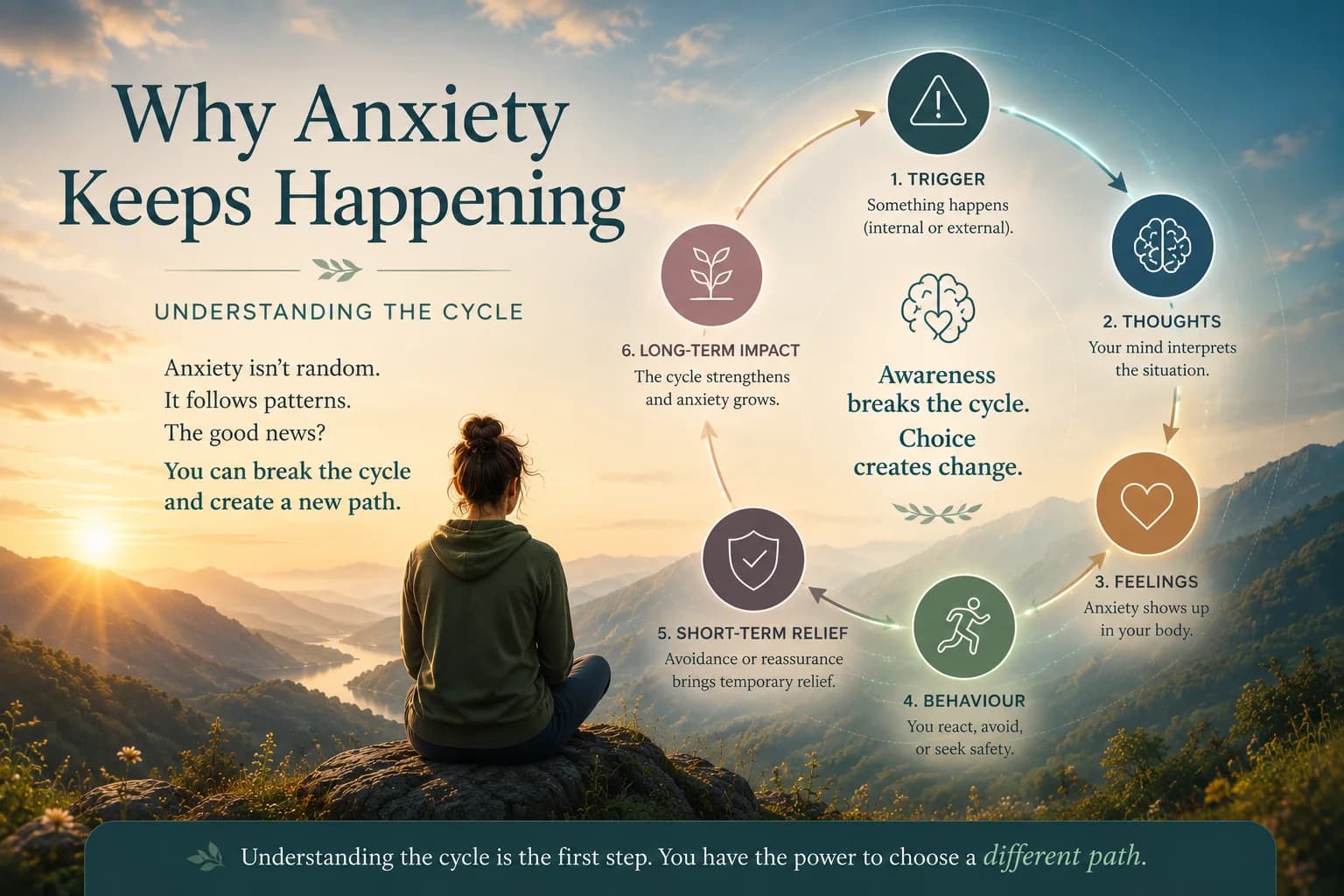
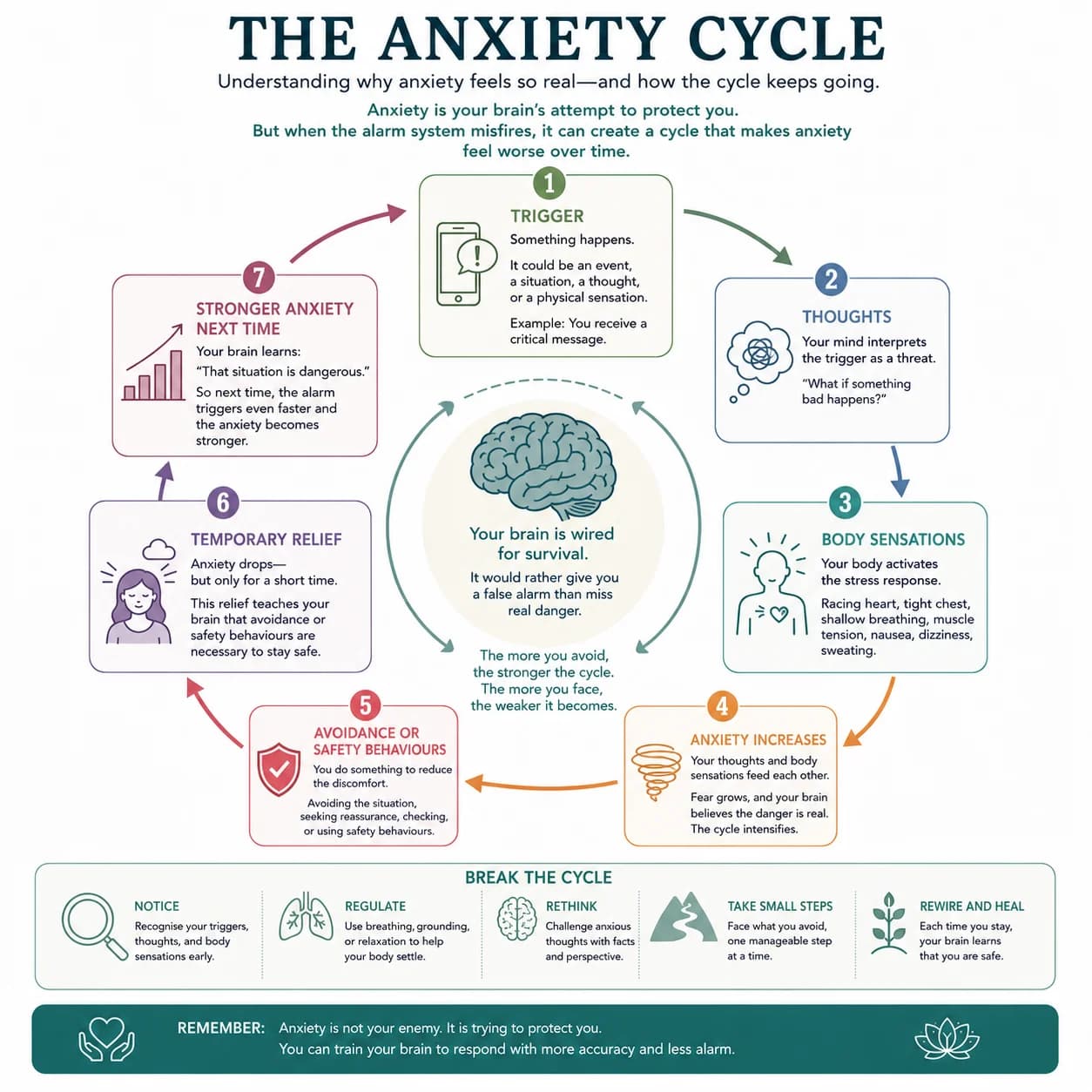
This creates one of the most important concepts in anxiety treatment: the anxiety cycle. It tends to unfold in six familiar stages.
1. A Trigger
Something happens. Perhaps you receive a text saying "Can we talk?", notice your heart beating faster, have to give a presentation, feel slightly dizzy, or walk into a crowded room. The trigger may come from the outside world, or from inside your own body.
2. The Brain Detects Possible Danger
Your amygdala reacts. Its job is not to ask, "Is this definitely dangerous?" Its job is to ask, "Could this be dangerous?" When uncertainty exists, it usually chooses caution.
3. The Body Activates
Stress hormones are released and your body prepares to survive. You notice a racing heart, sweating, shaking, nausea, muscle tension, faster breathing. These sensations are uncomfortable, but they are also completely predictable.
4. The Mind Tries to Explain the Feelings
Now your thinking brain joins in. Instead of recognising, "My nervous system has activated," it often concludes, "Something terrible is happening." This is where thoughts such as "I can't cope," "I'm losing control," "I'm going to embarrass myself," "I'm having a panic attack," or "I'm going to collapse" tend to appear.
5. Anxiety Increases
Those thoughts create even more fear. The brain now believes, "See? Even my thoughts agree we're in danger." More adrenaline is released, physical sensations become stronger, and the thoughts become even more frightening. The cycle accelerates.
6. Avoidance or Safety Behaviours
Naturally, you try to feel better. You may leave the situation, cancel plans, repeatedly check your pulse, search your symptoms online, ask loved ones for reassurance, avoid eye contact, carry medication "just in case," sit near exits, always have a bottle of water, or avoid travelling alone.
These behaviours make complete sense. Anyone who felt frightened would likely do the same. The problem is not that they don't work. The problem is that they work too well.
Why Avoidance Strengthens Anxiety
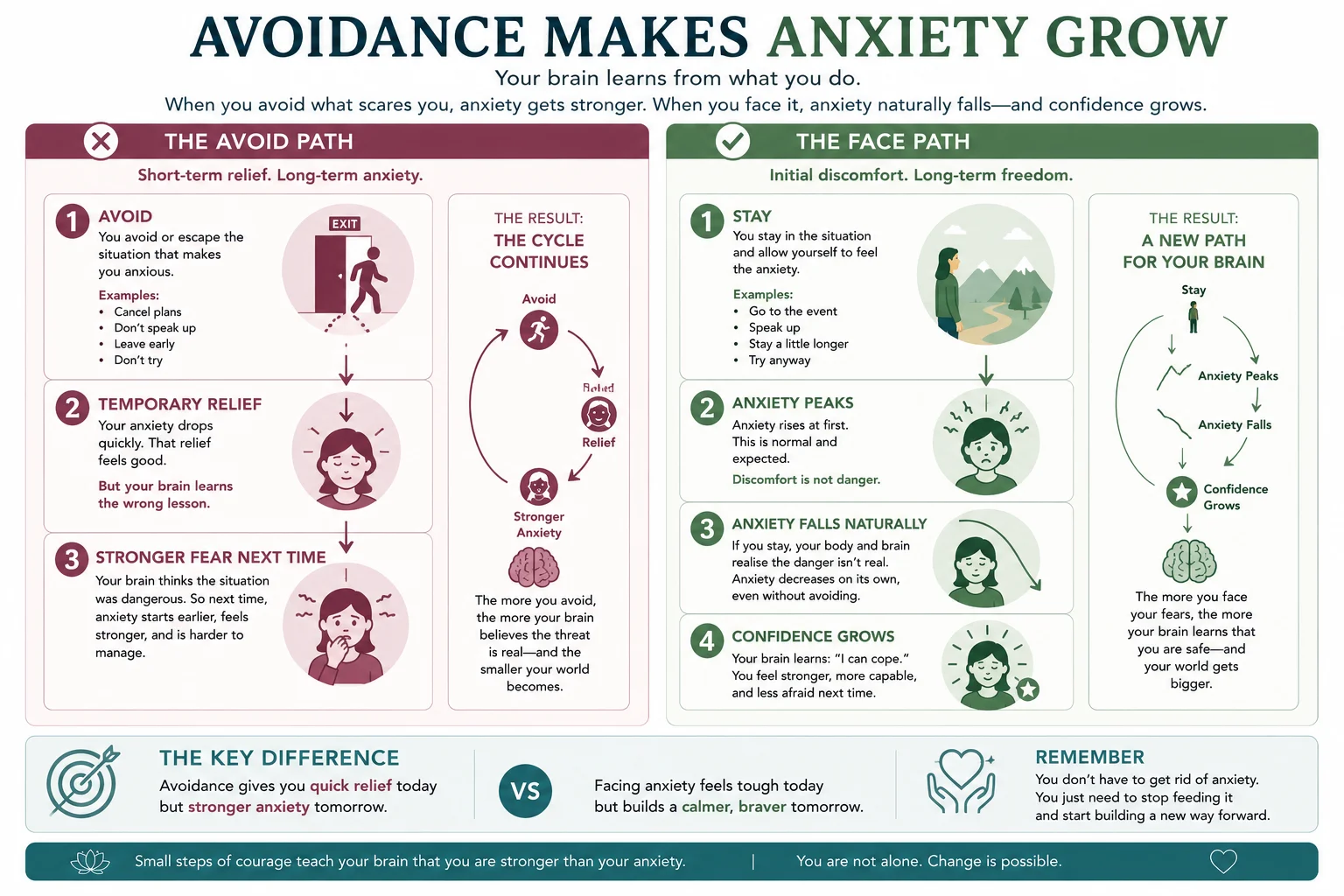
Imagine someone afraid of lifts. One day they take the stairs instead. Immediately, their anxiety drops. Their brain quietly records a lesson: "Good decision --- the lift really was dangerous."
Nothing dangerous actually happened. But the brain doesn't know that. All it knows is a simple chain: the lift was avoided, anxiety reduced, and avoidance kept me safe. Next time, the fear is stronger. Each avoidance teaches the brain that the danger was real.
This is why psychologists often describe avoidance as "feeding anxiety." Research consistently shows that avoidance is one of the key processes that maintains anxiety disorders (Craske et al., 2022).
Safety Behaviours
Sometimes people don't completely avoid a situation. Instead, they develop what psychologists call safety behaviours --- actions intended to reduce anxiety without actually addressing the fear itself. Examples include carrying "lucky" objects, sitting near the exit, constantly checking your smartwatch heart rate, only travelling with another person, rehearsing every conversation, avoiding silence, or always keeping your phone nearby.
Safety behaviours reduce anxiety temporarily. Unfortunately, they also prevent the brain from learning something important: maybe I could cope without them.
Why Recovery Feels Uncomfortable at First
This explains something many people find surprising: learning to manage anxiety often feels more uncomfortable before it feels easier. Why? Because you are asking your brain to ignore an alarm that it genuinely believes is protecting you.
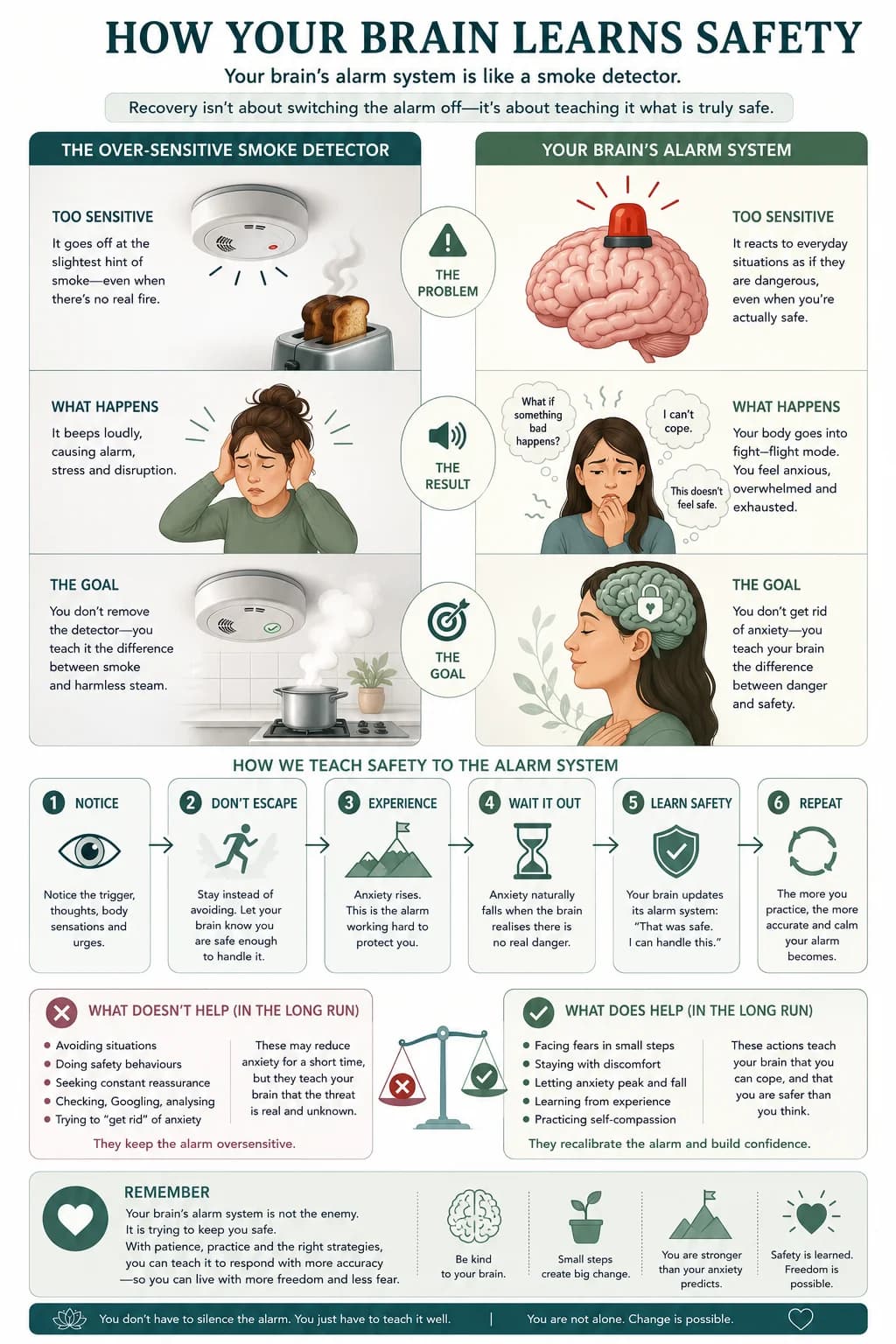
Imagine teaching an overly sensitive smoke detector not to react every time you make toast. You wouldn't smash the alarm, and you wouldn't shout at it. You would gradually teach it that this isn't smoke from a house fire, and that it's safe.
The brain learns in much the same way. Through repeated experiences of safety, the alarm gradually becomes more accurate. This process is known as inhibitory learning, and it is now considered one of the key mechanisms behind effective exposure-based treatments for anxiety (Craske et al., 2014).
Breaking the Anxiety Cycle
Fortunately, every stage of the anxiety cycle offers an opportunity for change. Instead of trying to eliminate anxiety completely, evidence-based therapies teach people to gently interrupt the cycle.
When a trigger appears, you can simply notice it. As your body reacts, you can slow your breathing. As thoughts appear, you can question them with curiosity rather than believing them automatically. When the urge to avoid arrives, you can take one small step towards the situation instead. And each time you do, your brain receives a new piece of information: perhaps I can cope after all.
Every time you stay in a situation long enough to discover that you are safe, your brain updates its expectations. Gradually, the alarm system becomes less sensitive. This doesn't happen overnight --- like any form of learning, it takes repetition. But the remarkable thing about the human brain is that it remains capable of changing throughout life, a quality known as neuroplasticity.
Anxiety Is Not the Problem
This may sound surprising, but anxiety itself is rarely the biggest problem. The biggest problem is the way anxiety changes our behaviour. Over time, life can quietly become smaller. People stop travelling, stop meeting friends, stop speaking up, stop trying new experiences, stop living according to their values.
Recovery is not about never feeling anxious again. Recovery is about refusing to let anxiety make your world smaller. Every small step towards the life you want to live teaches your brain something powerful: I am stronger than my anxiety predicted.
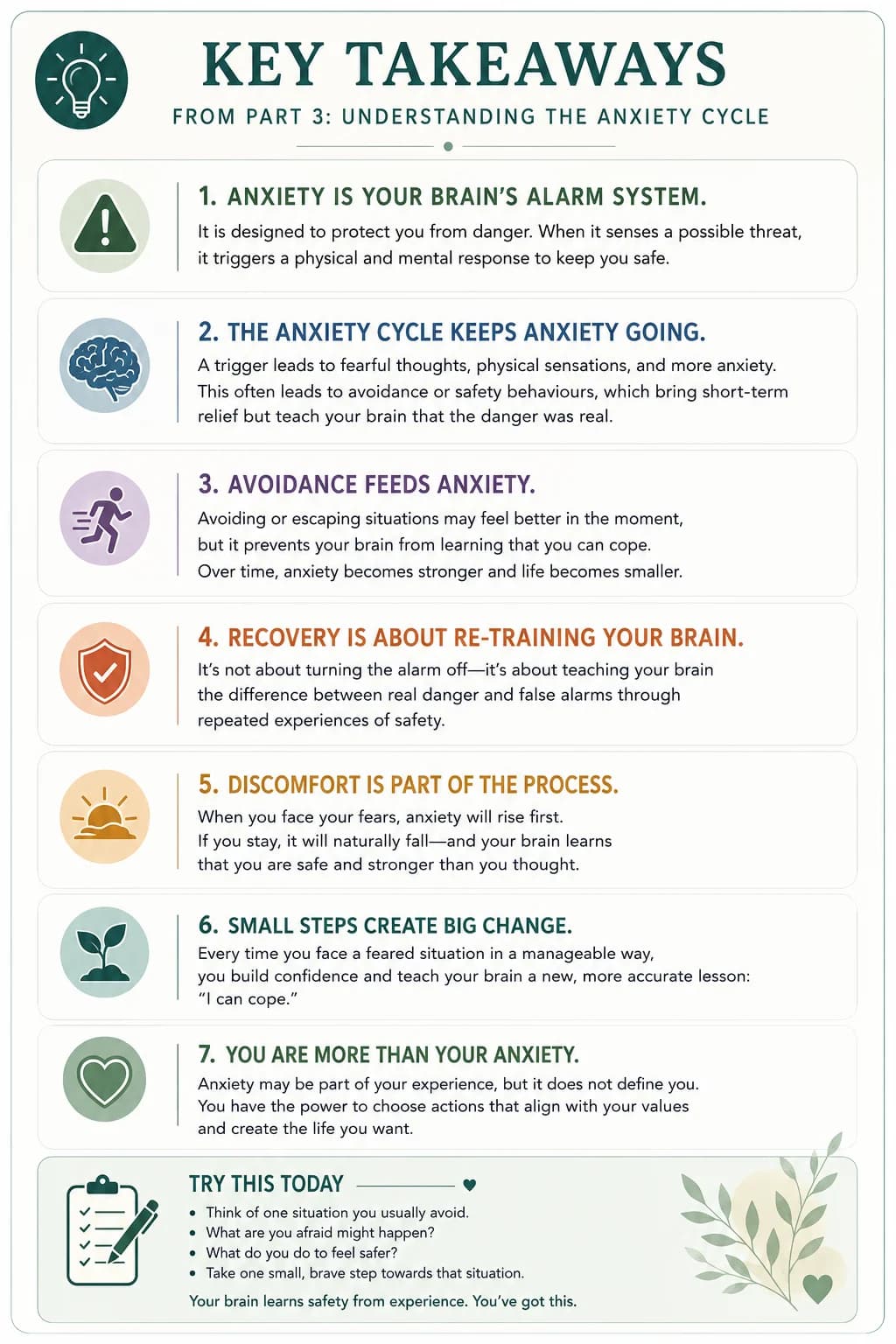
Try This Today
Think about one situation you've been avoiding because it makes you anxious. Ask yourself:
-
What am I afraid might happen?
-
What do I usually do to feel safer?
-
Has avoiding it made my anxiety smaller, or stronger, over time?
Now imagine taking one tiny step towards that situation. Not the biggest step --- just the next manageable one. Small experiences of safety are how your brain learns that it no longer needs to sound the alarm quite so loudly.
References
American Psychiatric Association. (2022). Diagnostic and statistical manual of mental disorders (5th ed., text rev.; DSM-5-TR). American Psychiatric Association Publishing.
Clark, D. M. (1986). A cognitive approach to panic. Behaviour Research and Therapy, 24(4), 461--470.
Craske, M. G., Treanor, M., Conway, C. C., Zbozinek, T., & Vervliet, B. (2014). Maximising exposure therapy: An inhibitory learning approach. Behaviour Research and Therapy, 58, 10--23.
Craske, M. G., Hermans, D., & Vervliet, B. (2022). Exposure therapy for anxiety: Principles and practice. Guilford Press.
LeDoux, J. E. (2015). Anxious: Using the brain to understand and treat fear and anxiety. Viking.
NICE. (2020). Generalised anxiety disorder and panic disorder in adults: Management (CG113). National Institute for Health and Care Excellence. https://www.nice.org.uk/guidance/cg113