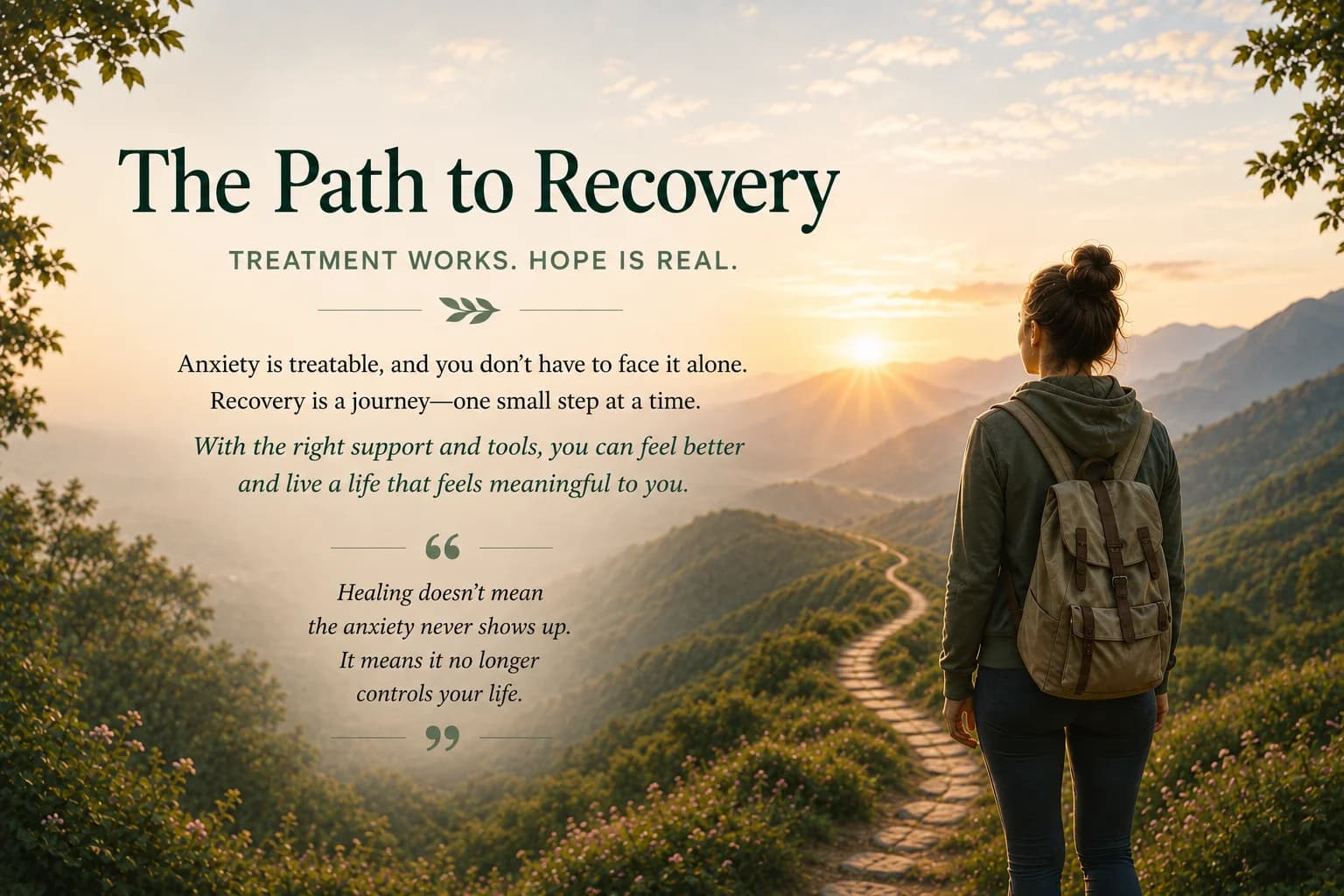
Recovery Begins with Hope
If you've been living with anxiety for weeks, months or even years, you may wonder whether things can ever really change. Perhaps you've tried telling yourself to "calm down." Perhaps you've avoided situations that make you anxious. Perhaps you've searched endlessly for reassurance. Many people begin to believe, "Maybe this is just who I am."
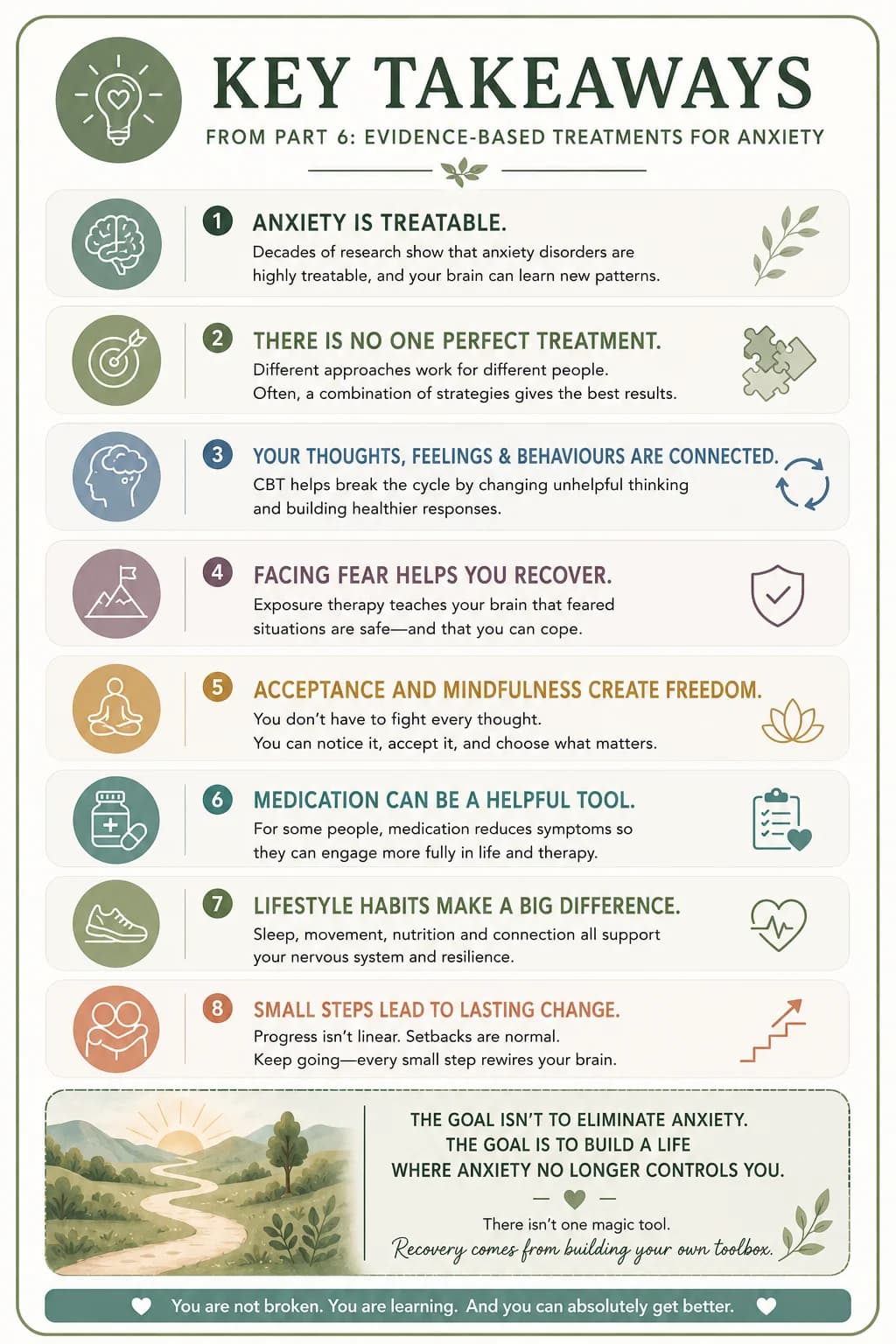
Fortunately, research tells a very different story. Anxiety disorders are among the most treatable mental health conditions. Decades of research have shown that the brain is capable of learning new patterns throughout life --- a quality known as neuroplasticity.
This means that although anxiety may have become a well-practised habit in your nervous system, it is not a permanent sentence. With the right support, practice and patience, your brain can learn to respond differently.
There Is No One Perfect Treatment
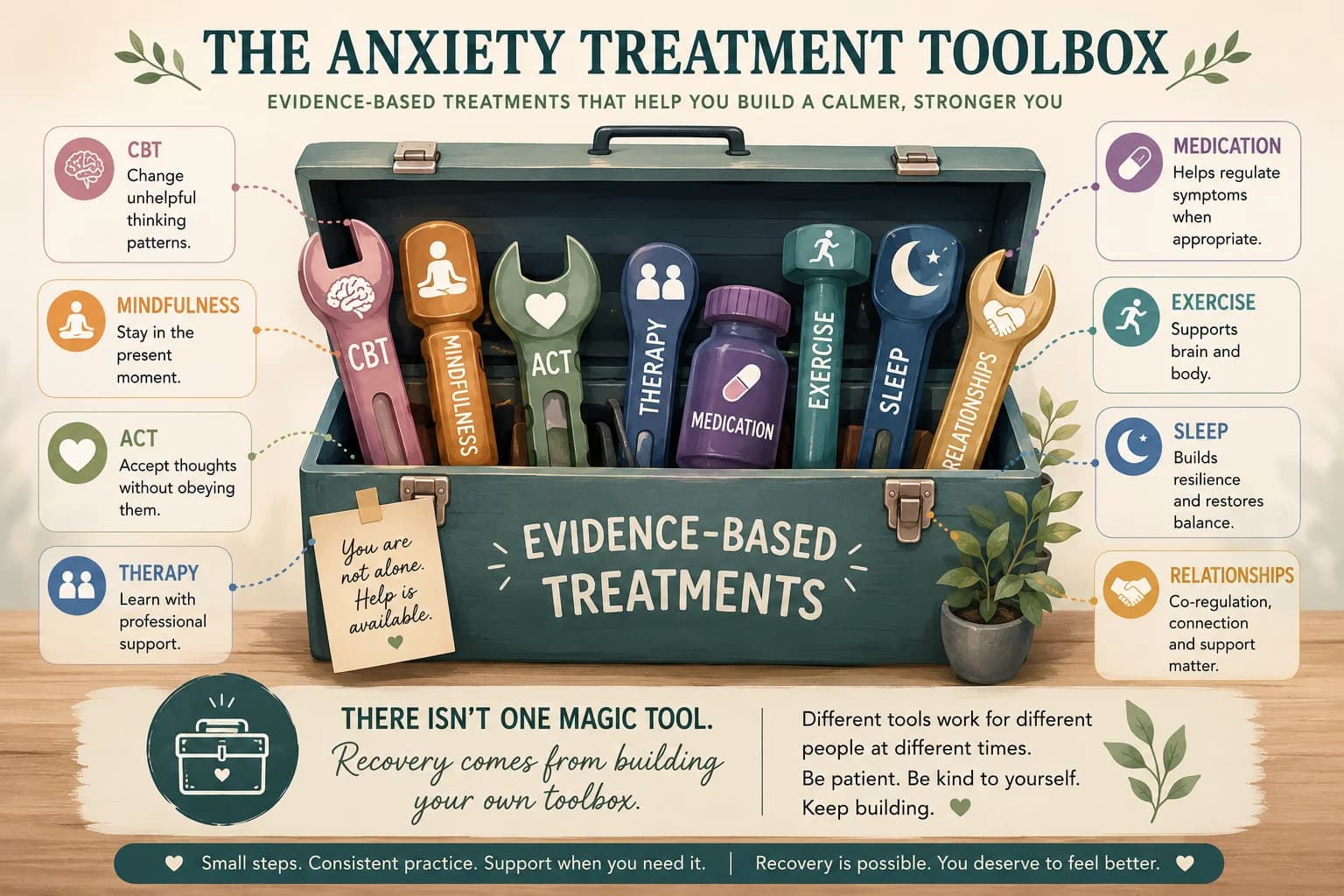
One of the first things to understand is that there is no single treatment that works for everyone. Different people respond to different approaches depending on the type of anxiety they experience, how long it has been present, past experiences, personality, physical health and personal preferences.
The encouraging news is that there are several evidence-based treatments that consistently help large numbers of people, and often the best results come from combining more than one approach.
Cognitive Behavioural Therapy (CBT)
If you have ever searched for treatment for anxiety, you have probably come across Cognitive Behavioural Therapy, commonly known as CBT. There is a good reason for that. CBT is one of the most extensively researched psychological treatments in the world and is recommended as a first-line treatment for many anxiety disorders by organisations such as the National Institute for Health and Care Excellence (NICE), the American Psychological Association, and the Anxiety & Depression Association of America.
The central idea of CBT is surprisingly simple: it is often not the situation itself that causes prolonged anxiety, but the way we interpret it and respond to it. CBT helps people recognise these patterns and gradually replace them with healthier, more balanced ways of thinking and behaving.
The Three Parts of CBT
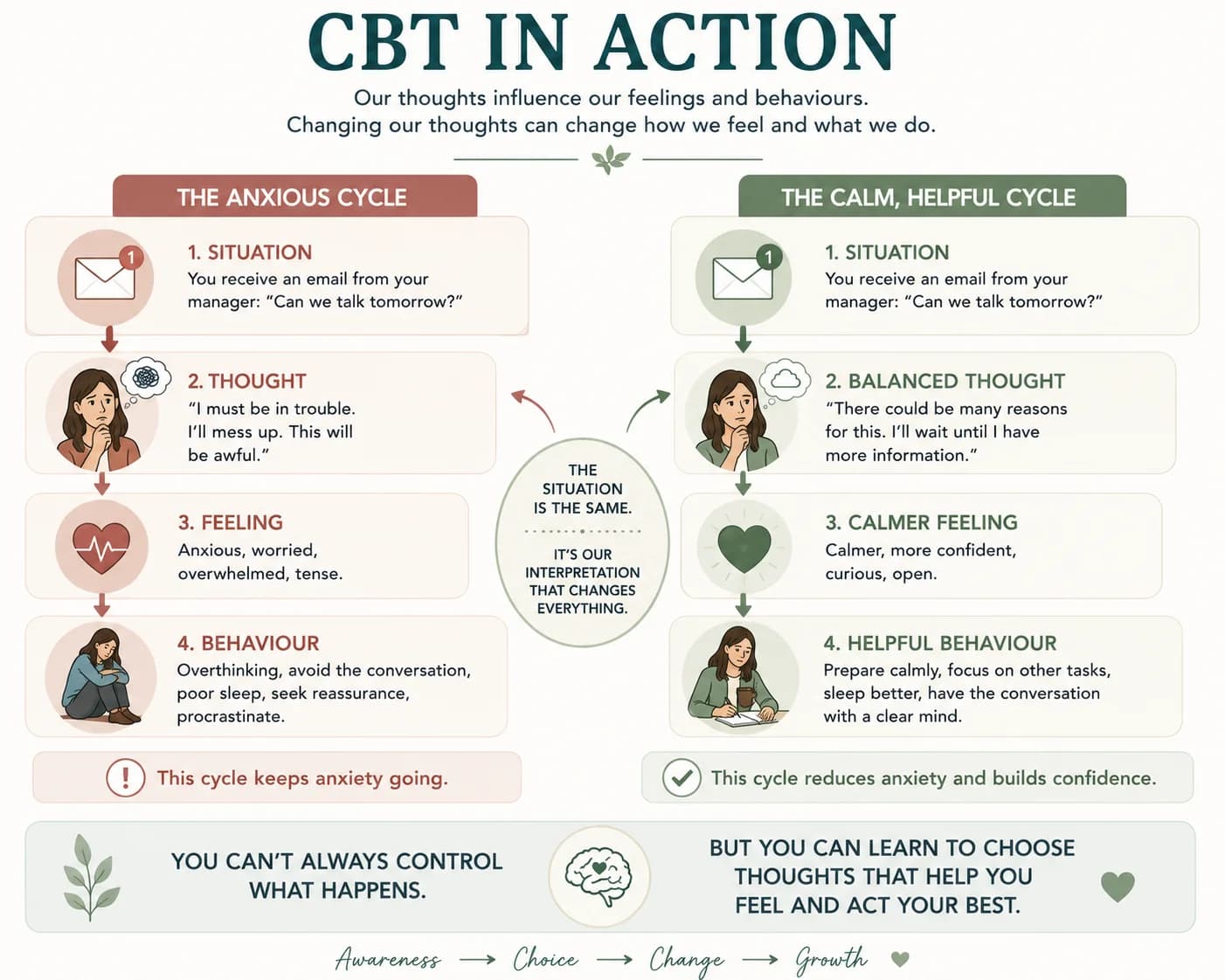
CBT focuses on the interaction between thoughts, feelings and behaviours. Imagine receiving an email from your manager that simply says, "Can we talk tomorrow?" One interpretation might be, "I'm in trouble." The feeling becomes anxiety, and the behaviour becomes overthinking, poor sleep and repeatedly replaying recent events.
Another interpretation might be, "There could be many reasons for this. I'll wait until I have more information." The situation hasn't changed --- only the interpretation has. And because the interpretation changes, the emotional response changes too.
Challenging Unhelpful Thinking
CBT doesn't encourage "positive thinking." Instead, it encourages accurate thinking. Rather than asking, "Can I think positively?", CBT asks:
-
What evidence supports this thought?
-
What evidence does not?
-
Am I predicting the future?
-
Am I assuming the worst?
-
Is there another explanation?
Over time, people begin to notice that many anxious thoughts are predictions rather than facts.
Exposure Therapy
Perhaps the most misunderstood treatment for anxiety is exposure therapy. At first, it sounds frightening --- after all, why would anyone deliberately face what scares them? The answer is simple: because avoidance teaches the brain that the fear was justified.
Exposure therapy teaches the opposite. It gently and gradually helps people experience feared situations while remaining safe, allowing the brain to learn something new: "I can cope."
Importantly, exposure therapy is not about overwhelming someone. It is carefully planned, collaborative and progresses in manageable steps. Research consistently shows that exposure-based interventions are among the most effective treatments for anxiety disorders and phobias.
Acceptance and Commitment Therapy (ACT)
While CBT often focuses on changing thoughts, Acceptance and Commitment Therapy (ACT) teaches a different skill. Instead of fighting every anxious thought, ACT encourages people to change their relationship with those thoughts.
Imagine your anxious mind says, "You're going to embarrass yourself." Instead of arguing with the thought, ACT encourages you to notice it: "I'm noticing that my mind is telling me I'm going to embarrass myself." This creates psychological distance. The thought becomes something you experience, rather than something you must obey.
ACT also encourages people to continue acting according to their values, even when anxiety is present. In other words, courage isn't the absence of anxiety. It is choosing to move towards what matters despite anxiety.
Mindfulness
Mindfulness has become increasingly popular over the past two decades, but it is often misunderstood. Mindfulness is not about emptying your mind. It is about learning to notice thoughts, feelings and bodily sensations without immediately reacting to them.
Instead of becoming caught in "what if...?", mindfulness gently brings attention back to "what is happening right now?" Research shows that mindfulness-based interventions can reduce anxiety, improve emotional regulation and decrease relapse for many people when practised consistently.
Medication
Medication can be an important part of treatment for some people. For moderate to severe anxiety, it may help reduce symptoms enough for people to engage more effectively in therapy and everyday life. Commonly prescribed medications include selective serotonin reuptake inhibitors (SSRIs) and serotonin-noradrenaline reuptake inhibitors (SNRIs).
Medication is not a sign of weakness, nor is it "the easy option." It is one evidence-based tool among many. Any decision about medication should always be made in consultation with a qualified healthcare professional who can discuss potential benefits, risks and side effects.
Lifestyle Changes That Matter
Although lifestyle changes alone may not completely resolve an anxiety disorder, they can significantly support recovery. Research suggests that several everyday habits influence the nervous system.
Sleep
Poor sleep increases emotional sensitivity and reduces the brain's ability to regulate stress. Developing a consistent sleep routine supports emotional resilience.
Physical Activity
Regular movement reduces stress hormones and increases the release of chemicals associated with improved mood and wellbeing. The goal is not perfection --- even a daily walk can make a meaningful difference.
Nutrition
Eating regular, balanced meals helps stabilise energy levels and supports healthy brain function. Some people also notice that reducing excessive caffeine or alcohol helps decrease anxiety symptoms.
Social Connection
Humans are social beings, and supportive relationships act as a powerful buffer against stress. Simply talking to someone you trust can help regulate the nervous system.
Why Small Steps Matter More Than Big Ones
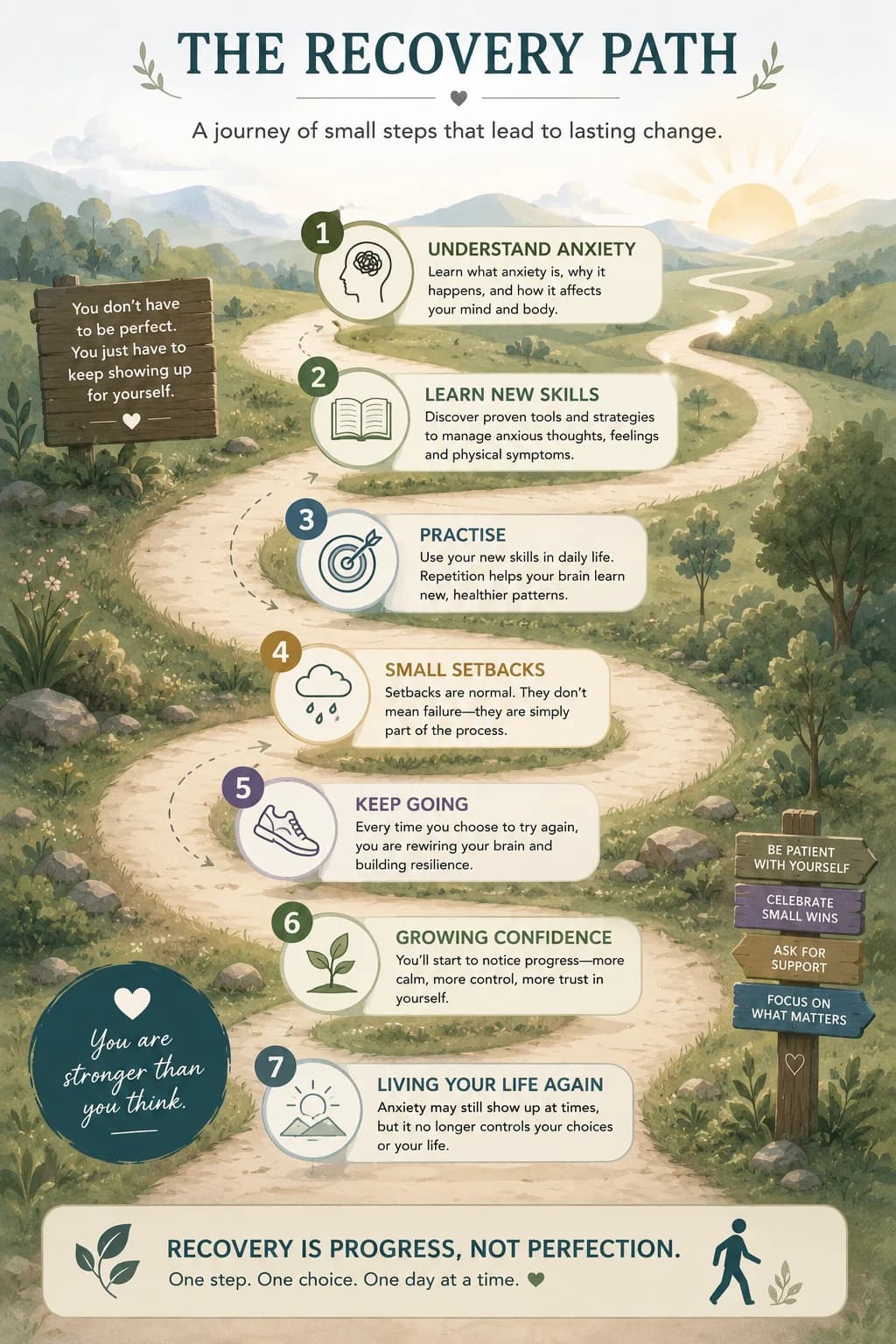
One of the most common mistakes people make is trying to eliminate anxiety overnight. Recovery rarely works that way. The brain changes through repetition, not dramatic breakthroughs.
Imagine learning a musical instrument. You wouldn't expect to become an expert after one lesson --- instead, you improve through hundreds of small practice sessions. Recovery from anxiety follows a similar pattern. Each time you challenge an anxious thought, remain in a feared situation a little longer, practise breathing, complete a CBT exercise, or choose a value over avoidance, your brain learns something new. Tiny lessons repeated consistently create lasting change.
Recovery Doesn't Mean Never Feeling Anxious Again
This is one of the most important ideas in the entire guide. Healthy people still experience anxiety. Athletes feel anxious before competitions. Parents feel anxious about their children. Students feel anxious before exams. Anxiety itself is not the enemy.
The difference is that healthy anxiety comes and goes. It no longer controls every decision. Recovery is therefore not about eliminating anxiety. It is about building confidence that you can handle it when it appears.
Choosing the Right Treatment
Finding the right approach sometimes takes patience. What works well for one person may not suit another. The important thing is not to lose hope if the first strategy you try isn't the perfect fit.
Many people benefit from a combination of therapy, lifestyle changes, mindfulness, medication (where appropriate), self-help tools and supportive relationships. Recovery is rarely one single breakthrough. It is usually the result of many small changes working together.
Try This Today
Instead of asking yourself, "How do I get rid of anxiety?", try asking, "What is one small thing I can do today that teaches my brain I am safe?"
It might be taking a short walk, practising a breathing exercise, completing a CBT thought record, staying in an anxious situation for one extra minute, or simply reminding yourself, "This feeling is uncomfortable, but I can handle uncomfortable." Recovery is built one small step at a time.
References
American Psychological Association. (2023). Clinical practice guideline for the treatment of anxiety disorders.
Cuijpers, P., Miguel, C., Harrer, M., et al. (2023). Cognitive behavioural therapy for anxiety disorders: A meta-analysis of randomised controlled trials. World Psychiatry, 22(1), 105--115.
Hayes, S. C., Strosahl, K. D., & Wilson, K. G. (2016). Acceptance and commitment therapy: The process and practice of mindful change (2nd ed.). Guilford Press.
Hofmann, S. G., Asnaani, A., Vonk, I. J. J., Sawyer, A. T., & Fang, A. (2012). The efficacy of cognitive behavioural therapy: A review of meta-analyses. Cognitive Therapy and Research, 36(5), 427--440.
National Institute for Health and Care Excellence. (2020). Generalised anxiety disorder and panic disorder in adults: Management (CG113). https://www.nice.org.uk/guidance/cg113
World Health Organization. (2023). Mental disorders. https://www.who.int/news-room/fact-sheets/detail/mental-disorders