
Introduction
Sadness is something everyone knows. It arrives with loss, disappointment, heartbreak and stress, sits with us for a while, and eventually loosens its grip. It is, in its way, evidence that we are paying attention to our own lives.
Depression asks to be understood differently. It is not an intensified version of sadness, and it doesn't behave like an emotion that passes once circumstances improve. The American Psychological Association draws a clear line here: everyday sadness and grief are normal responses to hard experiences, while clinical depression is a distinct condition that persists, deepens and begins to interfere with daily functioning [1]. It can settle into the body as much as the mind, and tasks that once required no thought at all, answering a message, making dinner, getting out of bed, can start to feel like tasks with no obvious starting point.
By current estimates, around 332 million people are living with depression worldwide, making it one of the leading causes of disability globally [2]. Behind that number are people who look, on the surface, entirely fine.
This piece is an introduction: not a diagnostic tool, but a starting point for understanding what depression actually is, why it develops, and why recovery is a realistic, well-documented outcome rather than a hopeful exception.
An Illness, Not a Character Flaw
"Just snap out of it" is, unfortunately, one of the most common things said to someone experiencing depression, and one of the least useful. It assumes depression is a matter of willpower. It isn't.
Clinically, a major depressive episode is defined as a period of at least two weeks in which a person experiences a persistently low or empty mood, or a loss of interest in activities they'd normally enjoy, alongside a cluster of other symptoms affecting sleep, appetite, energy, concentration or self-worth [3]. That clinical definition matters because it tells us something important: depression has a recognisable shape. It is not vague unhappiness. It is a condition with a name, a pattern, and a body of research behind it.
Brain imaging studies back this up. Structural and functional research has found measurable differences in regions involved in emotion, memory and motivation in people experiencing depression, along with disruptions to the brain's natural capacity for neuroplasticity, its ability to form new connections and adapt [4]. That may sound discouraging, but it's actually the opposite. If depression involves changes to how the brain functions, then treatment, therapy, lifestyle change, sometimes medication, works in large part by helping the brain change back. Neuroplasticity doesn't just explain how depression takes hold; it explains how recovery is possible.
One Condition, Many Faces
If you pictured depression as someone who cries frequently and struggles to leave the house, you wouldn't be wrong, but you'd only be seeing one version of it.
Depression can look like someone who hasn't cried in months, who goes to work every day, replies to emails on time, and shows up to dinner with friends, all while feeling hollow underneath it. It can look like irritability rather than tears, restlessness rather than exhaustion, or a flat, muted quality to everything that used to feel vivid.
The symptoms most commonly associated with depression include a persistently low mood, loss of interest in previously enjoyable activities, fatigue, feelings of worthlessness or excessive guilt, poor concentration, disrupted sleep, appetite changes, hopelessness, and emotional numbness [3]. Nobody experiences all of these at once, and depression itself ranges from mild to severe. Two people with the same diagnosis can have almost entirely different daily experiences of it.
Why Depression Develops
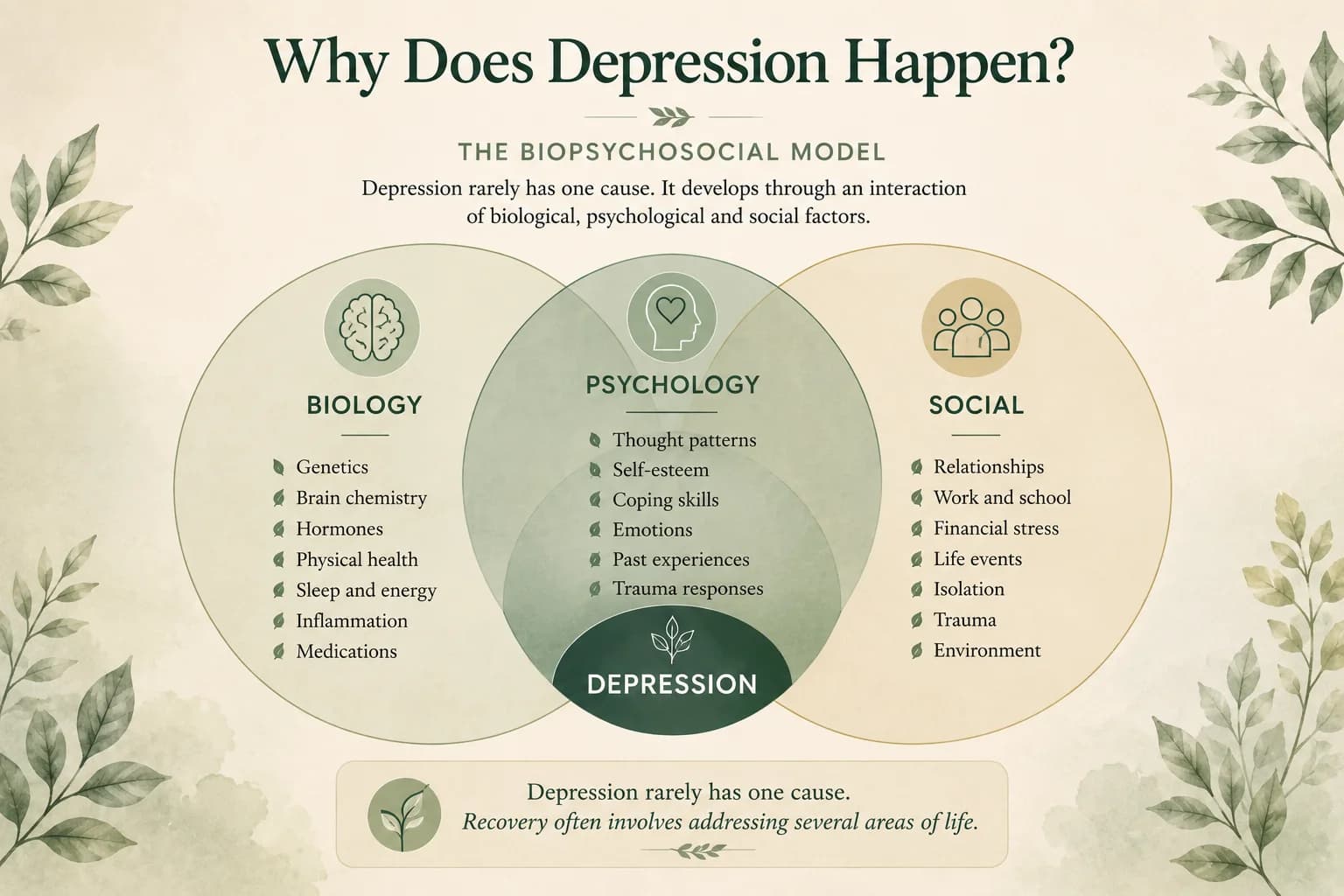
There is rarely one cause. Most clinicians and researchers now understand depression through a biopsychosocial lens: biology, psychology and social circumstance interacting with one another, rather than any single trigger acting alone.
Biology plays a role through genetic vulnerability, hormonal shifts, chronic illness, certain medications and prolonged physiological stress. Depression involves changes in neurotransmitter systems, including serotonin, dopamine and norepinephrine, though research increasingly cautions against reducing depression to a simple "chemical imbalance." It's a more layered story than that, involving brain structure, stress hormones, inflammation and plasticity all at once [4].
Psychology contributes through patterns of thinking that quietly shape how experience gets interpreted. This is where Beck's cognitive theory of depression is still one of the most influential frameworks: it proposes that depression is sustained by negatively biased thinking, distorted self-perception and errors in how information gets processed, not simply caused by external events [5]. Someone prone to self-criticism, perfectionism or rumination is carrying a heavier psychological load before difficulty even arrives.
Social circumstance rounds out the picture. Bereavement, relationship breakdown, financial pressure, unemployment, trauma, isolation, caregiving strain and discrimination are all recognised contributors. Usually, several of these arrive together rather than one alone tipping the balance.
The Lens Depression Puts On
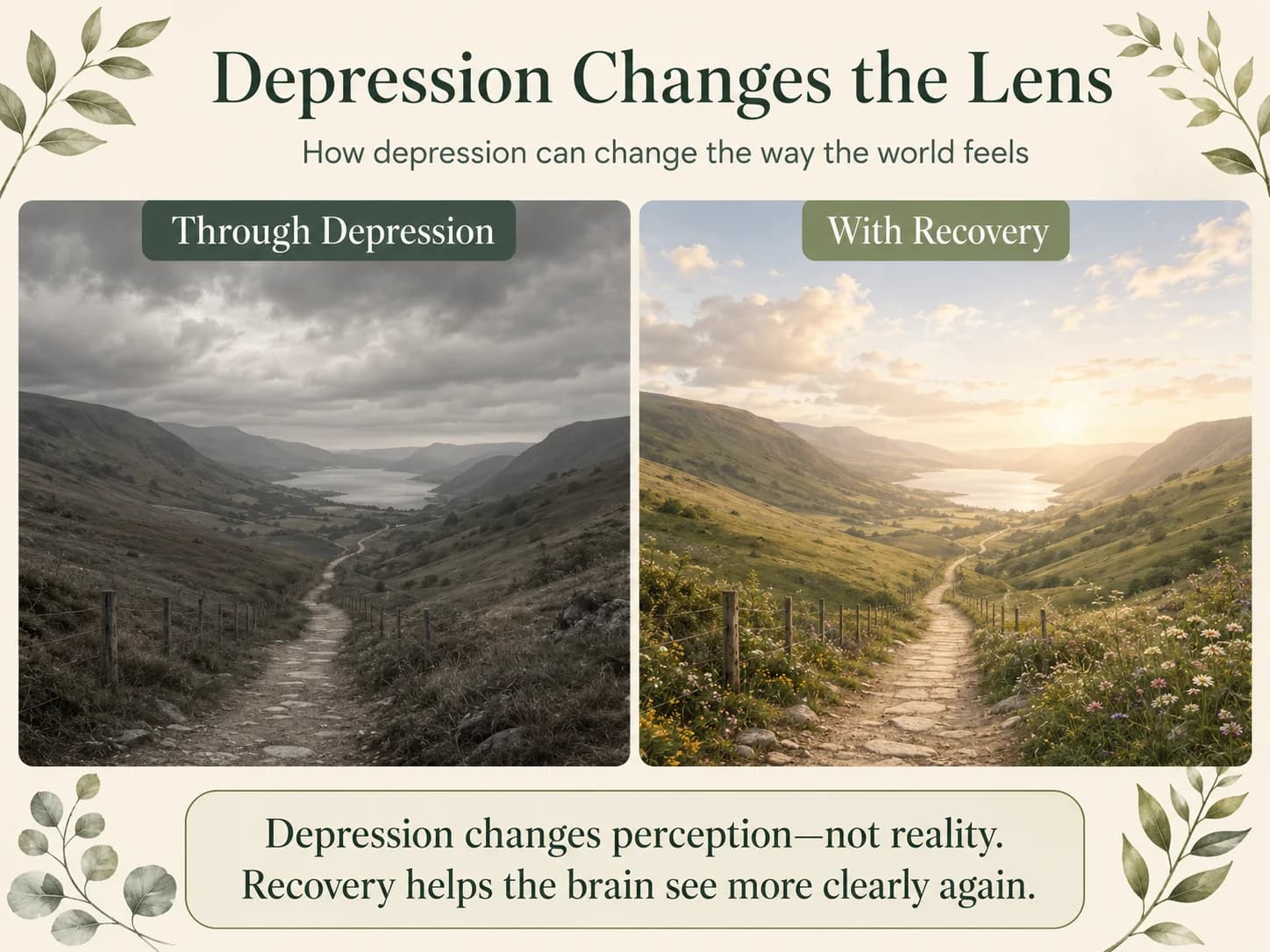
One of the most disorienting aspects of depression is that it doesn't just lower mood, it reshapes perception. Attention drifts toward what's wrong. The future looks flatter and further away. Achievements shrink; mistakes loom large.
This is what researchers call negative cognitive bias, and there's now a substantial body of neuroscience examining exactly how it operates, showing that depression involves a kind of imbalance between the brain's emotional processing and the regions meant to regulate it, making negative interpretations feel more automatic and harder to override [5][6]. It's less like inventing a darker world and more like viewing the same world through a tint that mutes anything positive.
This is precisely why thoughts like "nothing will get better" or "I'm a burden" can feel like conclusions rather than symptoms. Recognising them as the latter, evidence of an illness distorting perception rather than an accurate read on reality, is one of the more freeing shifts a person can make in recovery.
Depression Doesn't Check Credentials
It reaches students, parents, executives, athletes, retirees, clinicians and people who, from the outside, seem to have it entirely together. Many people function at a high level while depressed: showing up, performing, caretaking, all while privately exhausted. This pattern is sometimes referred to informally as high-functioning depression. It isn't a clinical diagnosis, but it names something real: competence and suffering can coexist, and often do, which is part of why so many people wait far too long before reaching out for support.
Why Recovery Is a Realistic Expectation, Not Just a Hopeful One
Depression is among the most studied conditions in mental health, and the evidence on recovery is genuinely strong. Effective treatments exist, ranging from cognitive behavioural therapy and other structured psychological approaches to lifestyle interventions and, for moderate to severe presentations, medication [3]. None of these work identically for everyone, and progress is rarely a straight line. Setbacks happen. But the underlying biology tells a hopeful story: a brain capable of neuroplastic change is a brain capable of healing [4].
That distinction is worth sitting with. Depression is something a person experiences, not something a person is. The work of recovery is less about becoming someone new and more about helping the brain, and the life around it, find their way back toward balance.

References
-
American Psychological Association. Depression. APA Dictionary of Psychology / Depression topic overview.
-
World Health Organization. Depressive disorder (depression). Fact sheet, updated 29 August 2025.
-
National Institute of Mental Health. Depression and Major Depression. Health topic pages.
-
Liu, W., et al. (2017). The role of neural plasticity in depression: from hippocampus to prefrontal cortex. Neural Plasticity; see also related review, Neural plasticity and depression treatment, PMC.
-
Beck, A.T. Cognitive theory of depression; see also: A theory of the neural mechanisms underlying negative cognitive bias in major depression. Frontiers in Psychiatry, 2024.
-
Self-reported cognitive biases in depression: a meta-analysis. Clinical Psychology Review (ScienceDirect).