
Introduction
One of depression's crueller tricks is that it steals the very energy recovery requires. Getting out of bed, replying to a message, showering, making a meal, tasks that once required no thought at all can start to feel disproportionately large. It's easy, in that state, to conclude you're lazy or failing. What's actually happening is that depression is affecting the brain systems responsible for motivation, reward and energy [11].
The goal isn't to force overnight productivity. It's to make recovery small enough that your brain can say yes to it. Small, repeated behavioural changes reliably rebuild confidence, motivation and wellbeing over time, which is exactly why behavioural activation, action before motivation, remains one of the most effective evidence-based treatments for depression [14][24].
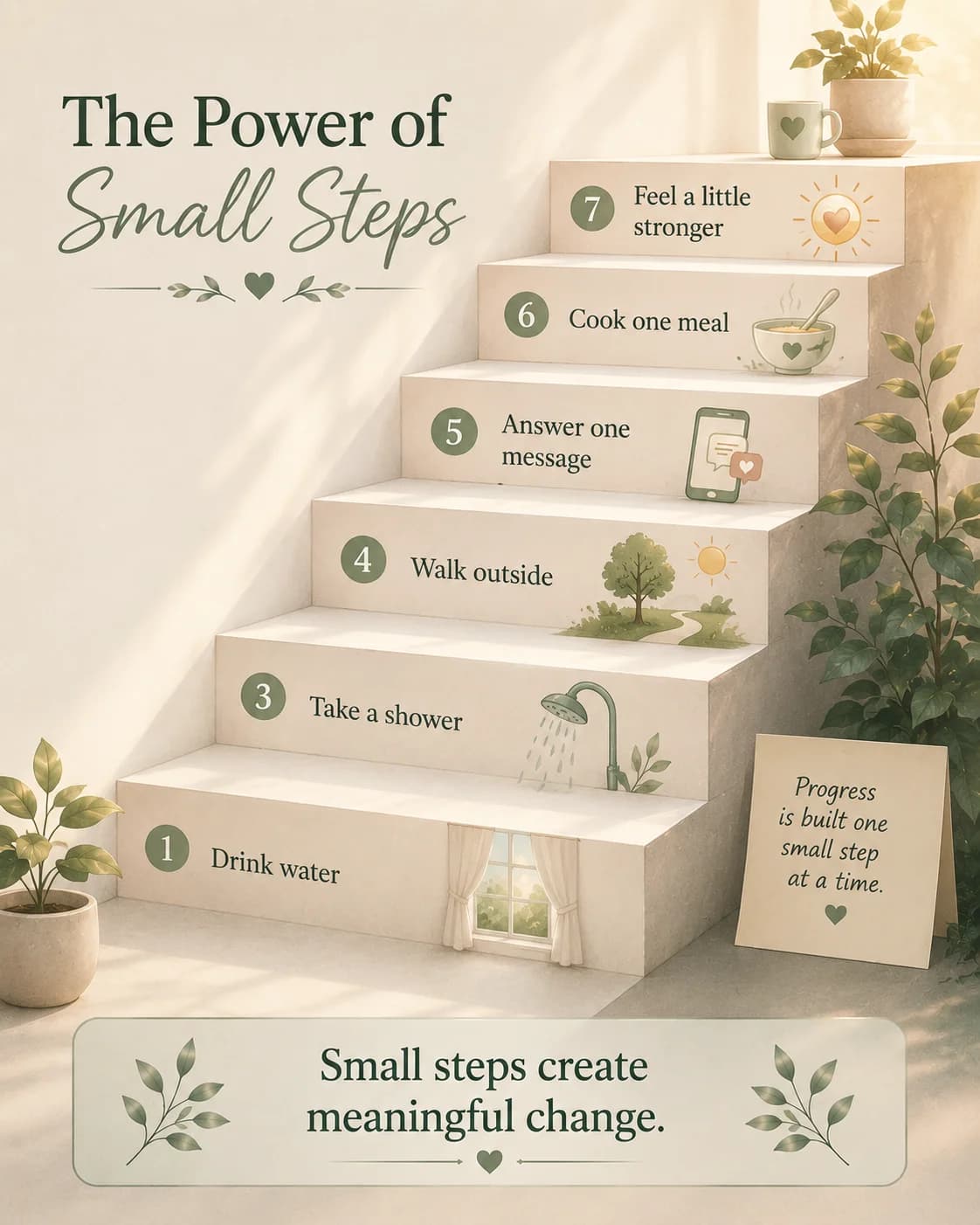
Start Smaller Than You Think
When depression is severe, once-easy goals can feel impossible. Instead of "how do I clean the whole house," try "can I put one cup in the sink." Instead of "I need to exercise," try "I'll walk to the mailbox." Instead of "I should call everyone back," try "I'll send one message."
Small successes matter because of what they teach the brain: I can still influence my day.
The Five-Minute Rule
A well-established CBT strategy: choose one task, commit to five minutes, and give yourself permission to stop once the timer's up [17]. Starting is usually the hardest part; once the brain shifts into motion, continuing tends to get easier. And if you do stop after five minutes, that still counts as a win.
Behaviour Before Motivation
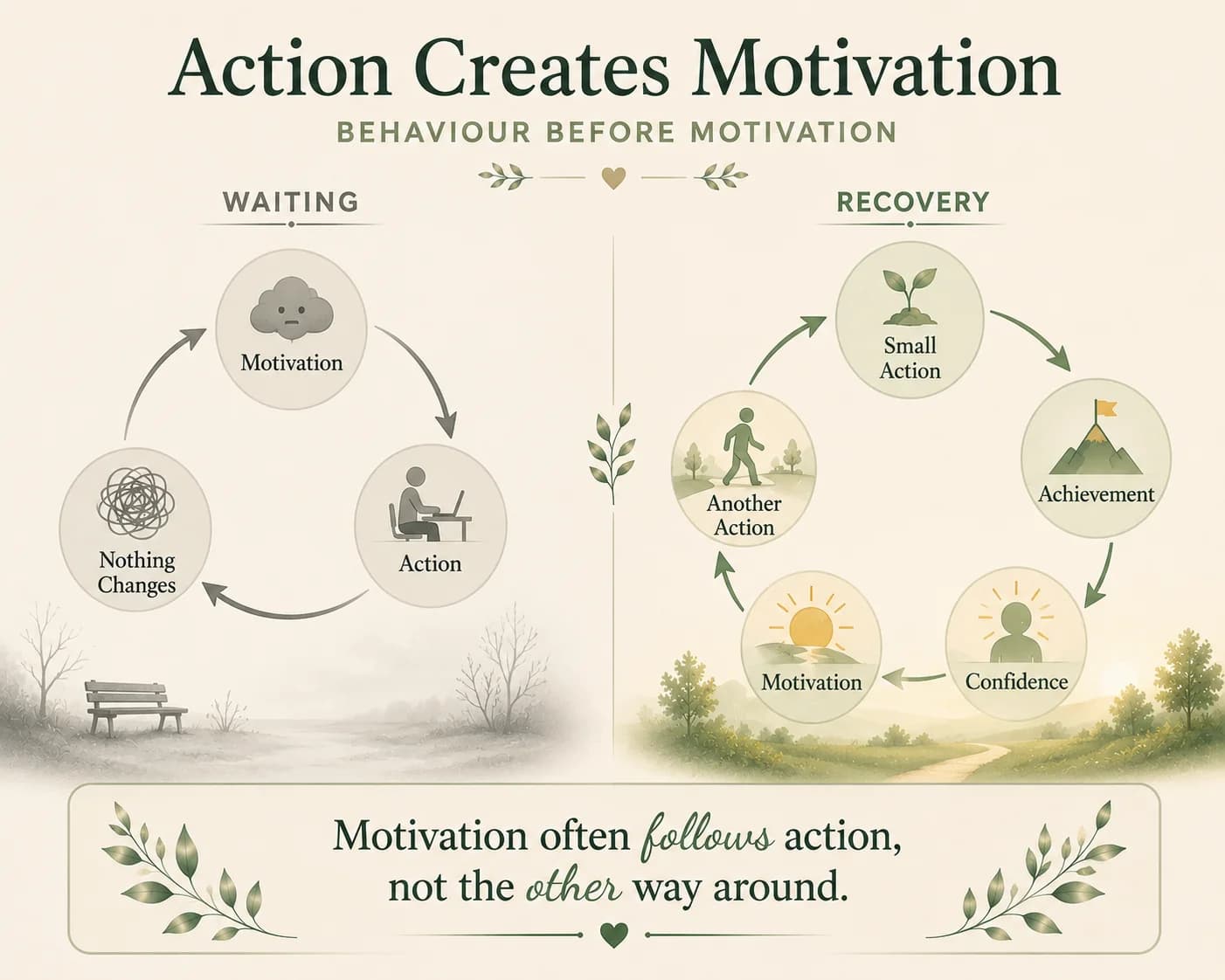
Most people assume motivation has to come first. Depression teaches the opposite. The healthy cycle actually runs: action → achievement → confidence → motivation → more action. Waiting for motivation to arrive often means waiting indefinitely, because action is usually what generates it, not the reverse [24].
Build Tiny Daily Habits
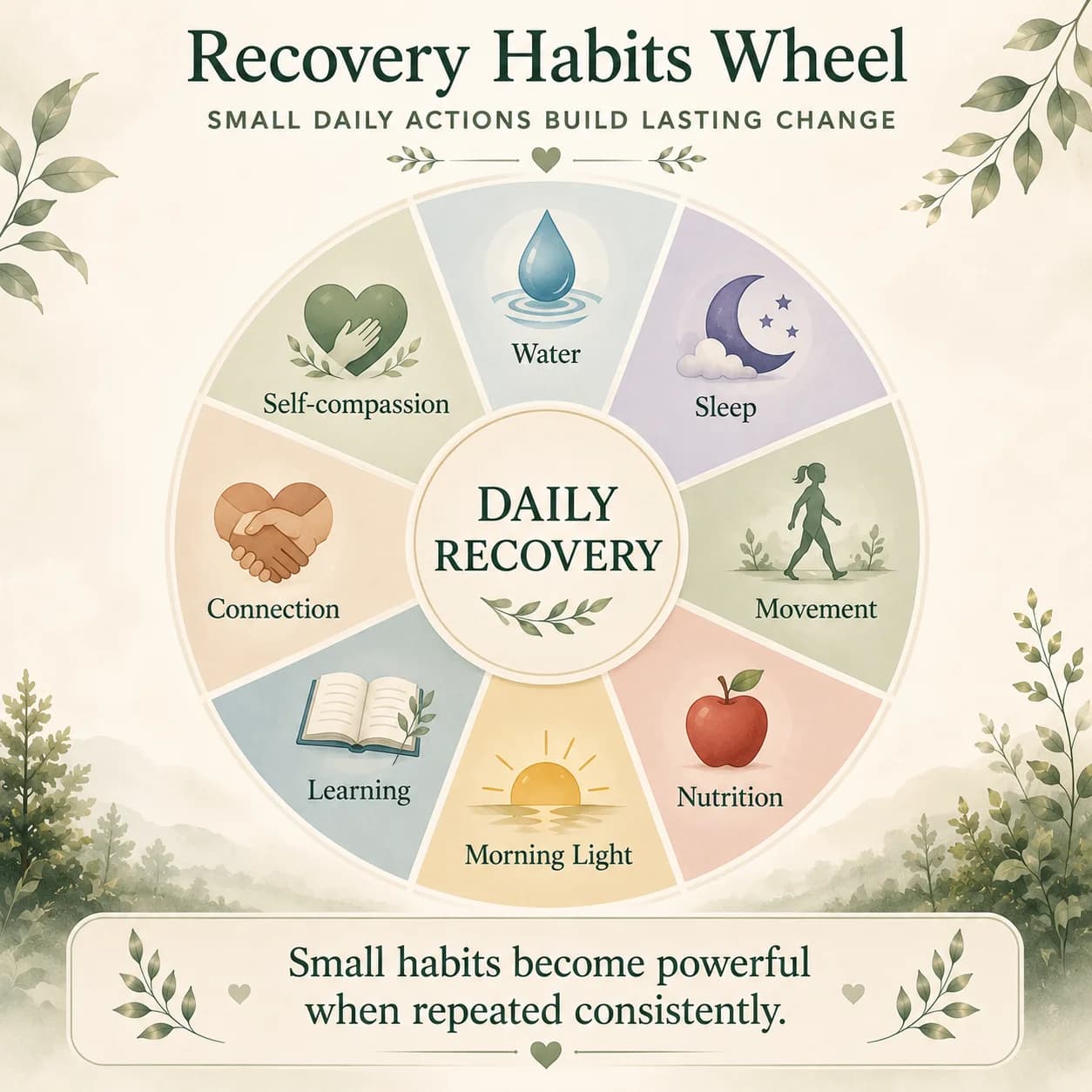
Recovery tends to grow through routine rather than dramatic breakthroughs: opening the curtains each morning, drinking a glass of water on waking, five minutes outside, one page read, three slow breaths before a meal, ten phone-free minutes, writing down one good thing about the day. Individually, each is tiny. Together, they add up to something substantial.
Movement Helps the Brain
Exercise isn't a punishment, it functions more like medicine. Regular movement supports serotonin and dopamine activity, stimulates BDNF, improves sleep, reduces inflammation and builds confidence [19]. Even brief bouts of walking have been shown to produce measurable, same-day improvements in mood [25]. No gym required; consistency matters more than intensity.
Look After Your Body
Depression often erodes basic self-care, so recovery sometimes means returning to fundamentals. Have you eaten? Had enough water? Showered? Moved? Rested? These aren't trivial questions during a depressive episode. Answering yes to any of them is a genuine act of recovery.
Challenge the Depression Voice
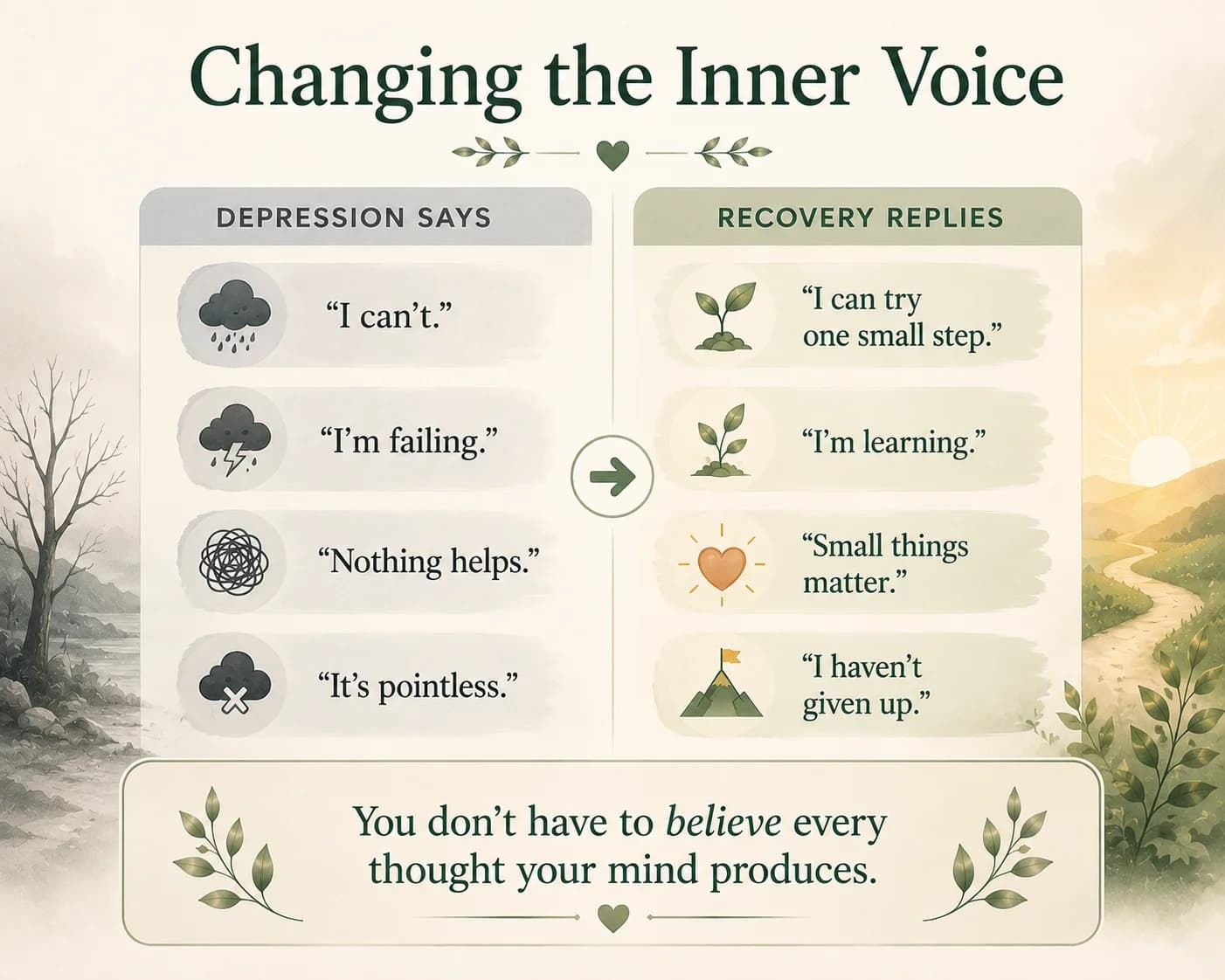
Depression tends to whisper "why bother," "I'm useless," "it won't help." Rather than arguing with every thought, try asking: is this depression talking? What evidence supports it? What evidence doesn't? What would I tell someone I love? [13][17] This creates a small but useful space between you and the thought.
Create a Safety Plan for Difficult Days
Some days will be harder than others, and that doesn't mean recovery has stalled. It helps to prepare in advance: people to contact, comforting activities, crisis numbers, reasons to keep going, and a reminder that feelings shift over time. Planning ahead makes hard days safer to move through.
Use Your Environment
Willpower is unreliable; environment is far more dependable. Laying out walking shoes, keeping medication visible, placing water by the bed, keeping healthy snacks within reach, charging your phone outside the bedroom, removing unnecessary friction, all of it makes the healthy choice the easy choice.
Progress, Not Perfection
Many people stop after missing a single day, but recovery was never about perfection. Missing a day is normal; what matters is returning. Think of it the way you'd think about learning a language: one missed lesson doesn't erase what's already been learned.
Celebrate Small Wins
The depressed brain is naturally tuned to notice problems, so recovery benefits from deliberately noticing progress instead: brushed your teeth, answered an email, laughed once, got outside, cooked dinner. Confidence is built from evidence, and small wins are the evidence.
You Don't Have to Do Everything
If this all feels like too much at once, pick one skill, practise it for a week, then add another. Recovery is built through consistency, not through doing everything at once.
Conclusion
Depression insists you'll never change. The evidence says otherwise: brains change, habits change, people recover [11][24]. Recovery rarely arrives all at once. It's built from hundreds of ordinary moments, one small choice, then another, then another.
References
-
World Health Organization. Depressive disorder (depression). Fact sheet, updated 29 August 2025.
-
Plasticity of synapses and reward circuit function in the genesis and treatment of depression. (2022). Neuropsychopharmacology.
-
Beck, A. T. (1979). Cognitive Therapy of Depression. Guilford Press.
-
Cuijpers, P., Miguel, C., Harrer, M., Plessen, C. Y., Ciharova, M., Ebert, D., & Karyotaki, E. (2023). Cognitive behavior therapy vs. control conditions, other psychotherapies, pharmacotherapies and combined treatment for depression. World Psychiatry, 22(1), 105–115.
-
National Institute for Health and Care Excellence. (2022). Depression in adults: treatment and management (NG222).
-
American Psychological Association. (2019). Clinical Practice Guideline for the Treatment of Depression Across Three Age Cohorts.
-
Beck, J. S. (2020). Cognitive Behavior Therapy: Basics and Beyond (3rd ed.). Guilford Press.
-
The optimal type and dose of exercise for elevating brain-derived neurotrophic factor levels in patients with depression. (2024). Depression and Anxiety.
-
Cuijpers, P., Quero, S., Noma, H., Ciharova, M., Miguel, C., Karyotaki, E., Cipriani, A., Cristea, I. A., & Furukawa, T. A. (2021). Psychotherapies for depression: a network meta-analysis covering efficacy, acceptability and long-term outcomes of all main treatment types. World Psychiatry, 20(2), 283–293.
-
Experimental effects of brief, single bouts of walking and meditation on mood profile in young adults. Mental Health and Physical Activity.